
The boreal owl (Aegolius funereus) is a small, secretive owl of northern coniferous forests. Recognizable by its square-shaped head, bright yellow eyes, white facial disk, and brown-and-white plumage, it spends most daylight hours hidden among trees and becomes active after dark. Boreal owls primarily hunt voles, mice, shrews, and other small mammals. They occur across northern North America and Eurasia, with some populations moving farther south during winters when prey becomes scarce.
What Is a Boreal Owl?
The boreal owl belongs to the typical owl family Strigidae. Its scientific name is Aegolius funereus, and in Europe it is commonly known as Tengmalm’s owl. Despite its broad northern distribution, it can be difficult to find because it is highly nocturnal and spends the daytime roosting quietly inside dense forest vegetation.
Boreal Owl Identification
Important characteristics include:
- Large, square-looking head
- No ear tufts
- Bright yellow eyes
- Pale grayish-white facial disk
- Dark border around the face
- Brown upperparts with white spots
- White belly with brown streaking
- Short tail and stocky body
Adults also have tiny white spots across the crown. Juvenile boreal owls can appear much darker and lack much of the obvious white spotting seen on adults.
Is There a Black Boreal Owl?
A true black boreal owl is not a recognized normal color form. Young birds, however, can have very dark brown plumage and may appear almost black in poor lighting.
Adult plumage becomes more obviously brown, gray, and white as the bird matures.
Boreal Owl Size and Wingspan
Boreal owls are small compared with familiar species such as barred or great horned owls. Their compact body and relatively broad wings allow them to maneuver efficiently through dense northern forests while hunting from perches.
How Big Is a Boreal Owl?
Typical measurements are:
- Length: 21–28 cm (8.3–11 inches)
- Weight: 93–215 g (3.3–7.6 oz)
- Wingspan: 55–62 cm (21.6–24.4 inches)
Females are substantially larger than males. Cornell notes that female boreal owls can sometimes weigh about twice as much as males, making their sexual size difference unusually pronounced among American owls.
Boreal Owl Habitat and Range
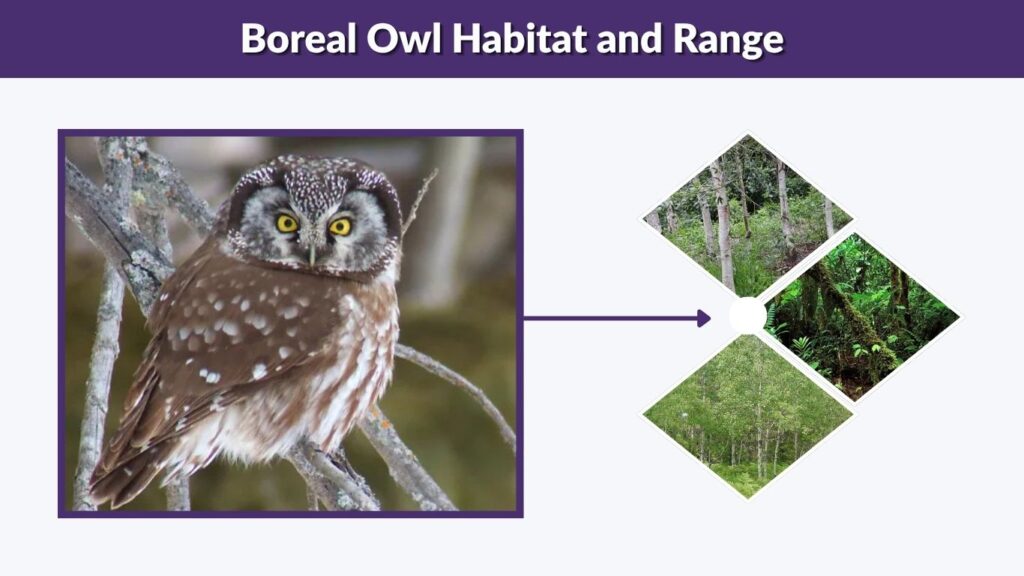
The boreal owl is closely tied to northern forest environments. It favors landscapes containing mature trees for nesting cavities and sufficient populations of small mammals for food.
Boreal Owl Habitat
Common habitats include:
- Spruce forest
- Fir forest
- Aspen stands
- Birch woodland
- Poplar forests
- Mixed coniferous woodland
- Subalpine forests
- High-elevation spruce-fir forests
Older forests are particularly important because boreal owls depend on tree cavities, although they can also use artificial nest boxes.
Where Does the Boreal Owl Live?
The species occupies the broad boreal forest belt across northern North America and Eurasia.
In North America, boreal owls occur across Alaska and Canada and extend south through some mountainous portions of the western United States. Populations also occur in parts of Minnesota and other northern states.
Farther south, suitable habitat is usually restricted to colder, high-elevation forests.
Boreal Owl Call and Sounds
The boreal owl call is often easier to detect than the bird itself. Males become especially vocal from late winter into spring while advertising territories and attracting females.
What Does a Boreal Owl Sound Like?
The male’s main song consists of approximately 8–20 low whistled toots that gradually become louder.
Other vocalizations include short:
- “Kip” calls
- “Kew” calls
- Contact notes
- Juvenile begging sounds
North American and European populations have slightly different song patterns. North American birds generally produce more notes at a slower rate than European Tengmalm’s owls.
When Can You Hear Boreal Owls?
They are particularly vocal from about mid-February through April.
Because the species is strongly nocturnal, listening after dark during the breeding season is often more successful than trying to locate a roosting bird during daylight.
What Does a Boreal Owl Eat?
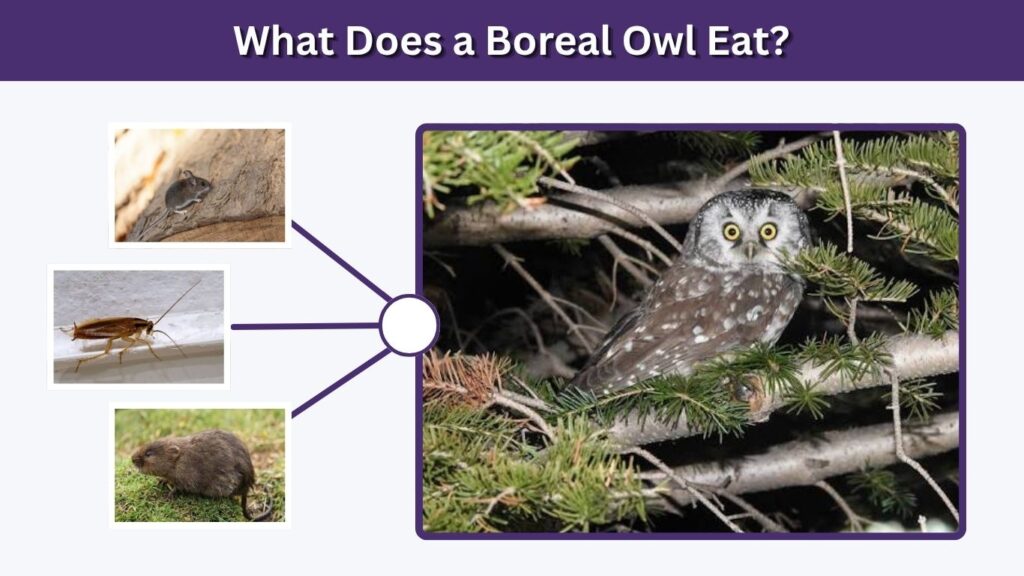
Boreal owls are predators that specialize primarily in small mammals. They usually hunt from a perch, listening and watching before dropping quickly onto prey with their talons.
Boreal Owl Diet
Common prey includes:
- Voles
- Mice
- Shrews
- Small squirrels
- Small birds
- Insects
Small mammals make up the most important portion of the diet in many regions.
How Does a Boreal Owl Hunt?
The owl typically waits quietly on a branch until it detects movement or sound below.
Its hearing is exceptionally accurate. The openings of its ears are positioned asymmetrically on the skull—one higher than the other—which helps the owl determine both the direction and vertical position of sounds.
This adaptation can even help it locate prey moving beneath snow.
Boreal Owl Adaptations for Survival
Life in cold northern forests requires several useful adaptations. Boreal owls combine excellent hearing, nocturnal vision, camouflage, and quiet flight to survive in environments where prey may be hidden by vegetation or snow.
Important Adaptations
Their adaptations include:
- Asymmetrical ears for locating prey
- Large eyes for low-light hunting
- Soft feathers that reduce flight noise
- Brown-and-white camouflage
- Strong talons for capturing rodents
- Thick plumage for cold environments
- Compact body suitable for forest hunting
Their sit-and-wait strategy also conserves energy during cold weather.
Boreal Owl Nest and Eggs
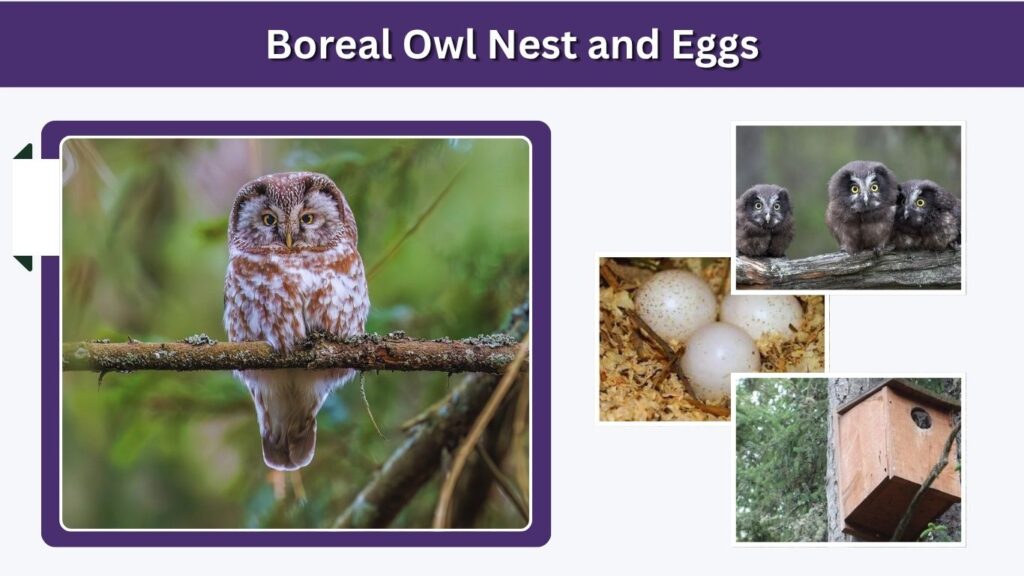
Boreal owls are cavity nesters, but they do not normally excavate their own nesting holes. Instead, they depend heavily on cavities created naturally or by woodpeckers.
Before breeding, a male may advertise several possible nest cavities, and the female chooses among them.
Boreal Owl Nesting Facts
Typical nesting characteristics include:
- Clutch: 2–9 eggs
- Egg color: Dull white
- Incubation: 26–32 days
- Nestling period: 27–36 days
- Broods: Usually one in North America
The male supplies food to the female before and during nesting, while the female performs most incubation duties.
Will Boreal Owls Use Nest Boxes?
Yes. Boreal owls readily use appropriately sized nest boxes within suitable breeding habitat.
Nest boxes can be particularly valuable in younger forests where suitable natural cavities are limited. They should be installed before the breeding season begins.
Boreal Owl Behavior
These owls are strongly nocturnal and solitary. Even breeding pairs generally do not spend their days roosting together.
During daylight, a boreal owl typically chooses a concealed roost close to a tree trunk.
Boreal Owl Flying
Its flight is usually quiet, controlled, and direct.
When hunting, the bird waits from an exposed perch and then glides or dives toward the ground with its talons extended.
Unlike species that continuously patrol open landscapes, boreal owls are primarily sit-and-wait hunters adapted to woodland.
Boreal Owl Irruptions
Boreal owls are generally associated with their northern forest range, but occasionally unusually large numbers move south during winter.
This movement is known as an irruption.
Why Do Boreal Owl Irruptions Happen?
Food availability is an important factor.
Populations of voles and other northern rodents naturally rise and fall. When prey becomes scarce, some boreal owls travel farther south searching for food.
This is why individuals sometimes appear well outside locations where they regularly breed.
Boreal Owl vs. Northern Saw-Whet Owl
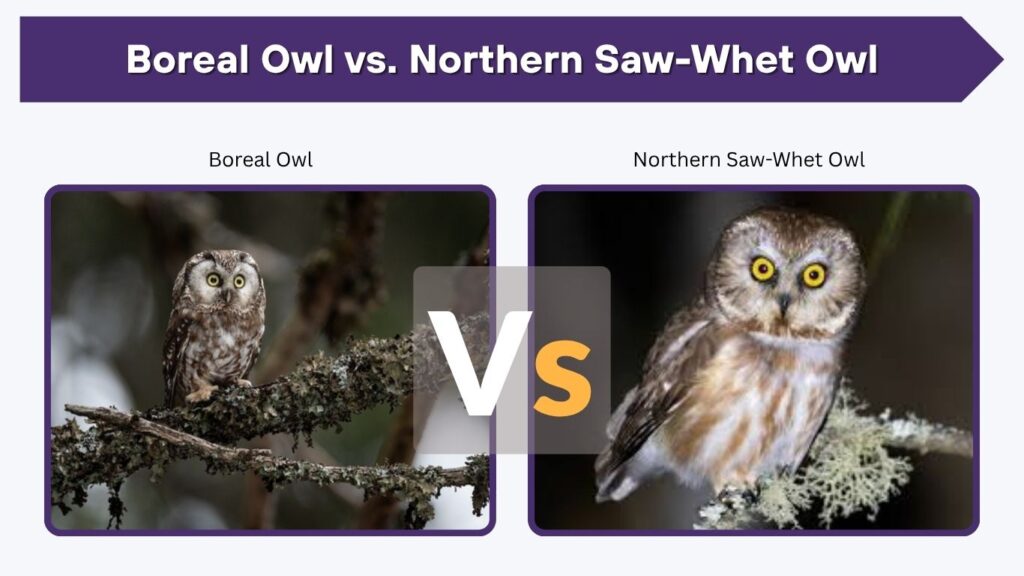
The northern saw-whet owl is one of the species most easily confused with the boreal owl because both are small forest owls in the genus Aegolius.
| Feature | Boreal Owl | Northern Saw-Whet Owl |
| Size | Larger | Smaller |
| Head | Large and squarish | More rounded |
| Facial disk | Pale with dark border | Pale but less strongly bordered |
| Bill | Yellowish | Dark |
| Eyes | Yellow | Yellow |
| Habitat | Strongly boreal/subalpine | Broader woodland habitats |
A boreal owl’s more obviously square head and strongly bordered pale face are particularly useful field marks.
Boreal Owl Lifespan
Wild boreal owls face predators, severe winters, food shortages, collisions, and other natural hazards, so individual lifespan varies greatly.
The oldest recorded boreal owl in North American banding records was at least 8 years old when it was recaptured in Idaho. This is a longevity record rather than the expected lifespan of every wild bird.
Boreal Owl Predators
Although boreal owls are predators themselves, their small size makes them vulnerable to larger birds of prey.
Potential predators include larger owl species, hawks, and other forest predators. Eggs and nestlings may also be vulnerable when nests can be reached.
Remaining hidden during daylight helps reduce this risk.
Is the Boreal Owl Endangered?
The boreal owl is currently considered a species of relatively low conservation concern at the broad population level. Cornell cites a Partners in Flight estimate of approximately 1.7 million breeding birds globally, although the species is difficult to survey because of its remote habitat and nocturnal behavior.
Maintaining mature boreal forests and cavity-producing trees remains important for nesting populations.
FAQs
What is the scientific name of the boreal owl?
The scientific name is Aegolius funereus. It is also widely called Tengmalm’s owl in Europe.
How big is a boreal owl?
Adults measure approximately 21–28 cm long, weigh 93–215 g, and have a wingspan of about 55–62 cm.
What does a boreal owl eat?
Its diet consists primarily of voles, mice, shrews, and other small mammals, with birds and insects also taken.
What does a boreal owl call sound like?
A male typically produces a rapid series of 8–20 low, whistled toots, especially during the breeding season.
Where do boreal owls live?
They inhabit northern boreal forests across North America and Eurasia, as well as high-elevation subalpine forests farther south.