
The Tropical Screech-Owl (Megascops choliba) is a small nocturnal owl found across much of Central and South America. With bright yellow eyes, short ear tufts, and mottled gray-brown or reddish plumage, it can disappear remarkably well against tree bark. Although tiny compared with many other owls, it is an effective nighttime predator that feeds heavily on insects and other small animals. Its distinctive trilling call is often heard long before the bird itself is spotted, especially around woodland edges, plantations, parks, and gardens.
Tropical Screech-Owl Identification
Tropical Screech-Owls have the compact body, rounded head, and feather tufts typical of screech-owls. Their coloration varies considerably, helping them blend into different habitats.
What Does a Tropical Screech-Owl Look Like?
Important identification features include:
- Bright yellow eyes
- Short feathered ear tufts
- Gray-brown, brown, or rufous plumage
- Pale facial disc with a dark border
- Fine dark streaks across the underparts
- Barred wings and tail
- Small, compact body
- Greenish-gray bill
- Excellent bark-like camouflage
The sexes look very similar, so males and females usually cannot be reliably separated by plumage alone.
Tropical Screech-Owl Size
The Tropical Screech-Owl is a relatively small owl.
How Big Is a Tropical Screech-Owl?
Adults are generally around 20–24 cm (8–9.5 inches) long and weigh roughly 96–160 grams (3.4–5.6 ounces). Despite their small body size, their broad wings, sharp talons, and powerful grip allow them to capture a surprisingly diverse range of prey.
Their feather tufts can make the head appear larger, particularly when the owl is alert.
Tropical Screech-Owl Call and Sound
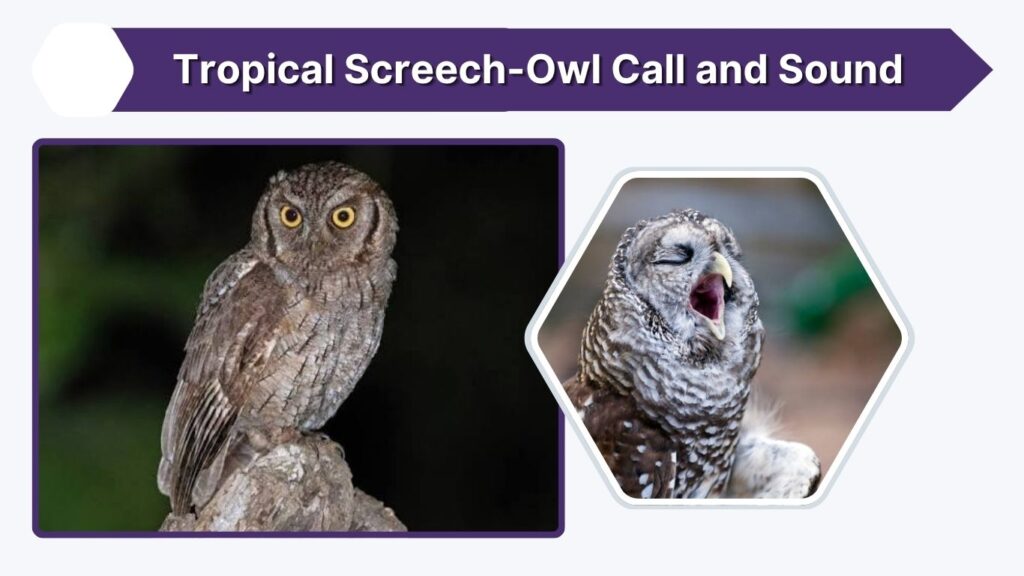
The call is one of the easiest ways to identify this species because Tropical Screech-Owls are difficult to see at night.
What Does a Tropical Screech-Owl Sound Like?
The characteristic call is a short, rapid or purring trill followed by stronger finishing notes. eBird describes it as a rapid trill with a distinctive final “pop,” while other descriptions characterize the primary call as a brief trill followed by two louder notes.
Tropical Screech-Owls also have additional vocalizations used during courtship, contact, and alarm situations.
When Do Tropical Screech-Owls Call?
They are mainly nocturnal and become vocal around dusk and during the night.
Males often call to advertise territories or communicate with mates. During courtship, both birds may become more vocal, producing different trills and contact calls.
Because the species spends daylight hours hidden among foliage, hearing its nighttime voice is often the best way to confirm its presence.
Tropical Screech-Owl Habitat
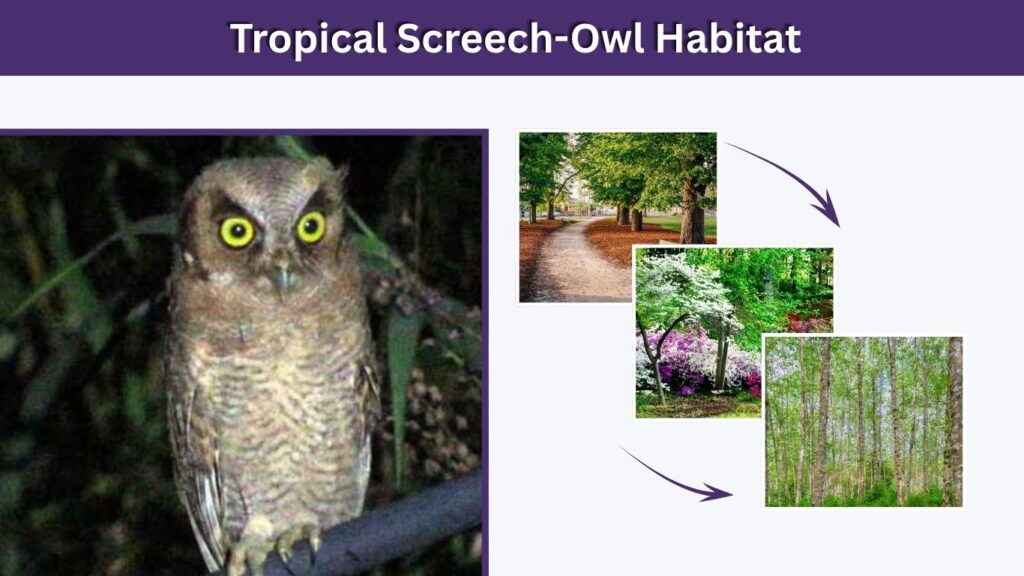
Tropical Screech-Owls are remarkably adaptable and do not depend exclusively on untouched rainforest.
Where Do Tropical Screech-Owls Live?
Typical habitats include:
- Open woodland
- Forest edges
- Secondary forest
- Wooded savanna
- Plantations
- Coffee-growing areas
- Gardens
- Parks
- Residential areas with mature trees
- Shrubby landscapes with scattered trees
They generally favor partially open wooded environments rather than the deepest interior of dense forest. They occur mostly from lowlands to around 1,500 meters, although records exist considerably higher.
Tropical Screech-Owl Range
The Tropical Screech-Owl has one of the broadest distributions among Neotropical screech-owls.
Its range begins in Costa Rica and Panama and extends south through a large portion of South America, including Colombia, Venezuela, Ecuador, Peru, Bolivia, Brazil, Paraguay, Uruguay, and northern Argentina. It occurs mainly east of the Andes.
Tropical Screech-Owl in Trinidad and Tobago
The species is well established in Trinidad, where it occurs in forests, plantations, woodland edges, and gardens with mature trees. Trinidad and Tobago wildlife sources describe it as common and widespread on Trinidad. Current regional bird lists generally treat it as a Trinidad species rather than a regular resident of Tobago.
Tropical Screech-Owl Diet
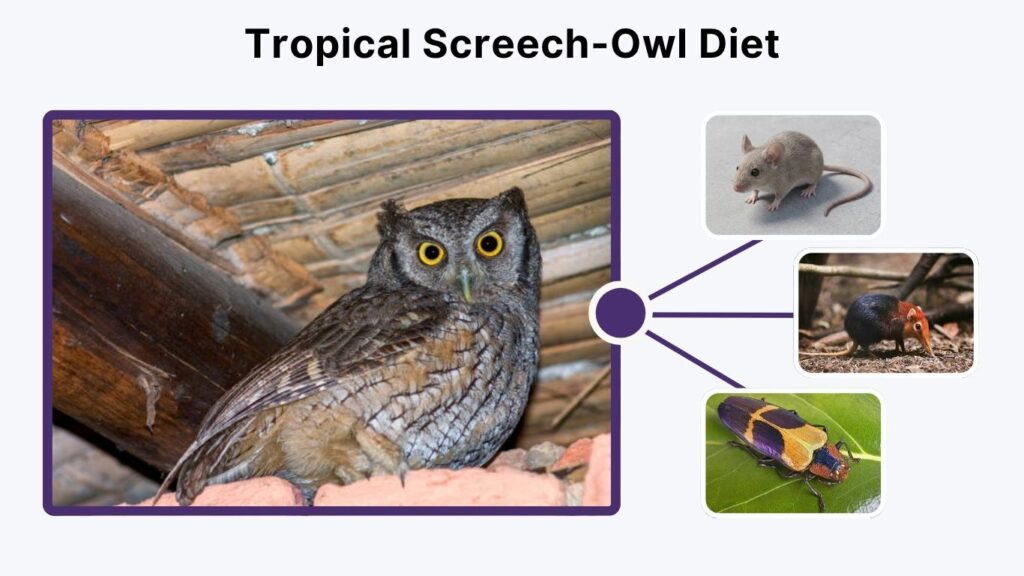
Although Tropical Screech-Owls can capture vertebrate prey, insects and other arthropods make up an important part of their diet.
What Does a Tropical Screech-Owl Eat?
Its prey can include:
- Crickets
- Katydids
- Beetles
- Ants
- Moths and other insects
- Spiders
- Scorpions
- Small rodents
- Small opossums
- Frogs
- Small snakes
- Occasionally other small vertebrates
They may capture insects directly from vegetation, from the ground, or in flight. Some have learned to hunt around artificial lights, where moths and other insects concentrate at night.
Tropical Screech-Owl Behavior
These owls are almost entirely nocturnal.
How Do Tropical Screech-Owls Hunt?
A Tropical Screech-Owl commonly waits quietly on a low perch and watches for movement before swooping down.
Large insects may be captured on the ground, from branches, or directly in flight. Their ability to hunt around forest edges and human-modified landscapes helps explain why the species can live successfully near towns and gardens.
During the day, they usually roost inside dense foliage or against tree trunks, where their patterned feathers provide excellent camouflage.
Tropical Screech-Owl Nest
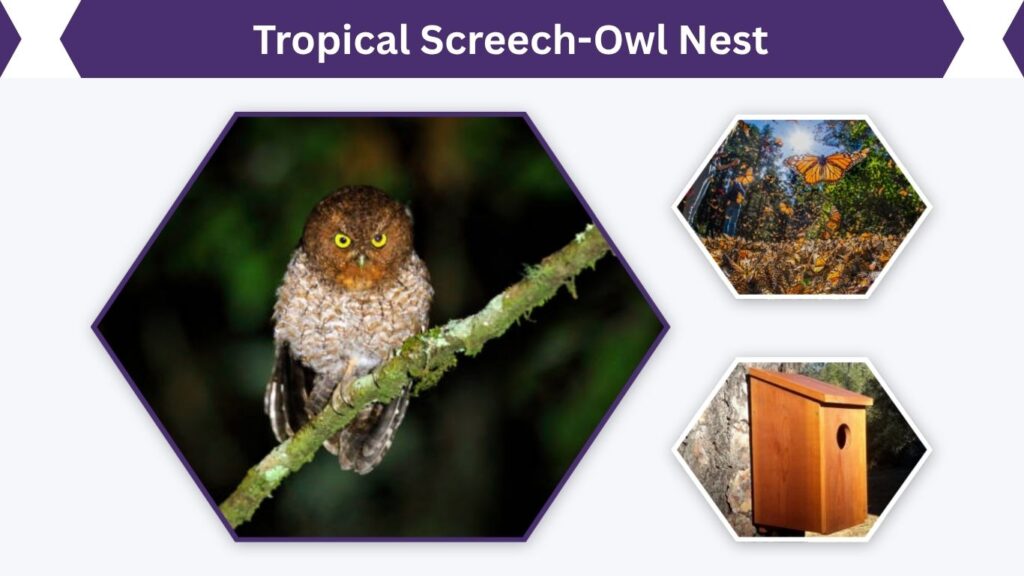
Tropical Screech-Owls are cavity nesters.
Where Do Tropical Screech-Owls Nest?
They may use:
- Natural tree cavities
- Old woodpecker holes
- Hollow trunks
- Termite structures in some areas
- Suitable artificial nest boxes
They usually do not construct an elaborate nest. Eggs are laid directly on material already present at the bottom of the cavity.
Tropical Screech-Owl Eggs and Reproduction
Breeding season varies geographically because this owl occupies such a large range.
How Many Eggs Do They Lay?
A typical clutch contains about 1–4 white eggs.
The female performs most or all of the incubation, while the male provides food. After hatching, the young remain inside the nest cavity while their parents continue bringing prey.
Young Tropical Screech-Owls generally fledge at roughly one month of age, although they remain inexperienced and dependent on their parents afterward.
Baby and Juvenile Tropical Screech-Owls
Young owls initially look much fluffier than adults.
As juveniles develop, their body becomes covered in patterned feathers, while their large eyes and rounded head remain especially noticeable.
A fledgling found sitting on a nearby branch is not necessarily abandoned. Young owls often leave the nest before becoming fully independent and may still receive food from their parents.
Tropical Screech-Owl Lifespan
The exact average lifespan of Tropical Screech-Owls in the wild is not well documented.
Like other small owls, they face risks from predators, vehicle collisions, habitat changes, and exposure to pesticides. The species sometimes hunts insects around roadsides and artificial lights, which can increase collision risks.
Because reliable long-term survival records are limited, precise lifespan claims should be treated cautiously.
Can You Keep a Tropical Screech-Owl as a Pet?
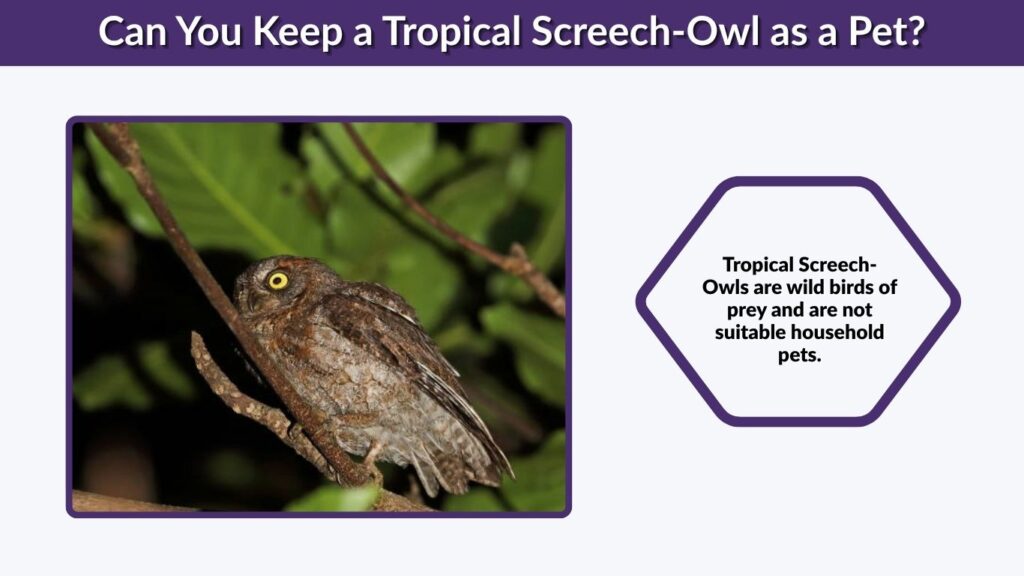
Tropical Screech-Owls are wild birds of prey and are not suitable household pets.
Owls require specialized diets, large amounts of appropriate space, veterinary expertise, and opportunities to express natural hunting and nocturnal behaviors. Wildlife laws also protect native owls in many countries.
In Trinidad, for example, the Tropical Screech-Owl is protected native wildlife.
Anyone encountering an injured or orphaned owl should contact a licensed wildlife rehabilitator rather than attempting to keep it.
Is the Tropical Screech-Owl Endangered?
The Tropical Screech-Owl is currently classified as Least Concern and remains widespread across a very large geographic range. Cornell’s Birds of the World likewise lists it as Least Concern.
Its ability to live in secondary woodland, plantations, parks, and residential areas likely contributes to its resilience.
However, removal of mature cavity-bearing trees, pesticide exposure, and collisions can still affect local populations.
Interesting Tropical Screech-Owl Facts
1. Its Voice Is Often More Useful Than Its Appearance
These owls can be extremely difficult to locate visually, but their rapid trilling call can reveal their presence at night.
2. They Come in Different Color Morphs
Individuals may be gray-brown, brown, or reddish, with intermediate variations also occurring.
3. They Frequently Live Near People
Gardens, plantations, parks, and other modified environments can provide suitable habitat when mature trees and prey remain available.
4. Insects Make Up Much of Their Diet
Unlike larger owls that depend heavily on rodents, Tropical Screech-Owls consume large numbers of insects and other arthropods.
5. They Do Not Build Traditional Nests
Instead, they typically lay their eggs inside existing cavities.
FAQs
What Is the Scientific Name of the Tropical Screech-Owl?
Its scientific name is Megascops choliba. It belongs to the typical owl family Strigidae.
How Big Is a Tropical Screech-Owl?
Adults are generally about 20–24 cm long and weigh approximately 96–160 grams.
What Does a Tropical Screech-Owl Sound Like?
Its characteristic sound is a short, fast trill with emphasized notes at the end. The call can sound purring, bubbling, or frog-like from a distance.
Where Do Tropical Screech-Owls Live?
They occur from Costa Rica and Panama through much of South America, mainly east of the Andes, and are also found on Trinidad.
What Do Tropical Screech-Owls Eat?
They primarily consume insects and other arthropods but also take spiders, scorpions, frogs, rodents, small reptiles, and other appropriately sized animals.