The Northern Hawk Owl (Surnia ulula) is a distinctive owl of northern boreal forests, named for its hawk-like shape, flight, and daytime hunting behavior. It has bright yellow eyes, a white face bordered by dark markings, heavily barred underparts, and an unusually long tail for an owl. Unlike many owls, it often hunts in full daylight from exposed treetops. Northern Hawk Owls mainly prey on voles and other small mammals and may occasionally move far south when northern prey becomes scarce.
Northern Hawk Owl Identification
The Northern Hawk Owl is a medium-sized member of the typical owl family, Strigidae. Its combination of a long tail, relatively small head, pointed wings, and upright posture gives it a silhouette somewhat reminiscent of a hawk. Adults are brown above with white spotting and have strongly barred pale underparts.
Size and Appearance
Important identification features include:
- Scientific name: Surnia ulula
- Length: About 36–45 cm (14.2–17.7 inches)
- Wingspan: Around 71 cm (27.9 inches)
- Weight: Roughly 240–454 g
- Bright yellow eyes
- White facial disk outlined with black
- Brown upperparts with white spots
- Horizontal brown barring across the belly
- Long, tapered tail
- Fully feathered legs and feet
The species is roughly crow-sized and is larger than a Boreal Owl but smaller than a Great Horned Owl.
Northern Hawk Owl Range and Habitat
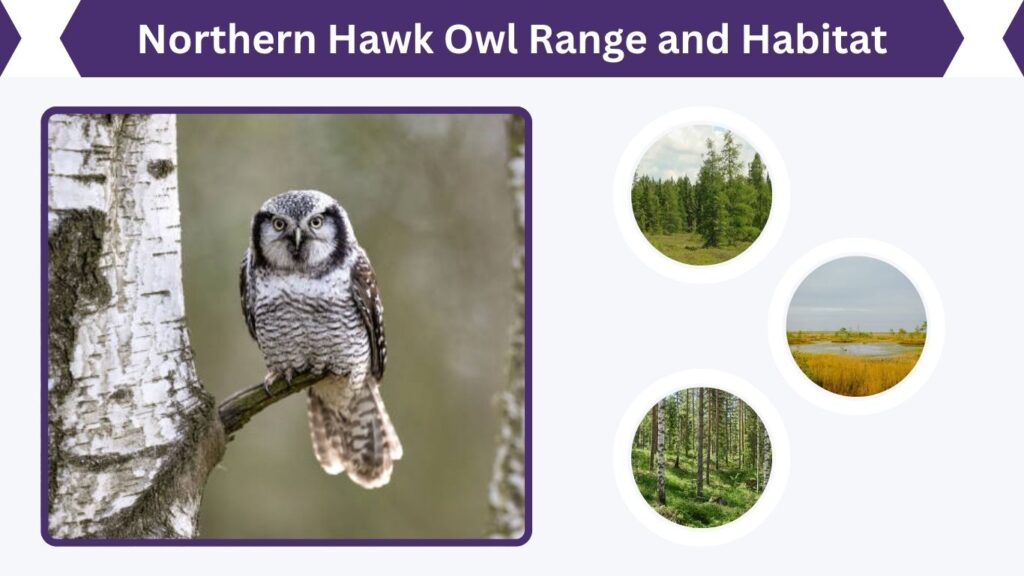
Northern Hawk Owls are birds of the far north. They occupy a broad circumpolar range across the boreal regions of North America and Eurasia. In North America, their main breeding areas extend through Alaska and northern Canada. They are generally resident or nomadic rather than regular long-distance migrants.
Where Do Northern Hawk Owls Live?
Typical habitats include:
- Boreal coniferous forests
- Open mixed forests
- Forest edges
- Marshes surrounded by scattered trees
- Burned forest areas
- Open woodland near wetlands
- Clearings and meadows with hunting perches
They often prefer relatively open forest rather than dense, continuous stands because open ground makes prey easier to detect.
Northern Hawk Owls in Alaska and the United States
Northern Hawk Owls breed in Alaska, where they may remain throughout the year if prey is plentiful. In some winters, individuals move south into southern Canada and the northern United States.
These movements are called irruptions. They can occur when populations of voles and other small mammals decline in northern breeding areas. Birds may then appear unusually far south.
Sightings in places such as Maine, Minnesota, New York, and other northern states are possible, but they are irregular rather than part of a predictable annual migration.
What Do Northern Hawk Owls Eat?
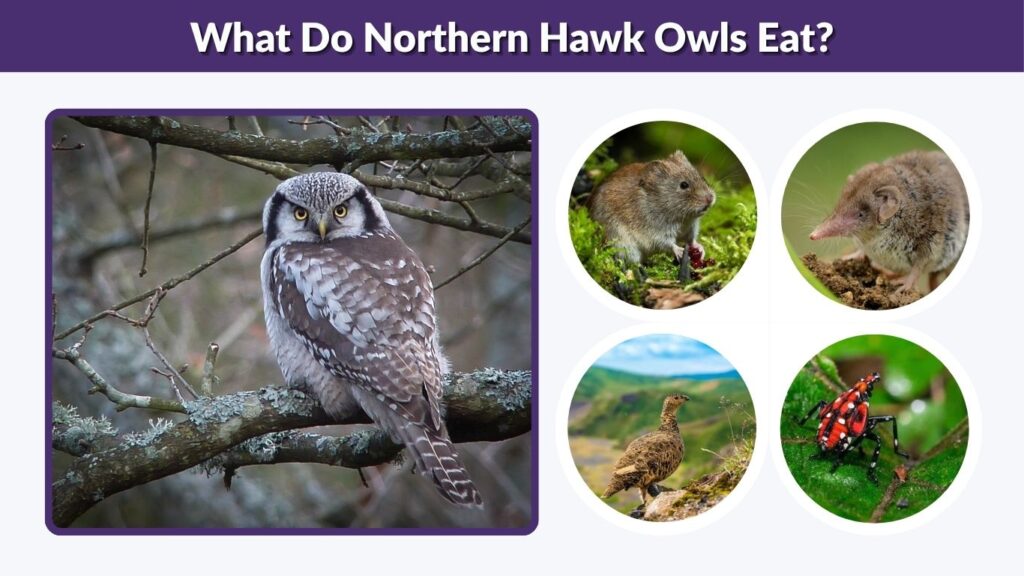
Northern Hawk Owls are carnivorous predators. Their diet changes somewhat with season and prey availability, but small mammals make up much of their food. Voles are especially important during summer, while birds may become more important during winter.
Northern Hawk Owl Diet
Common prey includes:
- Voles
- Mice
- Shrews
- Small squirrels
- Small birds
- Ptarmigan
- Grouse
- Occasionally insects
- Occasionally frogs or small fish
The availability of rodents strongly influences where these owls live and whether they move into new regions during winter.
How Does the Northern Hawk Owl Hunt?
The Northern Hawk Owl’s hunting behavior is one reason it received its unusual name. Rather than hiding deep in a forest and waiting for darkness, it often sits conspicuously at the top of a tree and scans large open areas.
Hawk-Like Hunting Adaptations
Important hunting adaptations include:
- Excellent long-distance vision
- Daytime hunting ability
- Strong, direct flight
- Long tail for maneuverability
- Powerful feet and talons
- High exposed hunting perches
- Ability to detect prey beneath snow
After spotting a rodent, the owl launches from its perch and flies quickly and low across the ground before striking with its talons.
Northern Hawk Owls can also locate prey by sound and may plunge into snow to capture rodents hidden beneath the surface. They sometimes cache excess prey in tree cavities, crevices, or dense branches for later use.
Northern Hawk Owl Sound and Call
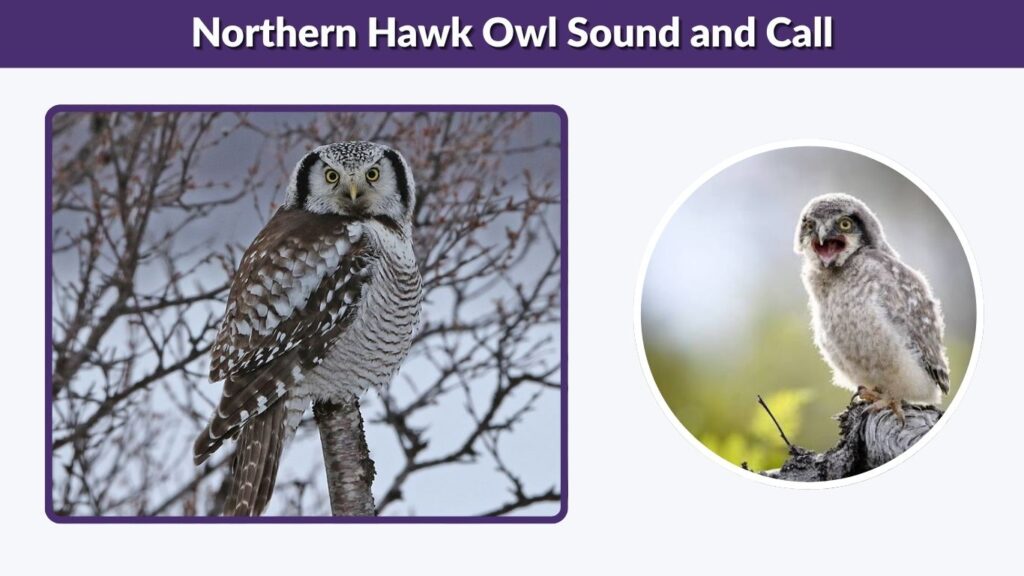
Northern Hawk Owls make several different vocalizations for courtship, communication, alarm, and contact with young. Their breeding sounds are especially noticeable when males are displaying and advertising for mates.
What Does a Northern Hawk Owl Sound Like?
The male’s breeding song is a long, rolling series of whistled notes that can continue for around 14 seconds. Females produce a similar but shorter and rougher song.
Their vocalizations also include:
- Rolling courtship whistles
- Harsh alarm screeches
- Repeated raspy calls
- High-pitched juvenile screams
Males may sing while performing display flights before landing on an exposed perch and continuing to call for a female.
Northern Hawk Owl Breeding and Life Cycle
Northern Hawk Owls generally breed in open boreal forests where suitable nesting cavities and productive hunting habitat occur together. They are cavity nesters and frequently depend on old or damaged trees rather than constructing traditional stick nests.
Nest, Eggs and Baby Northern Hawk Owls
Nest sites may include:
- Old woodpecker holes
- Naturally decayed tree cavities
- Broken tree trunks
- Occasionally abandoned stick nests
- Nest boxes in some parts of Europe
A female may lay 3–13 white eggs, usually producing one brood per year. Incubation lasts approximately 25–30 days. Newly hatched chicks are helpless and covered with white down.
The male supplies food to the female during incubation and early chick development. Young eventually leave the cavity and climb around the nesting tree before becoming strong flyers.
Northern Hawk Owl Behavior and Adaptations
This owl is unusual because it is strongly adapted to hunting during daylight, although it can also hunt at night. In northern summers, where daylight can last most of the day, this flexibility is particularly useful.
Interesting Northern Hawk Owl Adaptations
The species has several notable adaptations:
- Hunts extensively during daylight
- Uses tall exposed perches for scanning
- Can locate prey through snow
- Stores surplus food for later
- Has long tail feathers that assist maneuvering
- Uses powerful, fast flight resembling that of a hawk
- Can tolerate extremely cold northern environments
Its feathered legs and feet also provide insulation during winter.
When threatened near a nest, adults can become strongly defensive and may attack intruders, including humans.
Northern Hawk Owl Lifespan and Predators
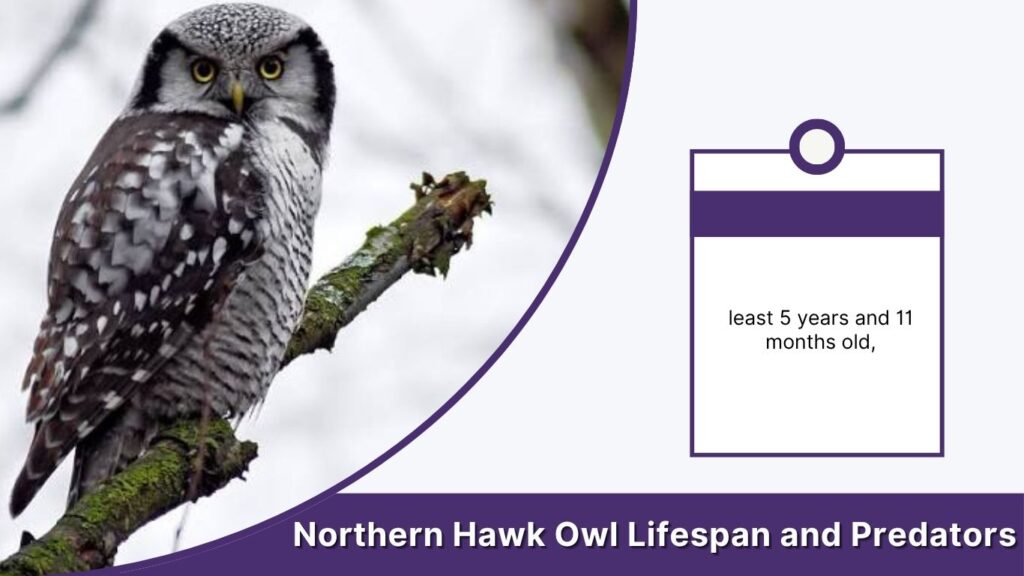
Because Northern Hawk Owls inhabit remote northern forests, determining their typical wild lifespan is difficult. Cornell reports that the oldest recorded individual in North America was at least 5 years and 11 months old, although some individuals may potentially live longer.
Predators and Survival
Adults are capable predators and face fewer threats than eggs and young. Potential dangers can include larger birds of prey and terrestrial predators capable of reaching nests.
Their most important population pressures are often indirect. Changes in vole numbers can dramatically affect breeding success, survival, and movement. Loss of suitable nesting trees and large-scale forest alteration may also reduce available nesting and hunting habitat.
Is the Northern Hawk Owl Endangered?
The Northern Hawk Owl is currently considered a species of low conservation concern/Least Concern globally. However, estimating population trends is challenging because much of its breeding range is remote and difficult to survey.
Its abundance can also fluctuate naturally as rodent populations rise and fall. Conservation of boreal forests, standing dead trees, natural cavities, and open hunting areas helps maintain suitable habitat.
FAQs
What is the scientific name of the Northern Hawk Owl?
Its scientific name is Surnia ulula. It is the only living species in the genus Surnia.
How big is a Northern Hawk Owl?
Adults are approximately 36–45 cm long, weigh around 240–454 grams, and have a wingspan of about 71 cm.
Are Northern Hawk Owls active during the day?
Yes. They are unusually diurnal for owls and commonly hunt during daylight, although they can also hunt at night.
What do Northern Hawk Owls eat?
They mainly eat small mammals, particularly voles and mice. They also prey on shrews, small squirrels, ptarmigan, grouse, and other birds.
Do Northern Hawk Owls migrate?
They do not have a regular long-distance migration. Instead, they are nomadic and may move south during some winters when prey becomes scarce, producing occasional irruptions into the northern United States.