
The spotted owl is a secretive forest owl best known for its dark brown plumage covered with pale white spots. Scientifically known as Strix occidentalis, it lives primarily in forests of western North America and depends heavily on mature woodland for shelter, nesting, and hunting. Three recognized subspecies include the northern, California, and Mexican spotted owls. Habitat loss and competition with barred owls have created conservation concerns for some populations. These nocturnal hunters mainly feed on small mammals and are rarely seen during daylight.
What Is a Spotted Owl?
The spotted owl is a medium-sized member of the true owl family, Strigidae. Unlike many owls with yellow eyes, spotted owls have dark brown to nearly black eyes.
Their plumage provides excellent camouflage against tree bark and shaded forest environments. During the day, they usually remain quiet on branches or inside dense vegetation before becoming active after sunset.
Spotted Owl Scientific Name
The scientific name of the spotted owl is Strix occidentalis.
Its classification includes:
- Common name: Spotted owl
- Scientific name: Strix occidentalis
- Family: Strigidae
- Order: Strigiformes
- Genus: Strix
- Type: Nocturnal bird of prey
Three major subspecies are generally recognized: northern spotted owl, California spotted owl, and Mexican spotted owl.
What Does a Spotted Owl Look Like?
A spotted owl has a rounded head without ear tufts and a heavily patterned brown body.
Its most recognizable characteristics include:
- Dark brown plumage
- Numerous white or cream spots
- Dark eyes
- Pale facial markings
- Rounded wings
- Short tail
- No visible ear tufts
- White spotting across the chest and back
Juveniles may appear somewhat different from mature birds as their adult plumage develops.
Types of Spotted Owls
The spotted owl is divided into three geographically distinct subspecies. Although they share similar appearance and behavior, each occurs in a different part of western North America and faces somewhat different environmental pressures.
Northern Spotted Owl
The northern spotted owl (Strix occidentalis caurina) inhabits forests from southwestern British Columbia through Washington and Oregon into northern California.
It is especially associated with mature and old forests containing large trees, multiple canopy layers, fallen logs, and cavities suitable for nesting.
Northern spotted owls have received considerable conservation attention because of habitat loss and competition from barred owls.
California Spotted Owl
The California spotted owl (Strix occidentalis occidentalis) occurs primarily in California.
Populations are associated with forested mountain regions, including the Sierra Nevada and areas of southern California. They use forests containing large trees and complex canopy structures.
Forest management, wildfire, drought, and habitat changes can influence suitable nesting and hunting areas.
Mexican Spotted Owl
The Mexican spotted owl (Strix occidentalis lucida) occurs farther south.
Its range includes parts of Arizona, New Mexico, Colorado, Utah, Texas, and Mexico.
Unlike northern spotted owls, which are closely associated with moist Pacific forests, Mexican spotted owls may occupy forested mountains and steep canyon environments.
Spotted Owl Habitat and Range
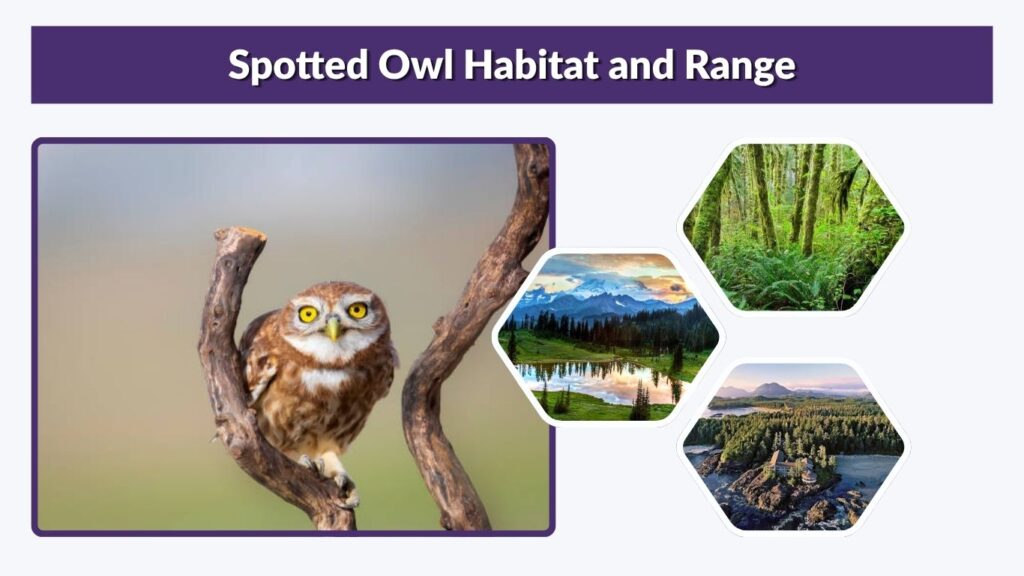
Spotted owls generally favor structurally complex forests that provide protected roosting sites and abundant prey. Large trees are particularly valuable because they can offer nesting cavities, broken tops, and broad branches.
Habitat requirements vary somewhat among the three subspecies because their geographic ranges include different climates and forest types.
Where Do Spotted Owls Live?
Spotted owls are native to western North America.
Depending on the subspecies, they occur in:
- British Columbia
- Washington
- Oregon
- California
- Arizona
- New Mexico
- Utah
- Colorado
- Parts of Mexico
Northern populations often inhabit cool, moist forests, while southern populations may occupy mountain forests and wooded canyon systems.
Northern Spotted Owl Habitat
Northern spotted owls are particularly associated with older forests containing complex vertical structure.
Useful habitat commonly provides large trees, broken tree tops, standing dead trees, logs, shaded understory, and abundant prey.
A mixture of nesting, roosting, and hunting habitat is important because an owl’s territory can cover a substantial area.
Spotted Owl Nest Sites
Spotted owls do not typically construct elaborate nests from scratch.
They may use:
- Natural tree cavities
- Broken tree tops
- Large branch platforms
- Abandoned nests of other large birds
- Accumulated debris in large trees
Suitable nest sites are often associated with mature forest structure.
Spotted Owl Size and Appearance
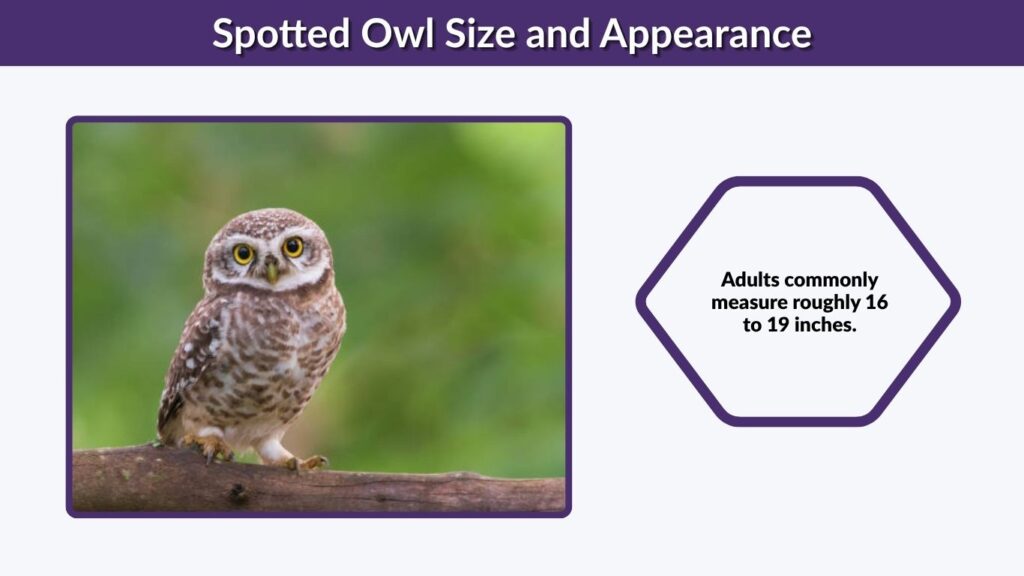
Spotted owls are medium-sized owls, generally smaller than barred owls but large enough to capture rodents and other small vertebrates.
Females, as with many birds of prey, tend to be larger than males.
How Big Is a Spotted Owl?
Adults commonly measure roughly 16 to 19 inches in body length, although size varies by sex and subspecies.
Their wings are broad and rounded, helping them maneuver through forests.
Soft-edged flight feathers reduce noise during flight, allowing the owl to approach prey with little warning.
Spotted Owl Feathers
Spotted owl feathers are predominantly dark brown with pale spots and bars.
This pattern provides camouflage when the owl rests against tree trunks or inside shadowed branches.
The soft structure of owl flight feathers also helps suppress sound, an important adaptation for nocturnal hunting.
What Do Spotted Owls Eat?
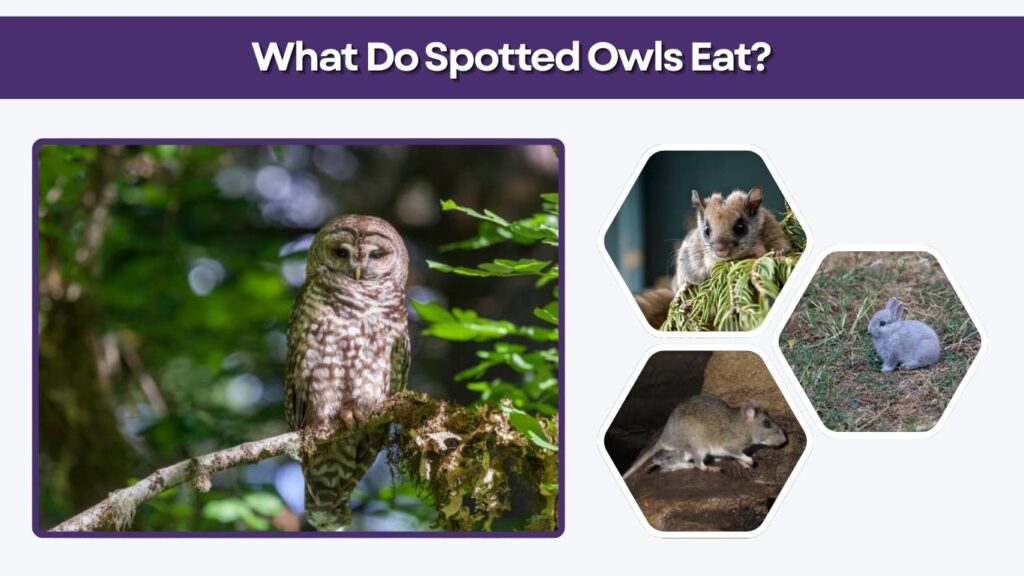
Spotted owls are predators that feed primarily on small mammals. Their exact diet depends on location and which prey species are available.
Northern spotted owls, for example, commonly prey on flying squirrels, while woodrats can become particularly important in parts of their range.
Main Foods of Spotted Owls
Their diet can include:
- Flying squirrels
- Woodrats
- Mice
- Voles
- Small rabbits
- Bats
- Small birds
- Large insects
- Other small vertebrates
Most prey is captured at night.
Spotted Owl Hunting Habits
Spotted owls frequently hunt from a perch.
The owl waits quietly while listening and watching for movement below. Once prey is located, it leaves the perch and glides or flies toward the target.
Exceptional hearing and low-noise flight allow it to hunt effectively in dark forest conditions.
The owl may then carry prey to another perch before eating it.
Spotted Owl Calls and Sounds
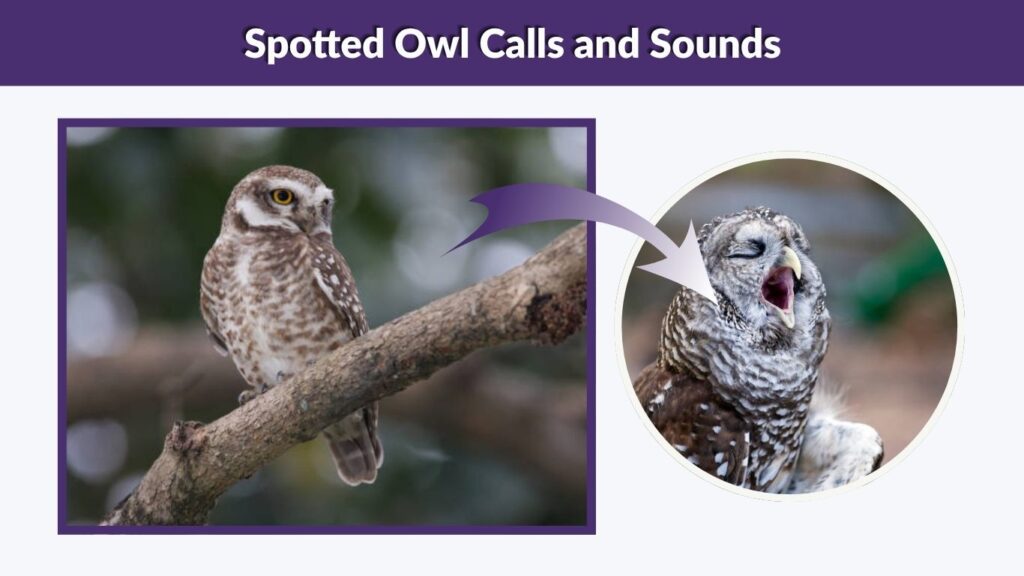
Spotted owls are heard more often than they are seen because they are nocturnal and often remain hidden within dense forests.
Calls are used for communication between mates, maintaining territories, and other social interactions.
What Does a Spotted Owl Sound Like?
One of the best-known vocalizations is a series of several hoots with a recognizable rhythm.
Spotted owls can also produce whistles, barks, and other vocalizations.
Researchers sometimes use owl calls during surveys to determine whether spotted owls occupy a particular forest area.
Spotted Owl vs Barred Owl
Spotted and barred owls belong to the same genus and can appear similar from a distance. However, important differences exist in their markings, size, calls, distribution, and ecological behavior.
The growing presence of barred owls in the Pacific Northwest has become particularly significant for northern spotted owls.
Appearance Differences
Key differences include:
- Spotted owl: White spots across dark brown plumage.
- Barred owl: Strong vertical and horizontal bar-like markings.
- Spotted owl: Usually somewhat smaller.
- Barred owl: Generally larger and heavier.
- Spotted owl: Dark eyes.
- Barred owl: Also has dark eyes.
Their overall brown coloration can make identification difficult without seeing the chest pattern clearly.
Call Differences
Barred owls are famous for a rhythmic call often represented by the phrase “Who cooks for you?”
Spotted owl vocalizations have a different rhythm and typically consist of distinct hooting sequences.
Listening to the pattern of calls can therefore help distinguish the two species when visibility is poor.
Why Are Barred Owls a Problem for Spotted Owls?
Barred owls expanded westward across North America and now overlap extensively with northern spotted owls.
Barred owls are generally larger and can use a broader range of habitats and foods. They may compete with spotted owls for territories, prey, and nesting areas.
The two species can also occasionally hybridize where their ranges overlap.
Are Spotted Owls Endangered?
Conservation status differs among spotted owl populations and geographic areas. The northern spotted owl has received particularly strong conservation attention because its numbers have declined in many parts of its range.
Forest habitat changes and competition from barred owls are among the major challenges.
Why Are Northern Spotted Owls Threatened?
Important pressures include:
- Loss of mature forest habitat
- Fragmentation of nesting areas
- Competition from barred owls
- Changes in prey availability
- Severe wildfire
- Drought and forest stress
- Disturbance of nesting habitat
Because spotted owls reproduce relatively slowly, populations may take considerable time to recover after major declines.
Spotted Owl Conservation
Conservation efforts focus heavily on protecting and restoring suitable forest habitat.
Scientists also monitor owl populations, nesting success, prey availability, and interactions with barred owls.
The spotted owl has become an important example of the difficult balance between wildlife conservation, forestry, land management, and human economic interests.
Spotted Owl Reproduction and Life Cycle
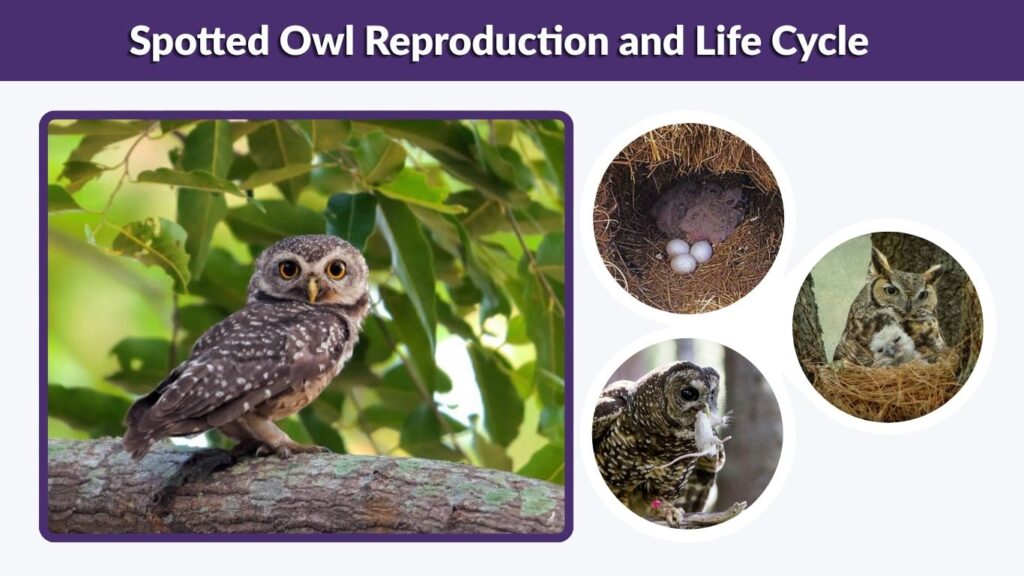
Spotted owls usually form breeding pairs and maintain territories containing suitable nesting and hunting habitat.
They do not necessarily reproduce successfully every year. Food availability, weather, habitat quality, and the age of the birds can influence nesting success.
Eggs and Young Owls
Females typically lay a small clutch of eggs.
The female performs most incubation while the male provides food. After the eggs hatch, both parents contribute to raising the young.
Young owls eventually leave the nest before becoming completely independent and continue relying on their parents while improving their flying and hunting abilities.
Interesting Spotted Owl Facts
Spotted owls have several adaptations that make them highly specialized forest predators.
Quick Facts
- Spotted owls have dark eyes rather than yellow eyes.
- Their scientific name is Strix occidentalis.
- Three recognized subspecies occur in North America.
- They are primarily nocturnal.
- Females are generally larger than males.
- Flying squirrels and woodrats are important prey.
- They usually nest in existing cavities or platforms.
- Their soft feathers help create quiet flight.
- Barred owls compete with northern spotted owls.
- Mature forests provide important nesting and roosting habitat.
FAQs
Where does the spotted owl live?
Spotted owls live in western North America, from southwestern Canada through the western United States and into Mexico. Exact distribution depends on the subspecies.
What does a spotted owl eat?
Spotted owls primarily eat small mammals such as flying squirrels, woodrats, mice, and voles. They may also take birds, bats, insects, and other small animals.
What is the scientific name of the spotted owl?
The scientific name is Strix occidentalis. Northern, California, and Mexican spotted owls are recognized subspecies.
What is the difference between a spotted owl and a barred owl?
Spotted owls have obvious pale spots, while barred owls have stronger barred and streaked patterns. Barred owls are also generally larger and have different calls.
Why is the northern spotted owl declining?
Major causes include habitat loss and fragmentation, competition with expanding barred owl populations, changes in prey, and severe disturbances such as wildfire.