A juvenile Barred Owl (Strix varia) is a young forest owl recognizable by its fluffy gray-brown plumage, large dark eyes, rounded head, and lack of ear tufts. Newly hatched owlets are covered in pale down, while older fledglings gradually develop the familiar brown-and-white barring of adults. Young Barred Owls also produce distinctive begging calls that may sound like squeaks, hisses, or harsh cries. They usually leave the nest before they can fly well and remain dependent on their parents for food for several months.
What Does a Juvenile Barred Owl Look Like?
Young Barred Owls change dramatically during their first few months. Hatchlings begin as tiny white-down-covered chicks, but by the time they start exploring outside the nest they are much larger and covered in grayish, fluffy feathers with developing brown markings.
Cornell describes juveniles as gray and fluffy with darker brown barring and mottling throughout.
Juvenile Barred Owl Identification
Look for:
- Large, rounded head
- No ear tufts
- Very dark brown or nearly black eyes
- Yellowish bill
- Gray or brown fluffy feathers
- Developing dark barring
- Broad wings
- Short, rounded tail
- Large feet and sharp talons
- Puffy appearance compared with adults
Young birds may retain wisps of down even after their flight feathers have developed.
Juvenile Barred Owl Size
Adult Barred Owls measure approximately 16.9–19.7 inches long, with a wingspan of about 39–43 inches.
A recently fledged youngster has not yet reached full adult weight. Cornell reports that chicks are only a little over 1.5 ounces at hatching but gain roughly half an ounce per day; by fledging, they may weigh about 50–75% of adult weight.
Their thick down can make them look surprisingly large even before they are fully grown.
Juvenile vs Adult Barred Owl
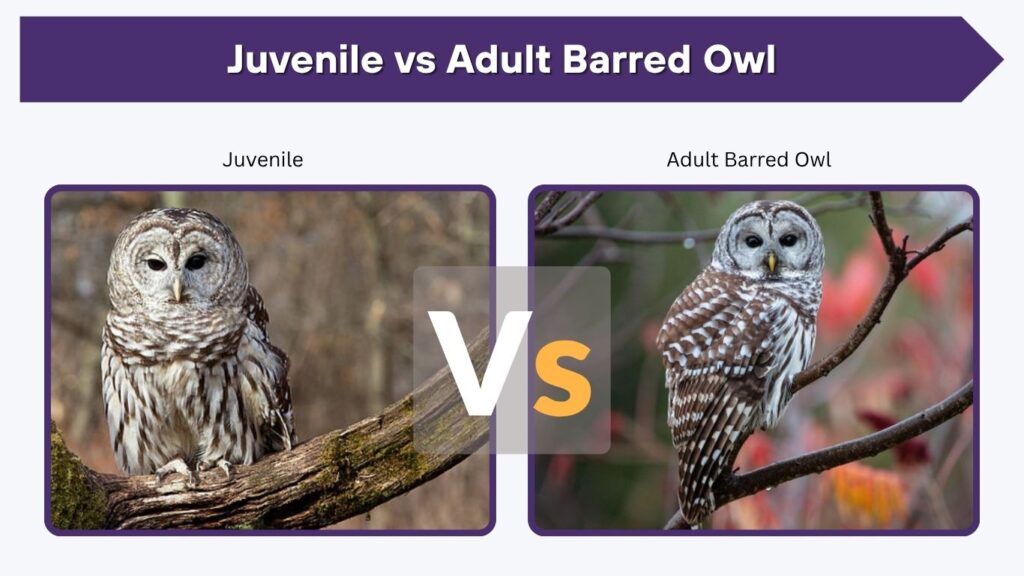
The easiest distinction is usually feather texture. Very young Barred Owls look fuzzy and unfinished, while adults have smooth, clearly patterned plumage.
Key Differences
| Feature | Juvenile | Adult |
| Plumage | Fluffy gray-brown | Crisp brown and white |
| Markings | Less defined | Strong barring and streaking |
| Down feathers | Often visible | Absent |
| Flight | Clumsy at first | Strong and controlled |
| Calls | Begging squeaks/hisses | Deep hoots |
| Dependence | Fed by parents | Independent |
Adult Barred Owls have horizontal bars across the upper breast and vertical brown streaks farther down the belly. Young birds gradually acquire a similar pattern as they molt.
When Do Juveniles Get Adult Feathers?
Barred Owl chicks begin replacing their down with juvenile plumage at around six weeks. Cornell reports that this molt may continue for five to six months.
Juvenile plumage resembles the adult pattern but tends to be browner, buffier, and less sharply marked. By the following spring, young birds may be extremely difficult to distinguish from adults.
What Does a Juvenile Barred Owl Sound Like?
A juvenile Barred Owl does not normally sound like an adult giving the famous deep “Who cooks for you?” territorial call.
Instead, young birds use repeated begging vocalizations to communicate with their parents.
Juvenile Barred Owl Begging Call
Older young produce a persistent high-pitched squeaking sound. Cornell notes that the begging call can even sound somewhat like a hiss.
You may hear:
- Repeated squeaks
- Hissing-sounding notes
- Thin cries
- Harsh begging calls
- Occasional bill snapping
Cornell’s Macaulay Library also maintains recordings specifically categorized as juvenile Barred Owl calls.
Why Do Juvenile Barred Owls Screech?
The most common reason is food begging.
Once young owls leave the nest, their parents still bring them prey. Calling helps parents locate hungry fledglings perched among dense tree branches.
Young birds may become particularly vocal after sunset when their parents become active and begin hunting.
Bill snapping is different from begging. Both young and adult Barred Owls may snap their bills during aggressive or stressful encounters.
Juvenile Barred Owl Behavior
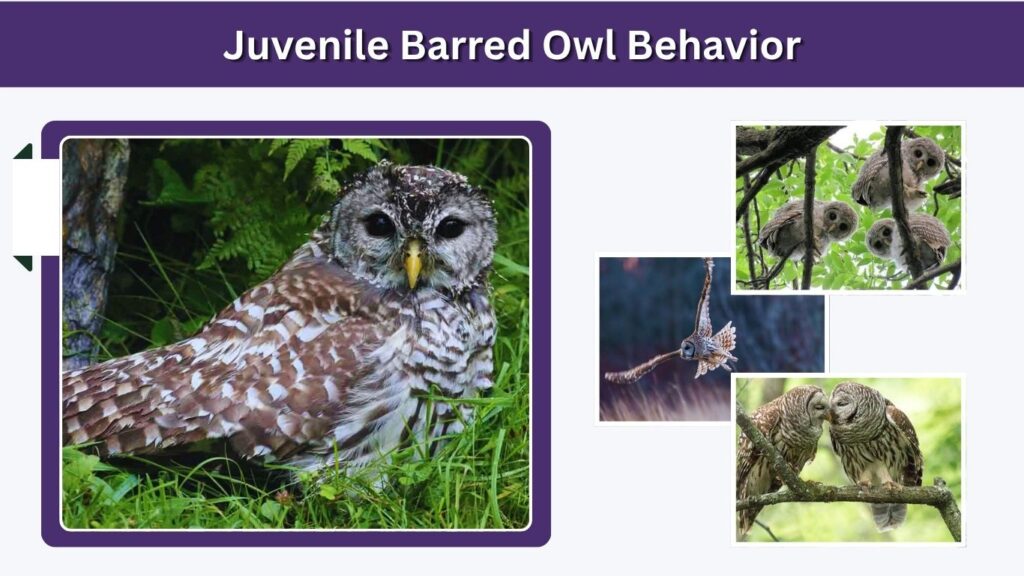
One of the most surprising behaviors occurs when Barred Owls first leave the nest. They often venture out before they are competent flyers.
This stage is sometimes called branching.
What Is Branching?
Young owls climb out of their nest cavity or box and begin moving around nearby branches.
At this stage they may:
- Climb tree trunks
- Hop between branches
- Flutter short distances
- Lose their balance
- Fall to the ground
- Use talons and bills to climb back up
- Beg loudly for food
Cornell has documented young Barred Owls climbing tree trunks shortly after leaving nest boxes. Falling or appearing clumsy can therefore be part of normal development.
When Do Juvenile Barred Owls Fly?
Barred Owl chicks generally leave the nest at roughly 28–35 days after hatching, often before they can fly proficiently.
Short flights can begin at around six weeks of age. Their abilities continue improving over the following weeks, and Cornell’s Barred Owl Cam observations indicate that it can take around 10–12 weeks for flight skills to become well developed.
How Long Do Juvenile Barred Owls Stay With Their Parents?
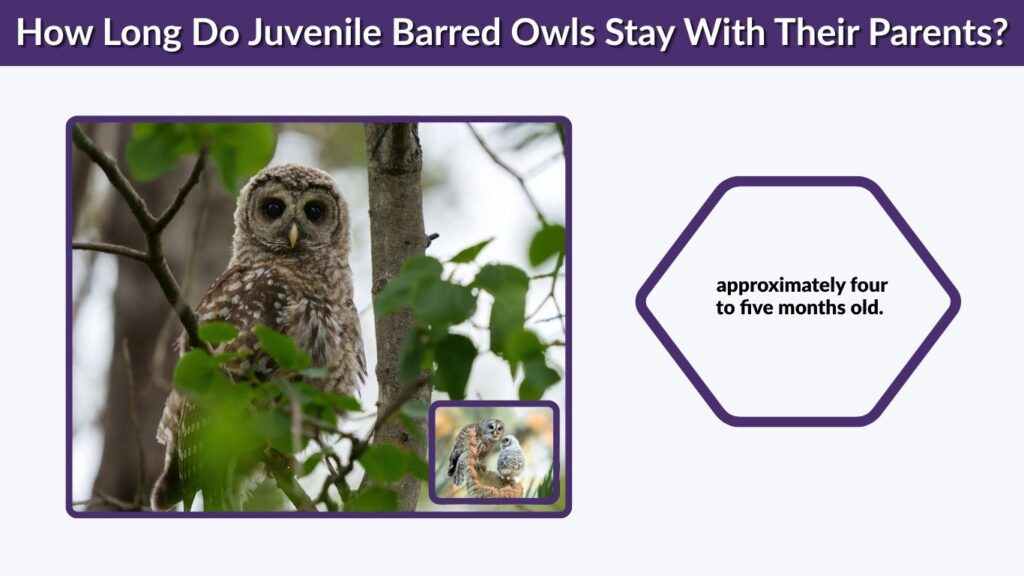
Leaving the nest does not mean independence.
Adults continue hunting for their offspring after fledging. Young Barred Owls remain near their natal territory while learning how to fly, locate prey, and hunt successfully.
Path to Independence
Young Barred Owls generally:
- Hatch helpless and covered with down.
- Grow quickly inside the nest.
- Leave the nest at roughly 4–5 weeks.
- Climb and branch before flying strongly.
- Practice short flights.
- Begin developing hunting skills.
- Continue receiving food from parents.
- Disperse at about 4–5 months old.
Cornell observations show parents can continue feeding fledglings until they are approximately four to five months old.
Juvenile Barred Owl Feathers
A juvenile’s feathers provide useful clues to its age.
New hatchlings possess soft white natal down. At approximately two weeks, a brownish-gray second layer of down begins developing.
Older fledglings develop true feathers but may retain fluffy patches around the head and body.
Feather Development
Hatchling: Mostly white fluffy down.
Growing nestling: Gray-brown secondary down develops.
Fledgling: Flight feathers and barred body feathers become obvious, but down remains.
Older juvenile: Increasingly resembles an adult.
Following spring: Usually difficult to distinguish from an adult based solely on plumage.
Juvenile Barred Owl vs Juvenile Great Horned Owl
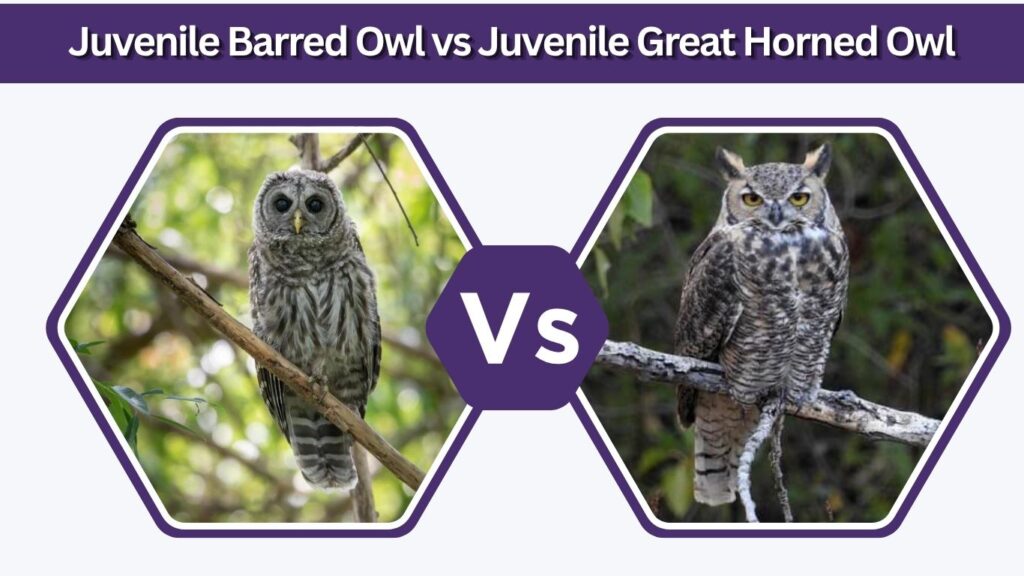
Young Barred and Great Horned Owls can both appear large and fluffy, but several features separate them.
Identification Differences
| Feature | Juvenile Barred Owl | Juvenile Great Horned Owl |
| Eyes | Dark brown/black | Bright yellow |
| Head | Rounded | Broad, eventually tufted |
| Ear tufts | None | Develop prominent tufts |
| Young plumage | Gray-brown barred | Often pale/white down on head |
| Adult size | Smaller | Larger |
| Begging | Squeaky/hissing | Piercing screams |
Juvenile Great Horned Owls are often covered in fluffy down with a noticeably whitish head contrasting with a darker facial disc and yellow eyes.
The eye color is particularly useful: Barred Owls have very dark eyes at all ages, while Great Horned Owls have yellow eyes.
What Should You Do If You Find a Juvenile Barred Owl?
A young owl sitting low on a branch—or even temporarily on the ground—is not necessarily abandoned.
Fledglings frequently leave their nests before becoming strong flyers, and their parents are usually somewhere nearby.
What to Do
- Observe from a safe distance.
- Keep dogs and cats away.
- Do not feed the owl.
- Do not attempt to raise it yourself.
- Avoid standing close for long periods.
- Give the parents room to return.
If the owl is visibly injured, caught in something, in immediate danger from traffic, or clearly unable to move normally, contact a licensed wildlife rehabilitator.
Simply being fluffy, calling loudly, or sitting low in a tree is usually normal juvenile behavior.
FAQs
1. What does a juvenile Barred Owl look like?
It is generally gray and fluffy with dark brown barring, large dark eyes, a rounded head, and no ear tufts.
2. What does a juvenile Barred Owl sound like?
Young Barred Owls make repeated begging calls that can sound like high-pitched squeaks or hisses rather than the deep hoots produced by adults.
3. Why is a juvenile Barred Owl screeching at night?
It is often begging its parents for food. Fledglings remain dependent on adults for months after leaving the nest.
4. When can juvenile Barred Owls fly?
They may leave the nest at around 4–5 weeks before flying well. Short flights develop afterward, while stronger flight skills take several additional weeks.
5. How can you tell a juvenile Barred Owl from a Great Horned Owl?
Check the eyes and head. A juvenile Barred Owl has dark eyes and no ear tufts, while a juvenile Great Horned Owl has bright yellow eyes and eventually develops obvious ear tufts.