
A female snowy owl is a large Arctic predator recognized by her white plumage, dark bars, broad wings, and powerful build. Although males and females belong to the same species, they often differ noticeably in size and coloring. Females are generally larger and retain more dark markings throughout adulthood, while older males may become almost completely white. However, age and individual variation can make identification challenging. This guide explains what female snowy owls look like, how they differ from males, and their role in nesting and raising young.
What Does a Female Snowy Owl Look Like?
A female snowy owl has predominantly white plumage covered with dark brown or black bars. These markings are usually visible across her head, back, wings, chest, and belly.
Her most recognizable features include:
- White feathers with extensive dark barring
- A large, rounded head without ear tufts
- Bright yellow eyes
- A short black bill partly hidden by facial feathers
- Broad, rounded wings
- Thickly feathered legs and feet
- A heavier body than most male snowy owls
The dark markings help break up the owl’s outline when she rests or incubates eggs on the open tundra. Nevertheless, plumage alone does not always confirm whether a snowy owl is male or female.
Female Snowy Owl Size and Weight
Female snowy owls are normally larger and heavier than males. This pattern, known as reverse sexual size dimorphism, occurs in many birds of prey.
A large female may approach 6.5 pounds, or approximately 3 kilograms. Snowy owls generally have a wingspan of roughly four to five feet, with females commonly occupying the upper end of the species’ size range.
A female’s broad wings allow her to fly efficiently across open tundra, grasslands, marshes, and coastal environments. Her size also gives her the strength to capture prey such as lemmings, voles, rabbits, ducks, and other birds.
Snowy Owl Male vs Female
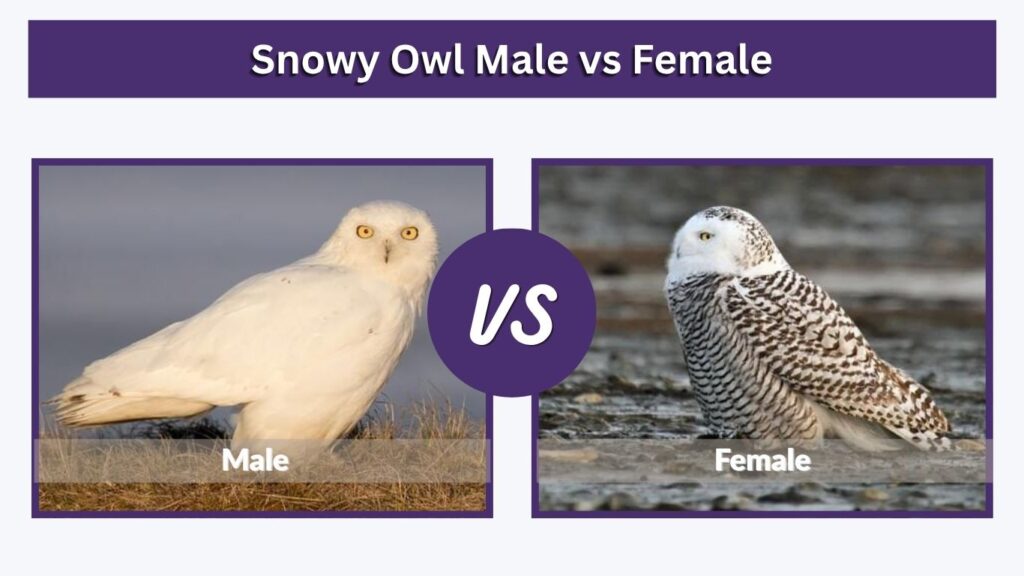
Size and plumage provide the best visible clues when comparing a male and female snowy owl.
| Feature | Female snowy owl | Male snowy owl |
| Body size | Generally larger and heavier | Generally smaller and lighter |
| Plumage | More heavily barred | Often whiter |
| Adult appearance | Usually retains dark markings | May become nearly pure white |
| Wing markings | Broad, dark bars are common | Markings are often smaller and lighter |
| Nesting role | Selects the nest site and incubates | Provides food and guards the territory |
| Field identification | Size and barring offer clues | Age can make young males resemble females |
Why Are Male Snowy Owls Whiter?
Young male snowy owls may be strongly barred, but many males lose some of their dark markings as they mature. Older males can appear almost entirely white.
Females usually remain more heavily marked, although some become paler with age. Consequently, a strongly barred owl may be female or a young male, while a nearly pure-white adult is more likely to be male.
Researchers have found considerable plumage overlap between first-year males and adult females. This means that identifying sex from a distant photograph is not always reliable. Size, feather patterns, age, and sometimes DNA testing must be considered together. Research on aging and sexing snowy owls documents this identification challenge.
How to Tell a Female Snowy Owl from a Male
When observing a snowy owl, look for several characteristics instead of relying on one feature:
- Compare its overall size with nearby birds or familiar objects.
- Examine the amount of dark barring across the chest and wings.
- Look for broad markings rather than small isolated spots.
- Consider whether the bird appears juvenile or fully mature.
- Avoid making a definite identification from poor-quality photographs.
Specialists may also examine the primary flight feathers. In young females, dark bars on these feathers often reach the central shaft, whereas young males tend to have lighter spots that do not touch it. This is a specialist technique and may not be visible in ordinary photographs.
Female Snowy Owl Behavior
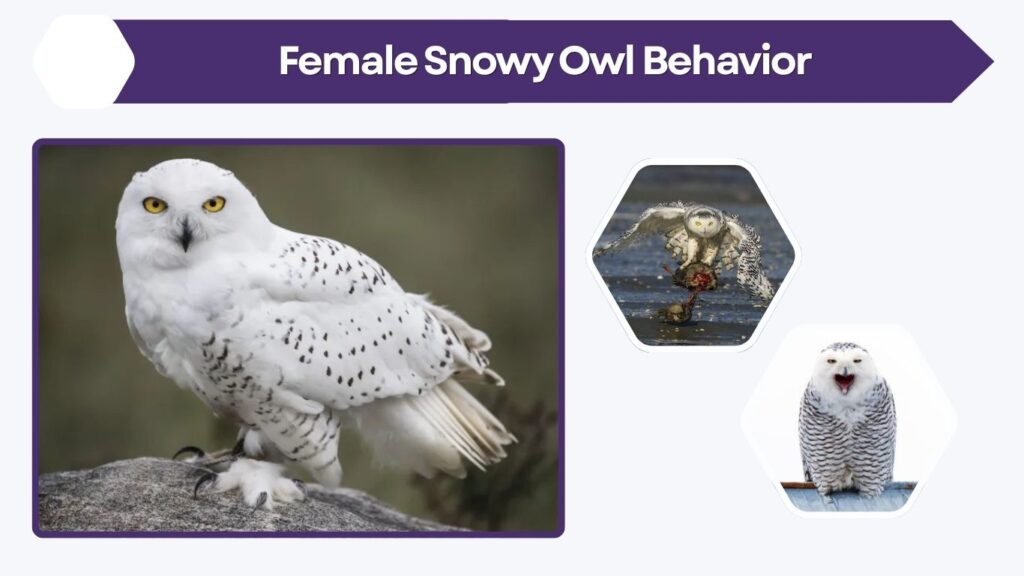
Female snowy owls are skilled hunters capable of catching prey during the day or night. This flexibility is especially important in the Arctic, where summer brings nearly continuous daylight and winter brings long periods of darkness.
A female normally watches for prey from a low perch or raised section of ground. After detecting movement, she flies low over the landscape and attacks using her powerful feet and sharp talons.
Female Snowy Owl Calls
A call alone is not a dependable way to distinguish a female snowy owl from a male. Snowy owls can produce hoots, whistles, barks, hisses, and bill-snapping sounds.
Males are particularly associated with territorial hooting during courtship. Females may use softer begging calls around a mate or harsh defensive sounds near their nest. However, their vocalizations overlap, so appearance and behavior provide better identification clues.
Are Female Snowy Owls Aggressive?
Female snowy owls are not naturally “angry,” but they can become extremely defensive around their eggs and chicks. A threatened female may:
- Spread or raise her wings
- Lower her head
- Hiss or bark
- Snap her bill
- Fly directly at an intruder
- Strike with her talons
Anyone encountering a defensive snowy owl should leave the area immediately. Approaching a ground nest can distress the adults and expose the chicks to danger.
Female Snowy Owl Nesting, Eggs and Parenting
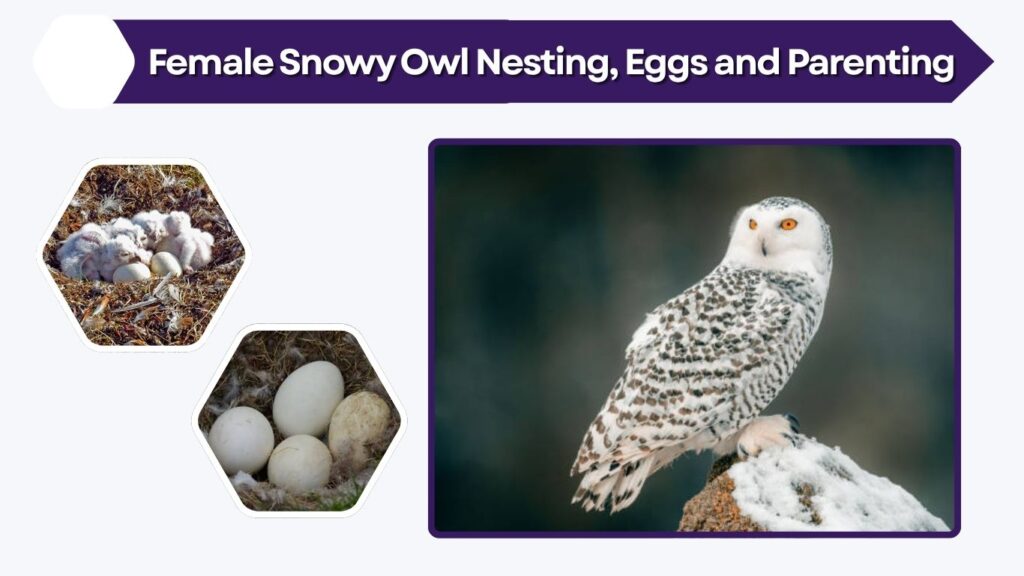
Snowy owls nest directly on the ground rather than in trees. The female usually selects a slightly elevated, snow-free location with a wide view of the surrounding tundra. She creates a shallow nest scrape and may line it with small amounts of vegetation or feathers.
Does the Female Incubate the Eggs?
The female snowy owl performs the incubation. She begins incubating after laying her first egg, so the chicks hatch at different times instead of all at once.
A typical clutch contains approximately three to eleven eggs, although the number varies with food availability. Incubation lasts around 32 days. According to the Cornell Lab of Ornithology, snowy owls normally raise one brood each year.
While the female remains in the nest, the male hunts and brings her food. He also watches the territory and warns of approaching threats. After hatching, the female protects the chicks and divides food into smaller pieces. Both parents defend the family, while the male continues supplying much of the food during the early nesting period.
Neither sex is more important. Their complementary responsibilities allow the eggs and chicks to survive in a demanding Arctic environment.
Young Female Snowy Owls
Snowy owl chicks initially have soft white down that becomes darker gray as they grow. Juveniles later develop heavily patterned feathers, making young males and females look very similar.
Young females often appear darker and more strongly barred, but this characteristic is not completely reliable. A first-year male can have enough dark plumage to be mistaken for an adult female.
As female snowy owls mature, they may become somewhat lighter, but most retain obvious bars or spots. Males generally show a greater reduction in markings with age.
FAQs
What is a female snowy owl called?
There is no unique scientific name for a female snowy owl. Ornithologists usually call her a female snowy owl. The word “hen” may be used informally for a female owl.
Are female snowy owls bigger than males?
Yes. Females are generally larger and heavier, although individual size ranges overlap.
What does a female snowy owl look like?
She usually has white plumage with extensive dark bars across her head, body, and wings. She also has yellow eyes, a rounded head, feathered feet, and a powerful build.
Why do female snowy owls have more spots?
Their markings are dark bars rather than true round spots. Females generally retain more of these markings into adulthood, while males tend to become whiter as they age.
Can you identify a female snowy owl from a picture?
Sometimes, but not with complete certainty. A large, heavily barred owl is more likely to be female, yet young males can look similar. Clear feather details, body measurements, or DNA testing may be necessary for reliable identification.