
The Oriental bay owl is one of the most unusual-looking owls in Asia. With its heart-shaped face, dark eyes, reddish-brown plumage, and compact body, it looks very different from many familiar owl species. This secretive nocturnal bird spends most of the day hidden in dense vegetation and becomes active after sunset. Because it is rarely seen in the open, many people first notice an Oriental bay owl by hearing its distinctive call at night rather than seeing the bird itself.
Oriental Bay Owl Quick Facts
The Oriental bay owl belongs to the family Phodilidae and is scientifically known as Phodilus badius. It occurs across parts of South and Southeast Asia.
| Feature | Oriental Bay Owl |
| Scientific name | Phodilus badius |
| Family | Phodilidae |
| Length | About 23–29 cm |
| Body type | Small, compact owl |
| Activity | Nocturnal |
| Diet | Carnivorous |
| Main foods | Small mammals, birds, reptiles, insects |
| Habitat | Forests and wooded areas |
| Plumage | Rufous, chestnut, cream, and white |
| Eyes | Large and dark |
| Nesting | Usually tree cavities |
Its unusual facial structure makes it one of the easiest owl species to recognize once seen clearly.
What Does an Oriental Bay Owl Look Like?
The Oriental bay owl has a distinctive appearance that separates it from typical round-faced owls.
Its face is divided into two pale heart-like sections surrounding large dark eyes. The upperparts are generally reddish-brown or chestnut with darker and lighter markings, while the underside is paler.
Oriental Bay Owl Identification
Important identification features include:
- Heart-shaped facial disc
- Large dark eyes
- Reddish-brown or chestnut plumage
- Pale cream-colored facial feathers
- White spotting on parts of the body
- Short rounded wings
- Relatively long legs
- Small hooked bill
- Compact body shape
- Feathered head without obvious true ear tufts
The unusual face sometimes gives the bird an almost mask-like appearance.
What Color Is an Oriental Bay Owl?
Its colors are primarily reddish-brown, chestnut, cream, buff, and white.
The back and wings are usually darker, while the face and underside are lighter. Dark edges around the facial disc make the eyes stand out strongly.
Color can vary slightly among individuals and geographic populations.
Oriental Bay Owl Size
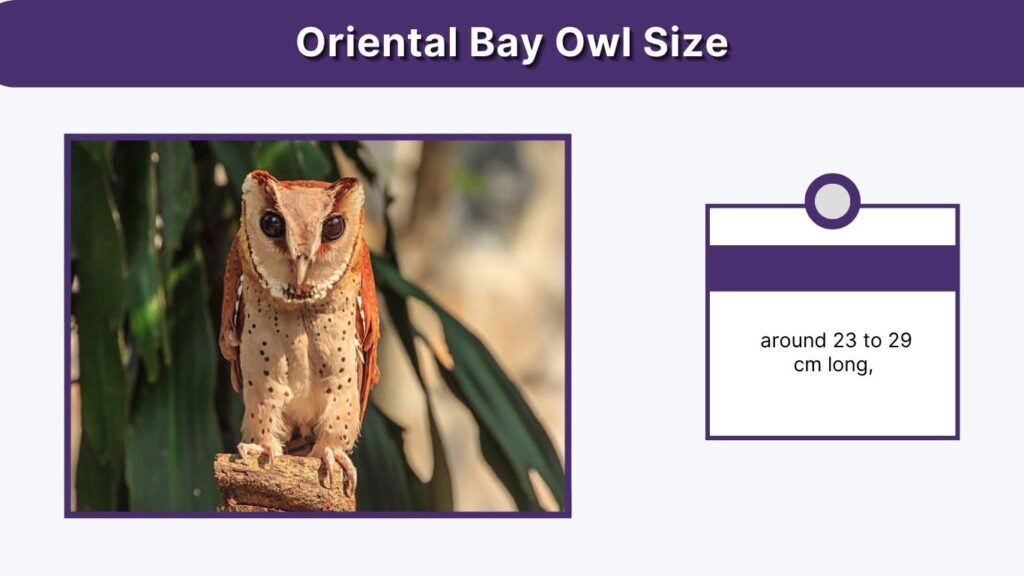
The Oriental bay owl is considered a relatively small owl.
Adults are generally around 23 to 29 cm long, making them considerably smaller than large species such as eagle-owls.
How Big Is an Oriental Bay Owl?
Although its body is compact, the large head and broad facial disc can make the owl appear bigger than it actually is.
Its relatively short wings are suitable for maneuvering through forests rather than long-distance soaring over open areas.
Exact wingspan measurements are less commonly reported than body length, but the species has broad, rounded wings adapted for controlled nighttime flight.
Oriental Bay Owl Habitat

Oriental bay owls are primarily forest birds.
They live across areas of South and Southeast Asia where suitable wooded habitats provide nesting sites, dense daytime cover, and abundant prey.
Where Do Oriental Bay Owls Live?
They can occur in countries and regions including:
- India
- Nepal
- Bangladesh
- Myanmar
- Thailand
- Malaysia
- Indonesia
- Cambodia
- Laos
- Vietnam
- Southern China
Depending on the region, they may inhabit tropical forests, subtropical forests, secondary woodland, plantations, and other well-vegetated environments.
During the day, they usually remain hidden inside dense foliage, tree cavities, or other sheltered locations.
Oriental Bay Owl Diet
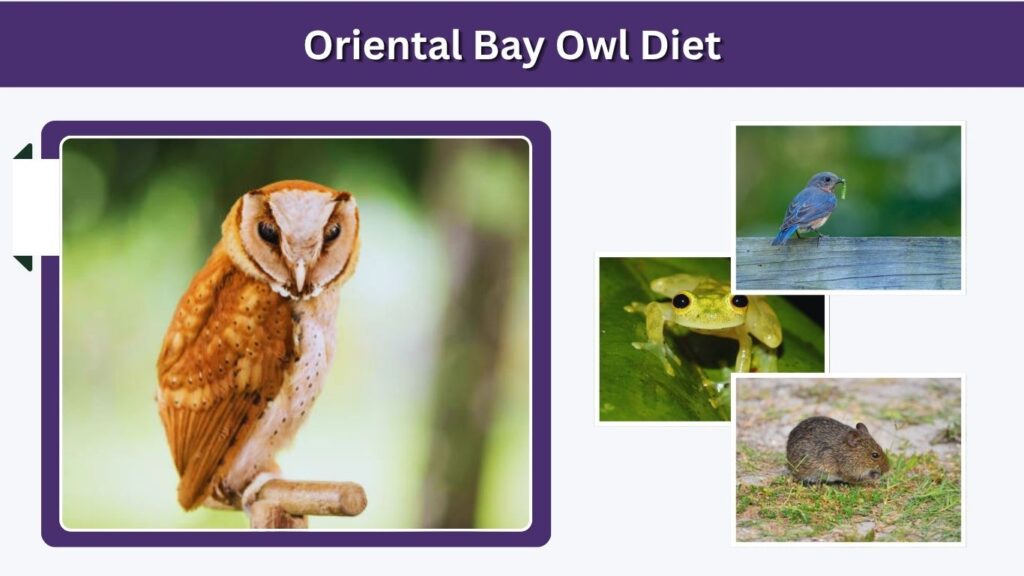
The Oriental bay owl is a nighttime predator that hunts a variety of small animals.
Its diet depends largely on what prey is available in its habitat.
What Do Oriental Bay Owls Eat?
Common prey may include:
- Mice
- Rats
- Small birds
- Lizards
- Frogs
- Large insects
- Small reptiles
- Other small vertebrates
Like many owls, it uses excellent hearing and low-light vision to detect prey after dark.
Once prey is located, the owl can descend rapidly and capture it using its strong feet and sharp talons.
Oriental Bay Owl Call and Sound
The Oriental bay owl call is one of the best ways to detect this secretive species.
Because it spends much of its life hidden in vegetation, people often hear it without ever seeing it.
What Does an Oriental Bay Owl Sound Like?
Its vocalizations can include strange, high-pitched whistles and repeated calls that may sound eerie in a quiet forest at night.
Different calls may be used for:
- Territorial communication
- Contact between mates
- Courtship
- Communication around nesting areas
The unusual sound is sometimes mistaken for another bird, mammal, or even an insect by people unfamiliar with the species.
Calling activity is often most noticeable after dark.
Oriental Bay Owl Behavior
Oriental bay owls are strongly nocturnal.
During daylight hours, they usually stay motionless in sheltered locations where their plumage helps them blend into the surrounding vegetation.
Nighttime Behavior
After sunset, the owl leaves its roost to search for prey.
It may hunt from a perch, listening and watching for movement before making a short flight toward prey.
Dense forests provide many branches that can be used as hunting perches.
These owls are generally secretive and are not often seen flying openly during daytime.
Oriental Bay Owl Adaptations
Several adaptations help Oriental bay owls survive as nighttime forest predators.
Heart-Shaped Face
The facial disc is not only visually distinctive. The arrangement of facial feathers helps direct sound toward the owl’s ears.
This improves its ability to locate animals moving in darkness.
Large Eyes
The Oriental bay owl’s large eyes help collect available light at night.
However, owls cannot move their eyes freely inside their sockets like humans do. Instead, they compensate by moving their heads.
Silent Flight
Like other owls, the structure of the wing feathers helps reduce noise during flight.
Quiet flight allows the owl to approach prey without easily revealing its position.
Oriental Bay Owl Eyes and Eyelids
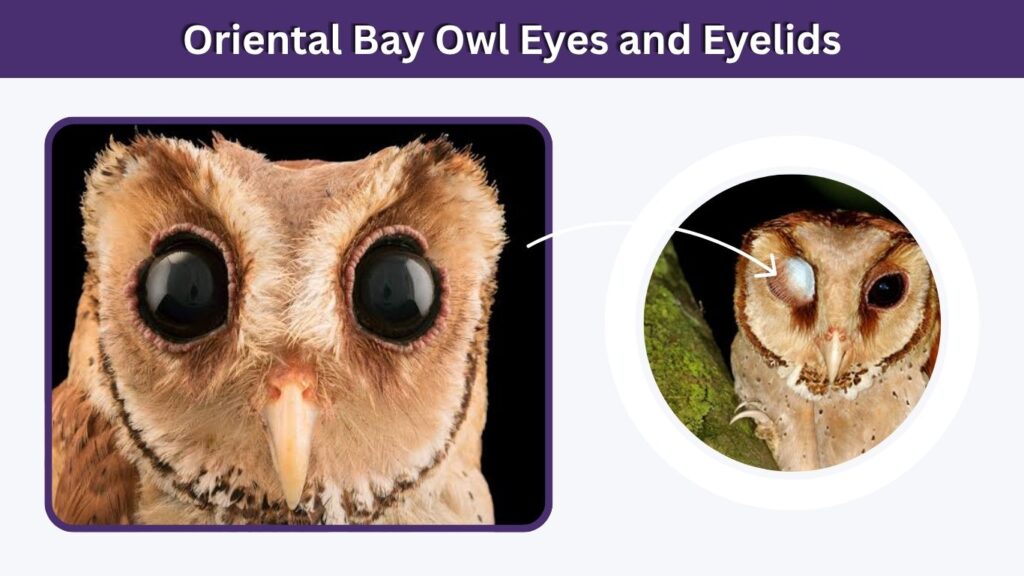
The large, dark eyes of the Oriental bay owl are one of its most noticeable features.
They are positioned toward the front of the face, providing strong binocular vision and helping the owl judge distance when hunting.
How Many Eyelids Does It Have?
Like other birds, the Oriental bay owl has upper and lower eyelids as well as a transparent or translucent nictitating membrane.
This third protective membrane can move across the eye and helps keep it clean while still providing protection.
Why Does the Oriental Bay Owl Change Shape?
Some photos and videos make Oriental bay owls appear to dramatically change their body shape.
This occurs largely because the bird can adjust its feathers and posture.
When relaxed, its feathers may appear fluffy, making the owl look rounder.
When nervous or trying to remain unnoticed, it may:
- Compress its feathers
- Stretch its body upward
- Narrow its facial appearance
- Hold its wings closer to the body
This behavior can make the same owl look surprisingly different within seconds.
Baby Oriental Bay Owl
Baby Oriental bay owls hatch in sheltered nests where their parents provide protection and food.
Tree cavities are particularly important nesting locations.
What Do Baby Oriental Bay Owls Look Like?
Young owls initially have softer, fluffier feathers than adults.
As they develop, their juvenile feathers are gradually replaced by the more recognizable reddish-brown and cream-colored adult plumage.
Both parents may participate in raising the young, although their exact roles can vary during the nesting cycle.
Young owls remain dependent on adults until they develop sufficient flight and hunting skills.
Oriental Bay Owl Lifespan
The exact Oriental bay owl lifespan in the wild is not as well documented as that of some commonly studied owl species.
Wild lifespan can be affected by:
- Food availability
- Predators
- Disease
- Habitat destruction
- Severe weather
- Human disturbance
Owls that successfully reach adulthood may survive for several years, although individual longevity can vary considerably.
Oriental Bay Owl Predators and Threats
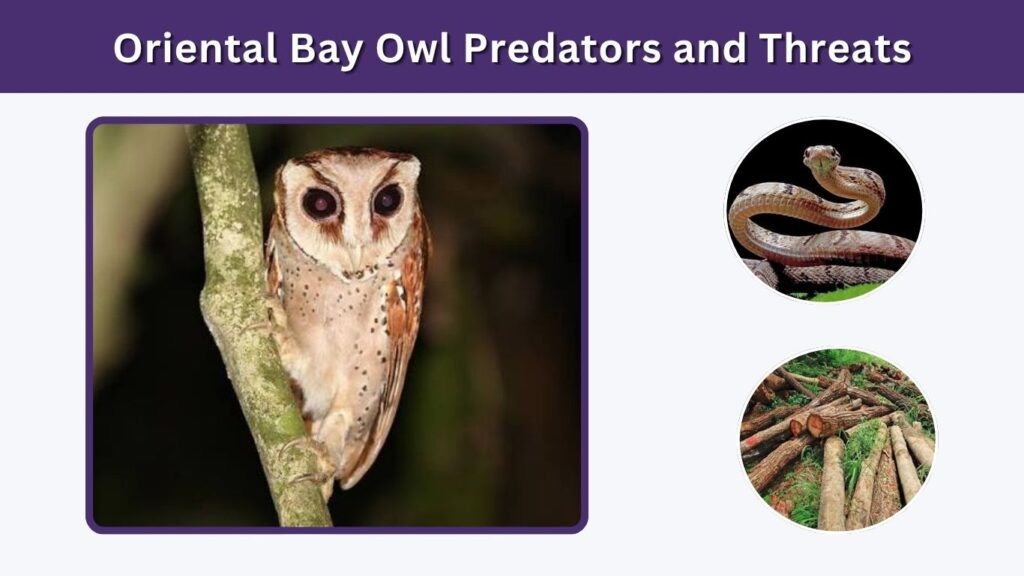
Adult Oriental bay owls have relatively few natural predators compared with small songbirds, but they are not completely safe.
Potential threats may include larger birds of prey, snakes, and other predators capable of reaching nests or roosts.
Eggs and young owls are particularly vulnerable.
Habitat Loss
One of the larger long-term concerns for forest-dependent wildlife is habitat destruction.
Clearing forests can reduce:
- Nesting cavities
- Safe daytime roosts
- Hunting territory
- Available prey
Maintaining healthy forest habitats therefore benefits Oriental bay owls and many other species living in the same ecosystems.
Interesting Oriental Bay Owl Facts
The Oriental bay owl has several characteristics that make it especially fascinating.
- It has one of the most distinctive faces among Asian owls.
- Its scientific name is Phodilus badius.
- It is primarily active at night.
- Its facial feathers help direct sound toward its ears.
- It often spends daylight hours completely hidden.
- Its plumage combines reddish-brown, cream, and white colors.
- Its posture can change dramatically when it feels threatened.
- It feeds on both small vertebrates and large insects.
- It commonly depends on wooded environments for shelter and nesting.
- Many people detect the species through its call before ever seeing one.
FAQs
Is the Oriental bay owl rare?
The Oriental bay owl can be difficult to observe because it is nocturnal and secretive. Even where it occurs, it may remain hidden in dense vegetation during the day, making sightings less common than its actual presence might suggest.
How big is an Oriental bay owl?
An adult Oriental bay owl is generally about 23 to 29 cm long. It is therefore considered a small owl, although its large head, facial disc, and thick feathers can make it appear somewhat larger.
What do Oriental bay owls eat?
Oriental bay owls are carnivorous predators. They may eat mice, other small mammals, small birds, frogs, lizards, insects, and other animals they can capture during nighttime hunting.
Where do Oriental bay owls live?
They occur across parts of South and Southeast Asia. Their preferred environments include tropical and subtropical forests, wooded areas, secondary forests, and other habitats with dense vegetation and suitable nesting cavities.
What does an Oriental bay owl call sound like?
The Oriental bay owl produces unusual high-pitched whistles and repeated nighttime calls. Its voice can sound eerie or unfamiliar, especially in dense forests, and may be easier to notice than the owl itself.