The common barn owl is a pale, nocturnal bird recognized by its heart-shaped face, dark eyes, long legs, and almost silent flight. It hunts mainly over grasslands, marshes, farms, and other open habitats, using exceptional hearing to locate mice and voles in darkness. Barn owls often roost or nest in tree cavities, barns, church towers, silos, and nest boxes. Although widely distributed, their abundance varies locally according to prey, nesting sites, weather, traffic, and land management.
What Is a Common Barn Owl?
The common barn owl belongs to Tytonidae, the barn owl family. It differs from typical owls through its heart-shaped facial disc, long legs, relatively small dark eyes, and distinctive screeching voice.
| Feature | Description |
| Common name | Common barn owl or barn owl |
| Traditional scientific name | Tyto alba |
| Order | Strigiformes |
| Family | Tytonidae |
| Length | Approximately 32–40 cm |
| Wingspan | Approximately 107–110 cm |
| Main diet | Mice, voles, rats, shrews, and other small mammals |
| Activity | Mostly nocturnal |
| Conservation status | Least Concern globally under BirdLife’s broad treatment |
Scientific Name and Classification
The scientific name traditionally used for the common barn owl is Tyto alba. However, owl classification has recently changed. In 2024, Cornell’s Clements taxonomy divided the widespread barn owl complex into the American barn owl, Tyto furcata; Eastern barn owl, Tyto javanica; and Western barn owl, Tyto alba. Other authorities still use Tyto alba more broadly, so the scientific name may differ among modern field guides.
Identification
- Distinctive white, heart-shaped facial disc
- Dark brown or black eyes
- Golden-buff, gray, and brown upperparts
- White, cream, or lightly spotted underparts
- Long legs with powerful talons
- Rounded wings and a short tail
- No visible ear tufts
- Slender body compared with many typical owls
- Females usually larger and more heavily spotted than males
Common barn owls are not completely gray. Their backs and wings contain a mixture of gray, buff, gold, brown, black, and white, while their face and underside are usually much paler. At night, an owl flying overhead may appear almost entirely white.
Common Barn Owl Habitat and Range
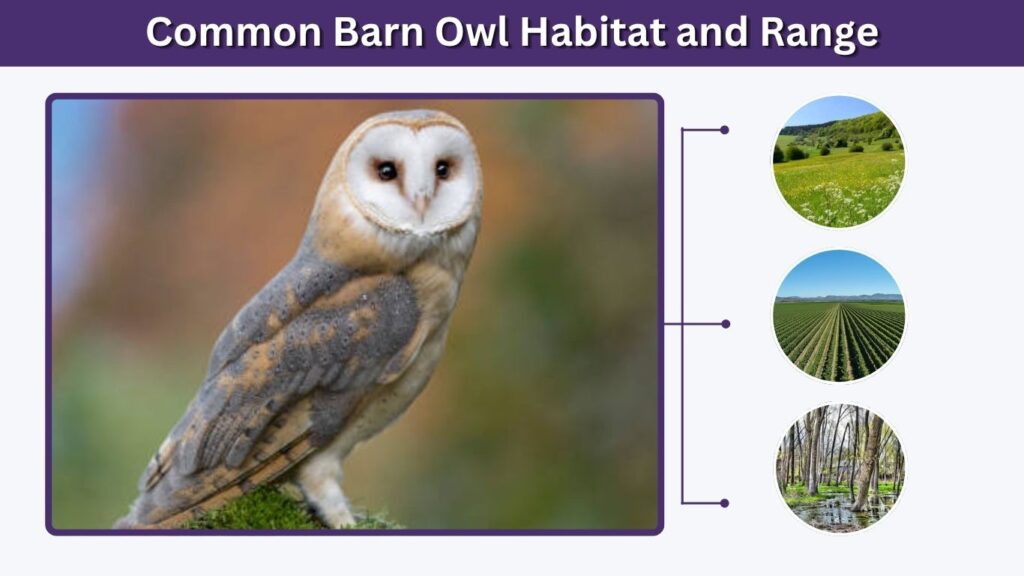
Barn owls need two main habitat features: open land where they can hunt and a quiet cavity where they can roost or nest. They can live near people when suitable feeding areas remain nearby.
Where Do Common Barn Owls Live?
Typical habitats include:
- Grasslands and meadows
- Agricultural fields
- Marshes and wetlands
- Open woodland edges
- Ranchlands and pastures
- Brushy fields
- Deserts with open hunting areas
- Suburban areas near fields
- River valleys and coastal plains
Barn owls nest and roost in tree hollows, caves, cliff crevices, barns, silos, church towers, attics, abandoned buildings, and artificial nest boxes. They generally avoid dense forests because thick tree cover provides fewer opportunities to hunt low over open ground.
How Common Are Barn Owls?
Barn owls are globally widespread, but they are not equally common everywhere. Their numbers can be high in productive farming regions with rough grassland, numerous rodents, mild winters, and safe nesting cavities. They may be scarce in heavily urbanized areas, cold uplands, intensively managed farmland, and places without suitable nest sites.
Local populations can fluctuate when vole and mouse numbers change. Severe winters, habitat loss, road collisions, removal of old buildings, and poisoning from rodenticides may also reduce their numbers. BirdLife classifies the broadly defined barn owl as Least Concern, although individual regional populations may still require protection.
What Do Common Barn Owls Eat?
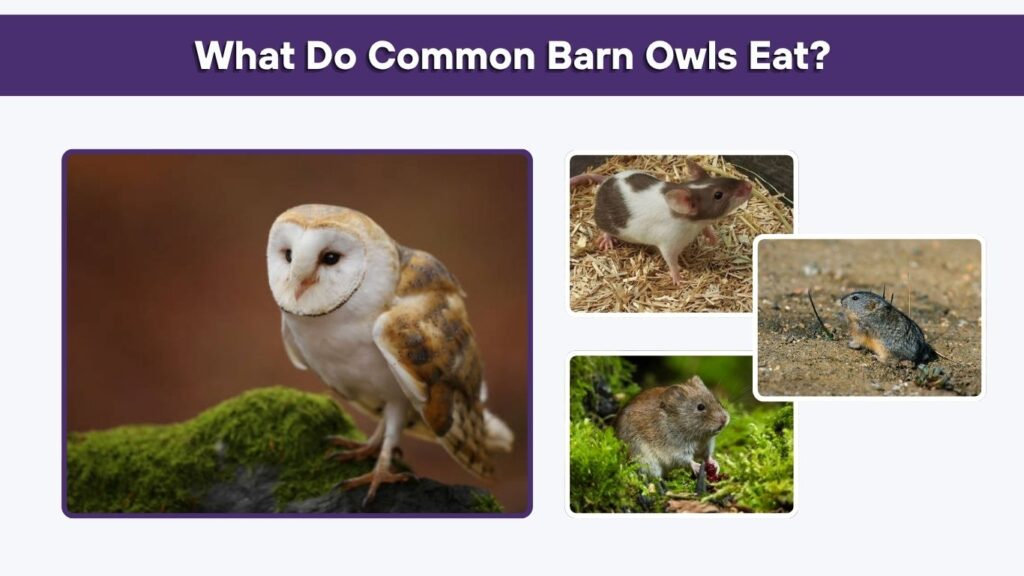
Common barn owls are specialist hunters of small mammals. The exact diet varies according to region and which prey species are locally abundant.
Common Prey
Their diet commonly includes:
- Mice
- Voles
- Small rats
- Shrews
- Lemmings
- Young rabbits
- Bats
- Small birds
They may occasionally catch amphibians, reptiles, insects, fish, scorpions, or crayfish, but these usually make up only a small part of the diet. A nesting pair may store multiple prey animals near the nest to feed newly hatched chicks.
Barn Owl Pellets
Barn owls commonly swallow small prey whole, including fur, bones, teeth, and claws. Soft tissues are digested, while indigestible material is compressed inside the stomach and later coughed up as a dark pellet.
Researchers examine these pellets to identify prey bones and determine which mammals live in the surrounding ecosystem. An owl may produce about two pellets per day, although the number varies with feeding activity and prey size.
Common Barn Owl Adaptations
Barn owls possess several adaptations that allow them to hunt effectively under dark and quiet conditions.
Silent Flight
Their broad wings allow slow, buoyant flight over fields. Soft feather surfaces and specialized edges reduce the sound created as air passes across the wings. This helps the owl approach prey without being heard and prevents wing noise from interfering with its own hearing.
Heart-Shaped Face and Hearing
The heart-shaped facial disc works like a sound collector, directing faint noises toward the ears. The ear openings are positioned asymmetrically, allowing the owl to compare when and how loudly a sound reaches each side of its head.
Barn owls can locate and capture mice using sound alone, even when prey is hidden by vegetation or when the surroundings are completely dark. Their ability to locate prey acoustically is among the most accurate tested in any animal.
Beak, Talons, and Legs
The hooked beak tears prey into manageable pieces, while sharp talons capture and kill small mammals. Long legs help the owl reach through tall grass without striking its wings or body against vegetation.
The facial disc also hides much of the beak when viewed from the front. Although it appears small, the beak is strong and sharply curved.
Are Common Barn Owls Nocturnal?
Common barn owls are primarily nocturnal, usually leaving their roosts around dusk and hunting throughout the night. They often fly low over fields while listening for movement below.
However, they sometimes hunt during daylight, particularly when feeding chicks, after poor nighttime hunting, or during seasons when prey is especially active. A barn owl seen during the day is therefore not automatically sick or injured.
What Does a Common Barn Owl Sound Like?
Barn owls do not produce the familiar rhythmic hooting associated with many typical owls. Their best-known call is a long, harsh, rasping scream lasting approximately two seconds.
They also produce:
- Hissing sounds when defending a nest
- Soft purring calls during courtship
- Chirps and twitters during feeding
- Snoring-like begging calls from chicks
- Bill snapping when threatened
- Wing claps during some display flights
These unusual sounds can be frightening when heard from a dark barn or attic, but they are normal forms of communication.
Common Barn Owl Life Cycle
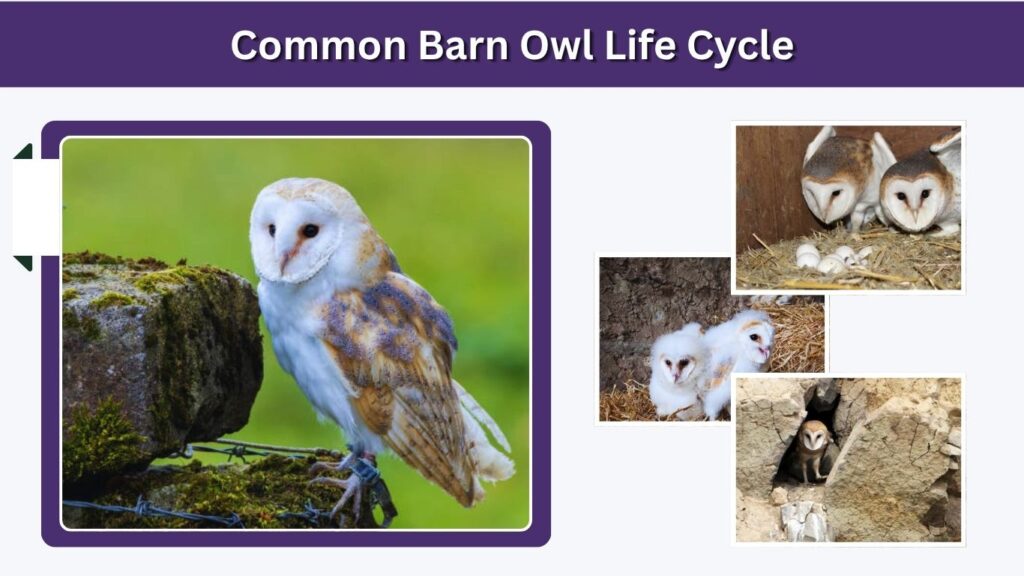
Barn owls use cavities rather than building traditional stick nests. The female lays her eggs directly on accumulated pellets, feathers, and nest debris.
Eggs and Chicks
A typical clutch contains four to six white eggs, although the number can range from two to twelve. The female performs most incubation, which usually lasts about 32 days. Because eggs are laid at intervals, chicks hatch at different times and may vary considerably in size.
Both parents contribute to raising the brood. The male usually delivers much of the food early in nesting, while the female tears prey into small pieces for the chicks. Young owls gradually develop flight feathers before leaving the nest and learning to hunt independently.
Lifespan
Many wild barn owls die young because of starvation, harsh weather, vehicle collisions, predation, or accidents. However, survivors may live much longer. The oldest recorded American barn owl was at least 15 years and 5 months old.
Predators and Threats
Adult barn owls may be killed by larger owls, eagles, hawks, foxes, and other predators. Eggs and chicks are more vulnerable to snakes, raccoons, cats, and climbing mammals.
Important human-related threats include:
- Vehicle collisions
- Loss of rough grassland
- Removal or renovation of nesting buildings
- Secondary poisoning from rodenticides
- Electrocution
- Barbed-wire collisions
- Disturbance near active nests
- Severe weather and reduced prey populations
Maintaining uncultivated grassy field margins and installing correctly designed nest boxes can support local populations. Rodent control should avoid methods that expose owls to poisoned prey.
Can a Common Barn Owl Be a Pet?
Barn owls are wild birds of prey rather than domesticated pets. They require whole-prey diets, specialized housing, room to fly, experienced handling, and professional veterinary care. They can also injure people with their talons and become severely stressed in unsuitable homes.
Wildlife laws commonly restrict capturing or keeping native owls without authorization. An injured or orphaned barn owl should be reported to a licensed wildlife rehabilitator rather than taken home.
FAQs
What is the scientific name of the common barn owl?
The traditional scientific name is Tyto alba. Under a recent taxonomic split, Western barn owls retain this name, while American and Eastern populations may be classified as Tyto furcata and Tyto javanica. The name used depends on the taxonomic authority.
What do common barn owls most commonly eat?
They eat mainly small nocturnal mammals, especially mice, voles, rats, and shrews. The precise diet depends on local prey availability. Birds, bats, rabbits, amphibians, reptiles, and large insects may occasionally be captured.
Are common barn owls rare?
They are globally widespread and classified as Least Concern, but their local abundance varies greatly. They can be common where open hunting habitat, rodents, and nesting cavities are plentiful, yet uncommon in highly urbanized, intensively farmed, or very cold regions.
How are barn owls different from common owls?
Barn owls belong to Tytonidae, while most other owls belong to Strigidae. Barn owls have heart-shaped faces, long legs, dark eyes, and screeching calls. Typical owls generally have rounder facial discs and are more likely to produce hooting calls.
Do common barn owls hunt during the day?
They primarily hunt at night but may appear during daylight, especially when raising chicks or when nighttime hunting has been unsuccessful. Daytime activity alone does not mean that the owl is ill.