
The spot-bellied eagle-owl is a large, powerful forest owl recognized by its prominent ear tufts, dark eyes and heavily marked underparts. It lives across parts of the Indian subcontinent and Southeast Asia, where it hunts birds, mammals and reptiles, mostly after dark. Its loud, mournful scream has inspired stories and superstitions in some areas. Although it is globally classified as Least Concern, the owl is uncommon, secretive and dependent on healthy forest habitat.
Spot-Bellied Eagle-Owl Quick Facts
| Feature | Information |
| Common name | Spot-bellied eagle-owl |
| Other name | Forest eagle-owl |
| Current scientific name | Ketupa nipalensis |
| Former scientific name | Bubo nipalensis |
| Family | Strigidae |
| Length | About 51–63 cm |
| Weight | Approximately 1.3–1.5 kg |
| Activity | Mainly nocturnal |
| Main habitat | Dense tropical and montane forests |
| Conservation status | Least Concern |
The species was traditionally classified as Bubo nipalensis. Modern taxonomy places it in the genus Ketupa, although the older scientific name remains common in books, research papers and wildlife articles.
What Does a Spot-Bellied Eagle-Owl Look Like?
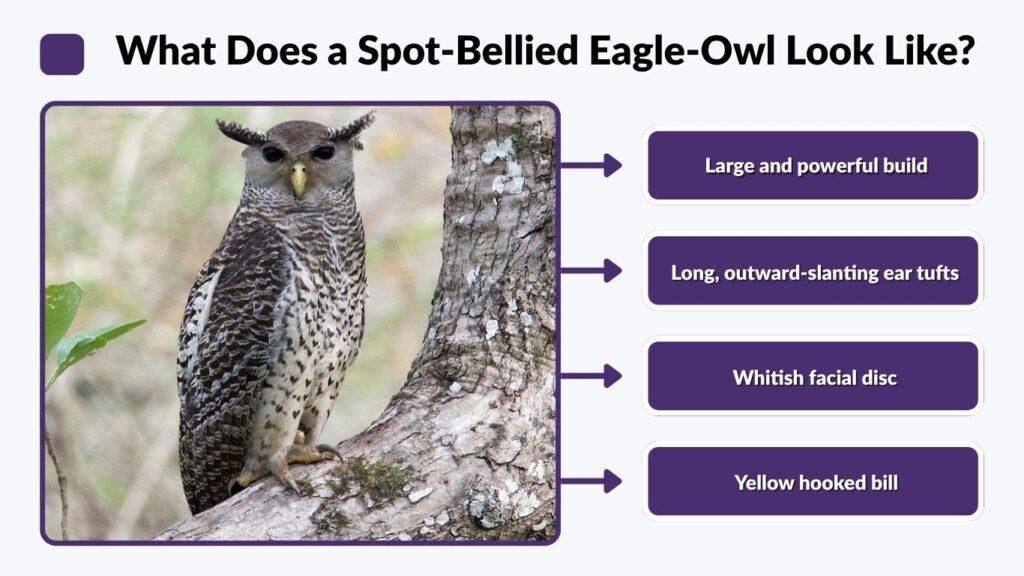
The adult spot-bellied eagle-owl has a bulky body, broad rounded wings and long outward-pointing ear tufts. Its facial disc is pale, while its large eyes appear dark brown or almost black. The beak is yellow, and the strong, fully feathered legs end in powerful feet and dark claws.
Identification Features
You can identify this owl by its:
- Large and powerful build
- Long, outward-slanting ear tufts
- Whitish facial disc
- Yellow hooked bill
- Dark brown eyes
- Dark brown upperparts with pale mottling
- Pale underparts covered with dark V-shaped spots
- White shoulder patches
- Broad, rounded wings
- Short, square tail
The markings on the lower breast and belly sometimes resemble hearts, explaining online searches for its “heart feathers.” These are natural dark feather patterns rather than actual heart-shaped structures. Juveniles look much paler than adults, with whitish or buff plumage and narrow dark barring.
Spot-Bellied Eagle-Owl Size and Weight
The spot-bellied eagle-owl measures approximately 51–63 centimetres, or 20–25 inches, in total length. Adults generally weigh between 1.3 and 1.5 kilograms, or about 2.9–3.3 pounds.
Although it is not among the world’s heaviest owls, its broad wings, prominent ear tufts and upright posture make it look imposing. Its large feet and strong talons allow it to overpower surprisingly heavy prey.
Where Does the Spot-Bellied Eagle-Owl Live?
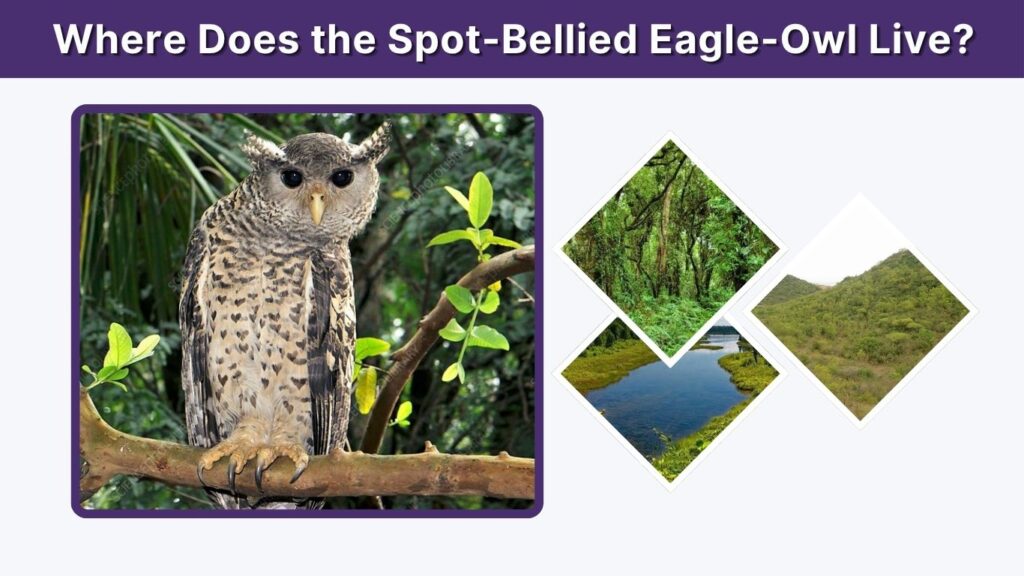
The species occurs from southern India and Sri Lanka through the Himalayan region to southern China. Its wider range extends through countries including Nepal, Bhutan, Bangladesh, Myanmar, Thailand, Cambodia, Laos and Vietnam.
In India, it has been recorded in the Western Ghats, Eastern Ghats, Himalayan foothills, northeastern forests and parts of central India. Because it is nocturnal and spends the day concealed in dense vegetation, it may be present in an area without being regularly observed.
Preferred Habitat
Spot-bellied eagle-owls inhabit:
- Dense evergreen forest
- Moist deciduous forest
- Montane wet forest
- Riparian woodland
- Mixed teak forest
- Bamboo jungle
- Forested hillsides
- Scrub near mature forest
- Edges of clearings
They are frequently associated with forests near water. Most records come from elevations between approximately 300 and 2,130 metres, although the species may occur as high as 3,000 metres in the Himalayas. It is considered a resident rather than a regular migrant.
What Does a Spot-Bellied Eagle-Owl Eat?
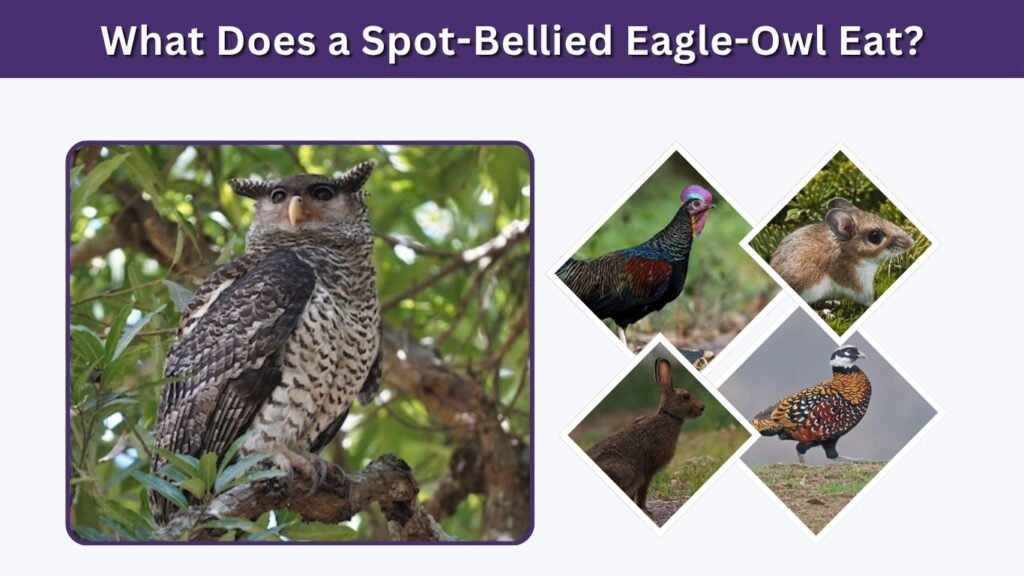
The spot-bellied eagle-owl is a formidable carnivorous predator. Large birds form an important part of its diet, but it also captures mammals, reptiles, fish and occasionally consumes carrion.
Its prey may include:
- Junglefowl
- Pheasants
- Peafowl
- Hares
- Rodents
- Snakes
- Monitor lizards
- Small deer fawns
- Mouse-deer
- Other forest birds
It usually hunts from a perch before dropping or pouncing onto prey. It may also capture sleeping birds at their nighttime roosts. Although mainly nocturnal, occasional daytime hunting has been documented.
A 2026 wildlife study documented a spot-bellied eagle-owl carrying an Indian chevrotain, or mouse-deer, in Odisha’s Similipal Tiger Reserve. The prey weighed roughly twice as much as the owl, demonstrating the bird’s remarkable strength.
What Does a Spot-Bellied Eagle-Owl Sound Like?
The owl produces more than one type of vocalization. Its regular call is a deep, low and resonant double hoot that sounds like “hoo-hoo.” The complete call lasts roughly two seconds.
It can also make a loud, mournful scream with a rising-and-falling rhythm. This unusual cry may sound human-like when heard at night, which explains searches describing it as a scream, shriek or cry. Recordings of both the hooting call and screaming vocalization are available in major bird-sound archives.
The frightening sound does not mean the owl is attacking someone. Calls are used for communication, territory advertisement and contact between birds.
Behavior and Hunting Adaptations
Spot-bellied eagle-owls are primarily active at night. During daylight, they usually rest quietly inside dense tree cover, making their mottled feathers useful camouflage.
Their hunting adaptations include excellent low-light vision, sensitive hearing, broad wings and strong feet. Special feather structures help reduce the sound created during flight, allowing the owl to approach prey with little warning.
Despite its size, the owl can move efficiently through forest openings. It may hunt near clearings, rivers, forest roads and places where prey becomes easier to detect.
Nesting and Reproduction
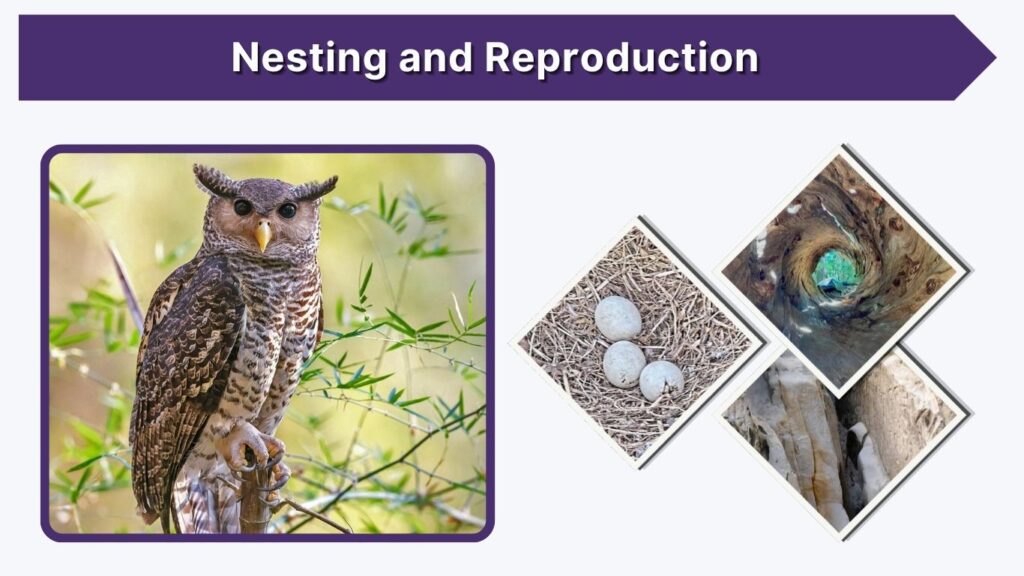
Breeding time differs across the owl’s range. Egg-laying generally occurs from February to March in Nepal and the Himalayas, from December to January in southern India, and from April to May in Sri Lanka.
Nest and Eggs
A pair may use:
- A large hollow inside a tree
- An abandoned stick nest built by another raptor
- A sheltered rock fissure
- A cave ledge
- Bare ground inside a protected rocky site
The female usually lays only one egg. Adults are reported to defend their nest, egg and young aggressively, so observers should never approach an occupied nesting site.
Young spot-bellied eagle-owls are pale and fluffy, with fine dark barring. Their plumage becomes darker and more strongly patterned as they mature.
How Long Does a Spot-Bellied Eagle-Owl Live?
A reliable species-specific lifespan has not been firmly established in major reference accounts. Like other large owls, it may potentially survive for many years under favorable conditions, but a precise maximum age should not be presented without verified long-term records.
Survival depends on access to prey, secure nesting sites and large areas of undisturbed forest. Collisions, persecution, poaching and habitat destruction can shorten the lives of wild birds.
Is the Spot-Bellied Eagle-Owl Rare?
The species is classified globally as Least Concern, meaning it is not currently considered at immediate risk of extinction. However, this does not mean it is common everywhere. Its global population size and trend remain uncertain, and the owl is described as rare or local across much of its range.
Its secretive habits also make it difficult to detect. A bird may remain hidden throughout the day and call only occasionally at night. Therefore, some populations may be overlooked.
Main Threats
Potential threats include:
- Clearing of tropical forests
- Loss of mature nesting trees
- Forest fragmentation
- Degradation of riverine habitat
- Reduction of large prey animals
- Human disturbance near nests
- Poaching and illegal wildlife trade
The owl appears strongly dependent on intact lowland and hill forests and may not adapt easily to heavily degraded landscapes.
FAQs
Is the spot-bellied eagle-owl dangerous to humans?
It is a powerful predator, but it does not normally hunt people. An adult may defend its nest or young if approached closely. Birdwatchers should maintain a respectful distance and avoid disturbing nesting sites.
Why is it called the spot-bellied eagle-owl?
The name refers to the dark V-shaped spots covering its pale lower breast and belly. Some of these markings resemble small hearts, especially in clear photographs.
Is Bubo nipalensis the correct scientific name?
Bubo nipalensis is the traditional name and still appears in many references. Current Cornell and eBird taxonomy uses Ketupa nipalensis following genetic research that reorganized several eagle-owl species.
Does the spot-bellied eagle-owl scream?
Yes. In addition to a low double hoot, it can produce a loud, mournful scream with a rising-and-falling quality. Its unusual nighttime cry has contributed to local folklore and the bird’s mysterious reputation.
Can a spot-bellied eagle-owl be kept as a pet?
It is a wild bird of prey, not a domesticated pet. Keeping, buying or selling native owls may violate wildlife-protection laws. Injured or orphaned birds should be reported to authorized wildlife officials rather than kept privately.