
The Cape eagle-owl is a powerful African owl recognized by its prominent ear tufts, orange eyes, heavily patterned breast, and strong feathered feet. Although its name suggests it occurs only around South Africa’s Cape region, its fragmented range extends through parts of southern and eastern Africa. This nocturnal hunter is strongly associated with cliffs, rocky slopes, gorges, and mountainous country.
What Is a Cape Eagle-Owl?
The Cape eagle-owl (Bubo capensis) belongs to the typical owl family Strigidae and the eagle-owl genus Bubo. Three commonly recognized subspecies occur in different parts of Africa:
- Bubo capensis capensis — South Africa and southern Namibia
- Bubo capensis dillonii — Ethiopia and Eritrea
- Bubo capensis mackinderi — Kenya southward toward western Mozambique
Despite phrases such as “spotted Cape eagle owl,” the Cape eagle-owl and spotted eagle-owl are separate species. Their ranges overlap in parts of southern Africa, which is why confusion is common.
| Feature | Cape Eagle-Owl |
| Scientific name | Bubo capensis |
| Family | Strigidae |
| Length | About 46–58 cm |
| Weight | Roughly 900–1,800 g |
| Wingspan | Approximately 120–125 cm |
| Activity | Mainly nocturnal |
| Conservation status | Least Concern |
The reported measurements vary slightly among sources and subspecies, while females are generally larger than males.
Cape Eagle-Owl Identification
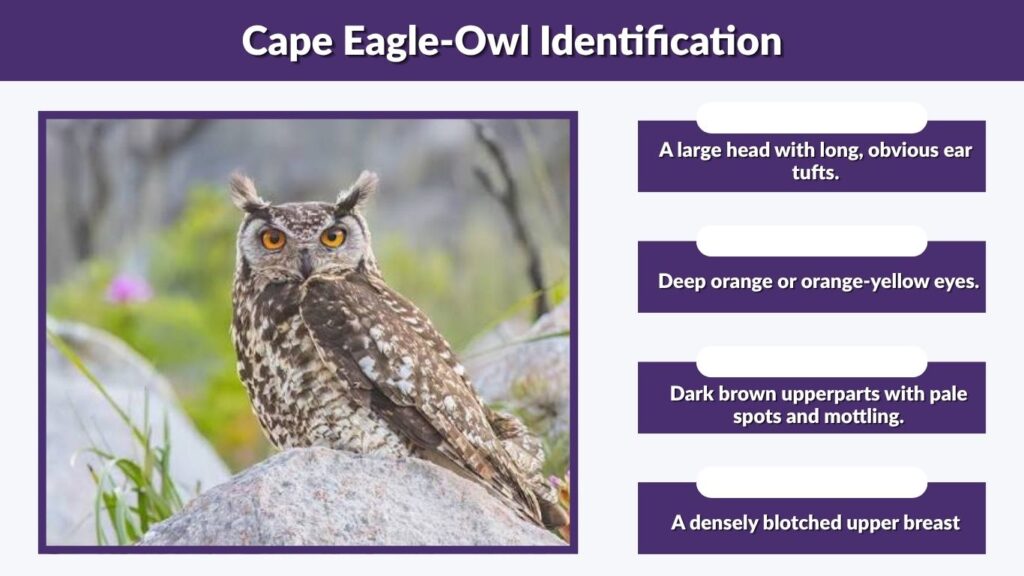
The Cape eagle-owl has a broad, powerful appearance and is generally darker and more heavily marked than the spotted eagle-owl. Its mottled plumage provides excellent camouflage against rocks, soil, and dry vegetation.
Key identification features include:
- A large head with long, obvious ear tufts
- Deep orange or orange-yellow eyes
- Dark brown upperparts with pale spots and mottling
- A densely blotched upper breast
- A paler belly with coarse dark bars
- A broad, barred tail
- Large feet with densely feathered legs and toes
- A dark, hooked bill and powerful talons
Males and females have similar plumage, although females are normally larger and heavier. Young Cape eagle-owls are paler, and their ear tufts may be shorter or less developed.
Cape Eagle-Owl Size and Wingspan
Cape eagle-owls measure approximately 46–58 cm from head to tail. Recorded weights range from around 900 grams to 1.8 kilograms, with females normally occupying the heavier end of the range. Their wingspan is approximately 120–125 cm.
This makes the species larger and more strongly built than the spotted eagle-owl, although it is not Africa’s largest owl. Its broad wings support quiet, controlled flight, while its heavy feet provide the strength needed to overpower mammals and birds.
Habitat and Distribution
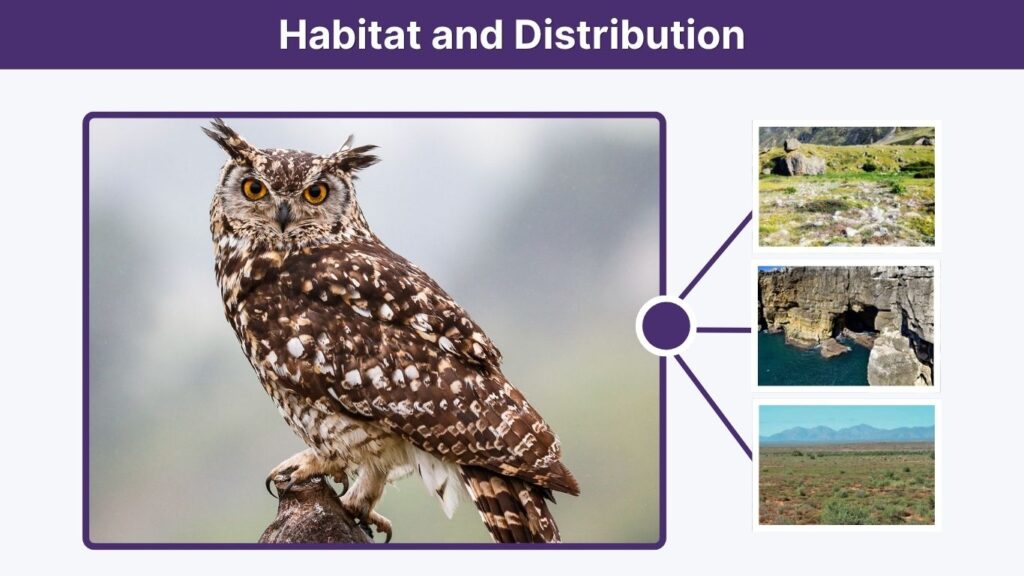
The Cape eagle-owl has a fragmented African distribution. Populations occur in South Africa, Lesotho, Namibia, Zimbabwe, and parts of Mozambique. Separate populations extend northward through portions of Tanzania, Kenya, Uganda, Ethiopia, and Eritrea.
Rocky terrain is the most consistent feature of its habitat. It favors:
- Mountain slopes and highland grasslands
- Cliffs, caves, and rocky ledges
- Rocky gorges and wooded gullies
- Karoo, fynbos, savanna, and semi-arid shrubland
- Quarries and buildings near natural rocky habitat
In southern Africa, the species occurs from near sea level to elevations above 3,000 metres. It may enter towns situated close to cliffs or rocky hills, using buildings as roosts and hunting urban pigeons.
An eagle-owl regularly observed in an ordinary Cape Town garden is more likely to be a spotted eagle-owl. Habitat and physical features must be examined before identifying it.
Behavior and Flying
Cape eagle-owls spend much of the day resting in caves, crevices, under rock ledges, beneath bushes, or occasionally inside dense trees. Their patterned feathers make them difficult to notice, even when they are sitting in a partially exposed location.
They become active around dusk and normally hunt throughout the night. A bird often watches from a prominent rock, post, or branch before gliding silently toward prey. Cape eagle-owls can also catch bats in flight as the bats leave their daytime roosts.
Pairs sometimes roost together, particularly before breeding. However, they are generally solitary and territorial birds.
Cape Eagle-Owl Sound and Call
The male’s typical song is a deep, powerful hoot followed by a shorter and softer note. It is sometimes represented as “boowh-hu.” The phrase may be repeated every few seconds from an exposed perch.
The female produces a similar but slightly higher-pitched call, and pairs occasionally duet. Other vocalizations include barking alarm calls and a drawn-out nasal call used by a female requesting food.
During courtship, the male may bow toward the female while calling. Its white throat becomes particularly noticeable as the feathers expand with each hoot.
Cape Eagle-Owl Diet and Food
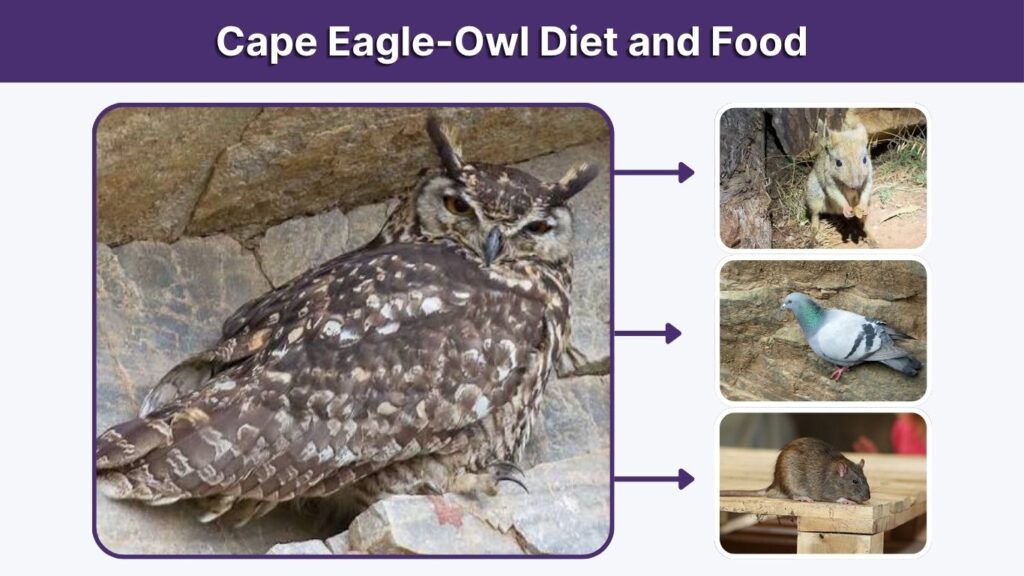
The Cape eagle-owl is an opportunistic carnivore. Medium-sized mammals and birds provide many of its meals, but its exact diet changes according to habitat and local prey availability.
Common prey includes:
- Rats, mice, shrews, and other rodents
- Hares, springhares, and young rock hyraxes
- Bats
- Pigeons, doves, francolins, starlings, and guineafowl
- Smaller owls and other birds of prey
- Lizards and frogs
- Crabs, scorpions, spiders, beetles, and grasshoppers
The owl normally hunts from a perch. It swoops onto an animal, grips it with its talons, and may kill larger prey with a bite to the head. Small animals can be swallowed whole, while larger prey is torn into manageable pieces with the bill.
Nest, Eggs, and Chicks
Cape eagle-owls do not usually construct elaborate nests. A pair commonly uses a shallow, unlined scrape on a protected rock ledge, at a cave entrance, between boulders, or on the ground beneath vegetation. Occasionally, they occupy a large stick nest previously built by another bird.
A typical clutch contains two white eggs, although one to three may be laid. The female performs most of the 34–38-day incubation while the male supplies food.
Chicks begin leaving the immediate nest area when they are approximately 45 days old. They may not fly confidently until around 70–77 days old, and the parents can continue feeding and protecting them for several months.
Cape Eagle-Owl vs Spotted Eagle-Owl

| Difference | Cape Eagle-Owl | Spotted Eagle-Owl |
| Size | Larger and heavier | Slightly smaller |
| Eyes | Usually deep orange | Usually yellow |
| Breast | Dark and heavily blotched | Greyer and more finely marked |
| Feet | Large and powerful | Comparatively smaller |
| Habitat | Cliffs, mountains, and rocky gorges | Savanna, woodland, suburbs, and gardens |
| Overall build | Broad and robust | Slimmer and less massive |
Eye colour is helpful but should not be used alone because unusual colour forms can occur. Habitat, breast markings, body structure, and foot size should be considered together.
Cape Eagle-Owl Lifespan
Detailed lifespan records for the species are limited. One compiled bird database reports a mean recorded age of approximately 6.9 years and a maximum age of about 27.6 years. This does not mean every Cape eagle-owl reaches that age; survival depends on food availability, habitat quality, injuries, and exposure to human-related hazards.
Threats and Conservation Status
The Cape eagle-owl is currently classified as Least Concern. However, it is uncommon or locally rare across much of its fragmented range and can easily be overlooked because of its nocturnal behavior and remote habitat.
Potential threats include:
- Nighttime road collisions
- Fires that alter feeding or nesting habitat
- Overgrazing
- Afforestation of open landscapes
- Loss or disturbance of rocky habitat
Protecting cliffs, gorges, highland grasslands, natural hunting areas, and established nesting locations can help maintain local populations.
FAQs
Is the Cape eagle-owl found in Cape Town?
It can occur around suitable rocky landscapes in the region, but many eagle-owls seen in Cape Town gardens and suburbs are spotted eagle-owls. Orange eyes, heavy breast blotching, powerful feet, and proximity to cliffs support Cape eagle-owl identification.
What does a Cape eagle-owl sound like?
Its best-known call is a deep two-part hoot, consisting of a powerful first note followed by a shorter, softer note. Males and females may duet, while alarmed birds can produce barking calls.
What does the Cape eagle-owl eat?
It eats rodents, hares, bats, birds, reptiles, frogs, scorpions, crabs, spiders, and large insects. Medium-sized mammals and birds usually provide its most substantial meals.
Does the Cape eagle-owl use a nest box?
It normally nests on rocky ledges, in caves, between boulders, or beneath bushes rather than using a standard owl box. Any artificial nesting structure would need to replicate a large, sheltered natural nesting site.
Is the Cape eagle-owl dangerous?
It normally avoids people and is not considered a routine danger. However, it possesses powerful talons and may defend a nest or chicks. Wild owls should always be observed from a respectful distance.