
The Indian eagle-owl is a powerful nocturnal bird recognized by its bright orange eyes, prominent ear tufts, heavily marked plumage, and deep, resonant call. Also known as the rock eagle-owl or Bengal eagle-owl, it inhabits rocky hills, scrublands, wooded ravines, and agricultural landscapes across the Indian subcontinent. Its ability to hunt rats and mice makes it especially valuable around farms.
What Is an Indian Eagle-Owl?
The Indian eagle-owl’s scientific name is Bubo bengalensis. It belongs to the family Strigidae, which contains the typical owls. Some older classifications treated it as a form of the Eurasian eagle-owl, but it is now generally recognized as a separate species.
BirdLife International uses the common name rock eagle-owl, while Indian eagle-owl and Bengal eagle-owl remain widely used alternative names. BirdLife currently categorizes the species as Least Concern.
Indian Eagle-Owl Identification
This is a large, strongly built owl with broad wings, powerful feet, and excellent camouflage. Its brown, buff, cream, and black markings help it blend into rocks, dry vegetation, and tree bark.
Key Identification Features
- Large, stocky body
- Long, dark ear tufts
- Bright orange-yellow or orange-red eyes
- Dark hooked bill
- Brown facial disc with a dark border
- White throat patch
- Mottled brown and black upperparts
- Pale underparts with dark streaks and fine bars
- Broad wings and a barred tail
- Heavily feathered legs and powerful talons
The “horns” on its head are feather tufts rather than actual ears. The owl can raise or flatten them depending on its alertness, mood, and surroundings.
There are no naturally occurring blue Indian eagle-owls. Birds described online as blue or unusually black may be affected by lighting, image editing, individual color variation, or incorrect identification.
Indian Eagle-Owl Size and Weight
Indian eagle-owls are among the larger owls of the Indian subcontinent, although they are generally smaller than Eurasian eagle-owls.
| Measurement | Approximate size |
| Body length | 50–56 cm |
| Body length in inches | 20–22 inches |
| Wing length | 35.8–43.3 cm |
| Tail length | 18.5–22.7 cm |
| Recorded male weight | About 1.1 kg |
| Female size | Usually larger than male |
Reliable published weight information is limited, but females are normally larger and heavier than males. Reports of extremely heavy individuals should be treated cautiously unless they come from documented measurements.
Where Do Indian Eagle-Owls Live?

The Indian eagle-owl occurs across much of the Indian subcontinent. It is strongly associated with dry, rocky terrain but can adapt to several landscapes when suitable roosting and nesting places are available.
Preferred Habitat
Common habitats include:
- Rocky hills and cliffs
- Dry scrubland
- Ravines and gorges
- Open woodland
- Thorn forest
- Agricultural fields
- Riverbanks with rocky slopes
- Quarries and abandoned excavations
- Large, densely foliaged trees near villages
During the day, the owl usually rests inside a rock crevice, beneath an overhang, in thick vegetation, or within a large tree. After sunset, it may perch on a boulder or exposed branch before gliding toward its hunting grounds.
Behavior and Flight
Indian eagle-owls are mainly nocturnal, becoming active around dusk. However, they may occasionally move during early morning or daylight, especially when disturbed or caring for young.
Their flight combines slow, deliberate wingbeats with extended periods of gliding. They frequently fly close to the ground while searching for prey. Like other owls, their specialized feathers reduce flight noise, helping them approach animals without being easily detected.
Indian eagle-owls usually live alone or in established pairs. Adults may become highly defensive around a nest. Some have been observed using distraction displays, including pretending to have an injured wing to draw danger away from their young.
What Do Indian Eagle-Owls Eat?
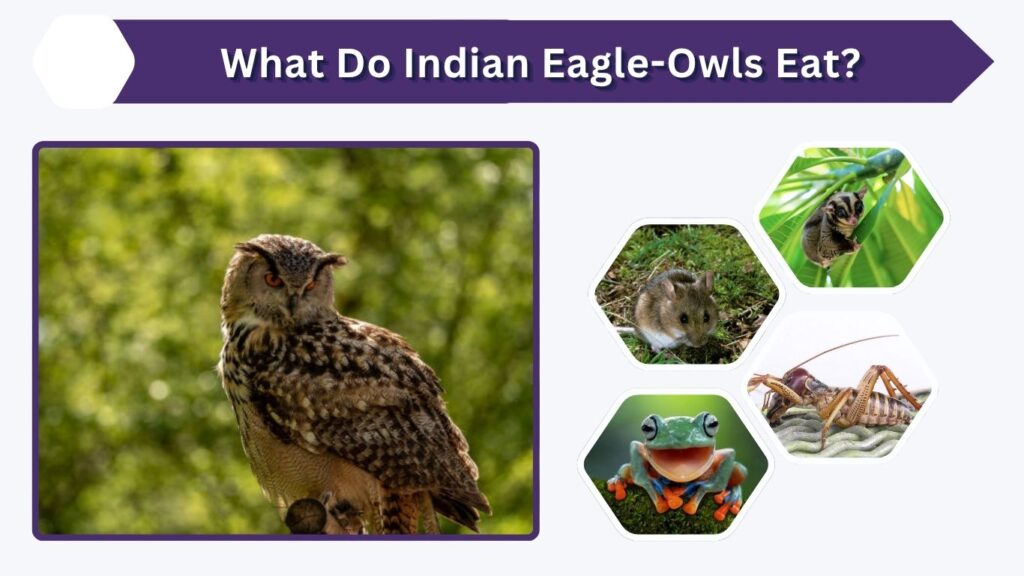
The Indian eagle-owl is an adaptable carnivore. It captures prey with its strong talons and usually swallows smaller animals whole. Larger prey may be carried to a secure perch and torn apart.
Its diet includes:
- Rats and mice
- Small mammals
- Birds
- Lizards and snakes
- Frogs
- Bats
- Large insects
- Spiders and scorpions
- Crabs
- Occasional fish
Research in agricultural habitats found that rodents formed a major part of its diet. Agricultural pests contributed 88% of the recorded prey biomass in one study, showing that the owl can provide valuable natural rodent control around farms.
How Does It Hunt?
The owl commonly watches from a rock, post, branch, or other elevated perch. When prey is detected, it glides downward and strikes with its feet. It may also make low hunting flights over open ground.
Its forward-facing eyes provide strong depth perception, while its sensitive hearing helps locate animals moving through darkness or vegetation.
Indian Eagle-Owl Call and Sound
The male produces a deep, penetrating double hoot often represented as “bu-whooh.” It repeats the call at intervals of several seconds. The female gives a similar call, but hers is generally slightly higher in pitch.
Pairs may call to communicate, strengthen their bond, or advertise their territory. Around the nest, adults may produce clucking sounds, repeated softer notes, growls, or hisses.
Calling is often most noticeable soon after sunset. A loud hoot near a rocky hillside does not necessarily mean the owl is close, because its voice can travel a considerable distance.
Nesting and Baby Indian Eagle-Owls
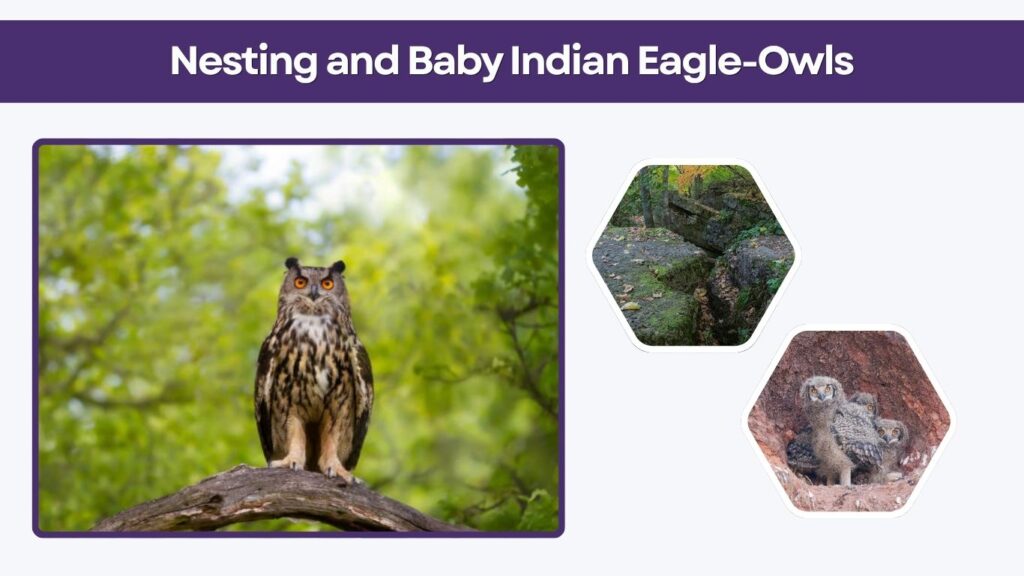
Indian eagle-owls do not usually build elaborate stick nests. Instead, they use a shallow scrape or protected depression in a naturally sheltered location.
Possible nesting sites include:
- Rock ledges
- Cliff crevices
- Spaces beneath boulders
- Ground beneath dense bushes
- Sheltered quarry walls
- Rocky slopes with overhangs
The pale, down-covered chicks are initially dependent on their parents for warmth and food. As they develop, they become darker and more heavily marked. Young owls may leave the immediate nest area before becoming strong fliers, but their parents continue protecting and feeding them.
People should not approach, touch, or move an apparently grounded chick unless it is clearly injured or in immediate danger. The parents are often nearby and may defend the nesting area.
Indian Eagle-Owl Lifespan
A dependable species-specific lifespan for wild Indian eagle-owls has not been firmly established. Survival depends on food availability, nesting success, habitat quality, disease, persecution, collisions, and other threats.
Claims that every Indian eagle-owl lives for a particular number of years are therefore misleading. Large owls can potentially be long-lived, particularly under protected conditions, but more documented records are needed to provide an accurate average for this species.
Conservation Status and Threats
The rock eagle-owl is currently listed as Least Concern by BirdLife International, indicating that it is not considered globally threatened at present. However, individual populations may still be harmed by habitat disturbance, quarrying near nests, road collisions, electrocution, poisoning, and deliberate persecution.
Superstitious beliefs also lead to the capture or killing of some owls. This is especially damaging because breeding pairs may depend on traditional nesting locations and produce relatively few young compared with many smaller birds.
Can You Keep an Indian Eagle-Owl as a Pet?
The Indian eagle-owl is not a suitable household pet. It is a strong wild predator that requires extensive space, specialized food, professional handling, and appropriate veterinary care.
In India, Bubo bengalensis is included in Schedule I of the Wild Life (Protection) Act. Its capture, possession, transfer, and commercial trade are therefore subject to strict legal protection and authorization. People should never purchase an owl offered through an unverified seller or wildlife market.
Indian Eagle-Owl vs. Spot-Bellied Eagle-Owl
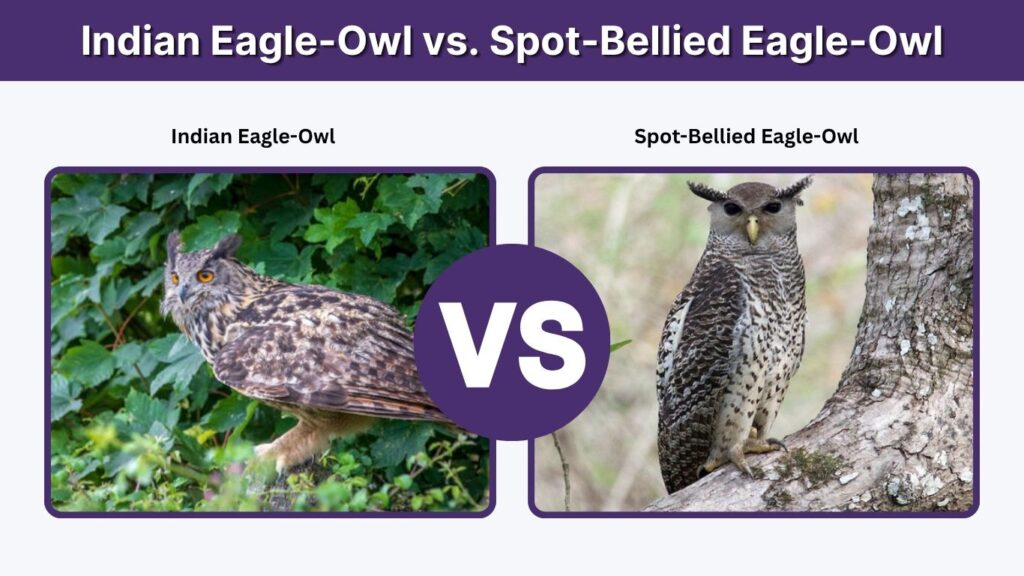
These are separate species, although both occur in India.
| Feature | Indian eagle-owl | Spot-bellied eagle-owl |
| Scientific name | Bubo bengalensis | Bubo nipalensis |
| Typical habitat | Rocky, dry and open areas | Dense forest and wooded hills |
| Appearance | Brown, buff and heavily streaked | Darker, with bold heart-shaped spots |
| Build | Large and compact | Generally larger and longer-looking |
| Common call | Deep double hoot | Deep, unusual booming calls |
Habitat is often a useful clue. An eagle-owl seen on an exposed rocky slope is more likely to be an Indian eagle-owl, while the spot-bellied eagle-owl is more strongly associated with forested landscapes.
FAQs
Is the Indian Eagle-Owl Rare?
It is not currently considered globally threatened and is categorized as Least Concern. However, it may appear uncommon because it is nocturnal, well camouflaged, widely dispersed, and often hidden in rocky or densely vegetated daytime roosts.
What Is the Indian Eagle-Owl Called in India?
Common English names include Indian eagle-owl, Bengal eagle-owl and rock eagle-owl. Local names differ among Hindi, Marathi and other regional languages, so there is no single vernacular name used throughout India.
Does the Indian Eagle-Owl Attack Humans?
It normally avoids people. However, adults may defend their chicks or nesting territory if someone approaches too closely. Observers should remain at a respectful distance and avoid standing near a nest, especially during the breeding season.
Are Female Indian Eagle-Owls Larger Than Males?
Yes. As in many birds of prey, females are generally larger than males. Both sexes have similar plumage, so size is helpful only when a bonded pair is seen together and cannot reliably determine the sex of a single bird.
Why Is the Indian Eagle-Owl Important?
It helps control rats, mice and other agricultural pests. By reducing rodent numbers naturally, the owl can benefit farmers and limit crop damage while also supporting the balance of local food webs.