
Spotted Owls and Barred Owls are similar-looking woodland birds with rounded heads, dark eyes, and no ear tufts. However, they differ in feather patterns, size, calls, habitat requirements, diet, and conservation status.
The comparison is especially important in the Pacific Northwest, where expanding Barred Owl populations compete with the smaller Northern Spotted Owl. Although the two species can occasionally interbreed, they remain separate owl species.
Spotted Owl vs Barred Owl at a Glance
| Feature | Spotted Owl | Barred Owl |
| Scientific name | Strix occidentalis | Strix varia |
| Body pattern | White spots over dark-brown plumage | Brown-and-white bars and streaks |
| Length | About 18.5–18.9 inches | About 16.9–19.7 inches |
| Weight | About 17.6–24.7 ounces | About 16.6–37 ounces |
| Wingspan | About 39.8 inches | About 39–43.3 inches |
| Main habitat | Mature western forests | Mature mixed forests, often near water |
| Main food | Woodrats, flying squirrels, and other mammals | Mammals, birds, fish, reptiles, amphibians, and invertebrates |
| Conservation | Several populations are threatened | Generally numerous and widespread |
Barred Owls overlap broadly with Spotted Owls in size but can be substantially heavier. Cornell describes the Spotted Owl as slightly smaller than the Barred Owl.
How to Identify a Spotted Owl
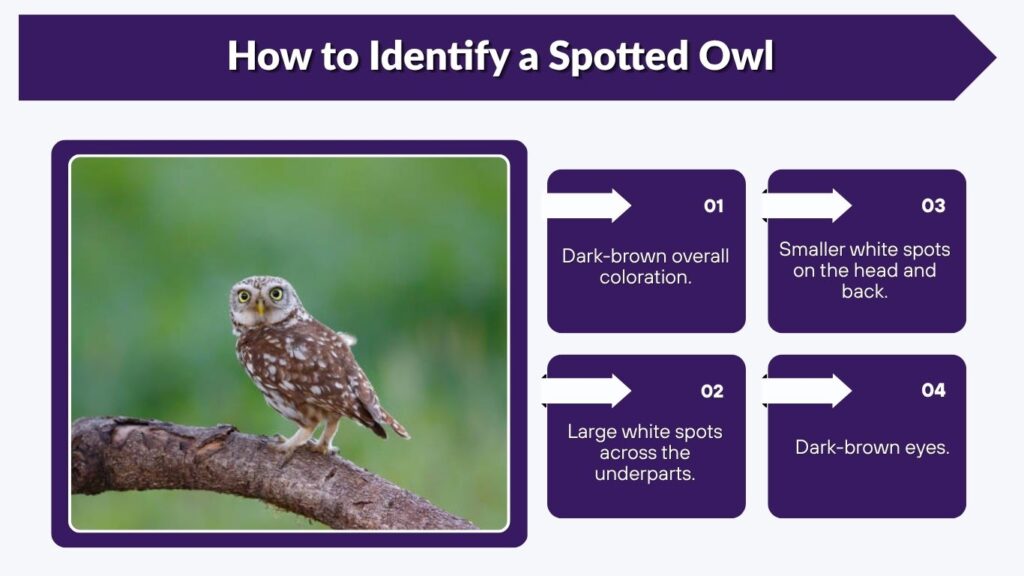
The Spotted Owl is dark brown with rounded or oval white spots covering its chest, belly, head, and back. Its facial disc is generally dark, with pale markings that may create an X-shaped pattern between the eyes.
Spotted Owl Identification Features
- Dark-brown overall coloration
- Large white spots across the underparts
- Smaller white spots on the head and back
- Dark-brown eyes
- Rounded head without ear tufts
- Short tail and broad, rounded wings
- Dark facial disc
- Relatively compact body
Three Spotted Owl subspecies are recognized. The Northern Spotted Owl is the darkest, the California Spotted Owl is somewhat lighter, and the Mexican Spotted Owl generally has larger white markings and paler coloration.
How to Identify a Barred Owl
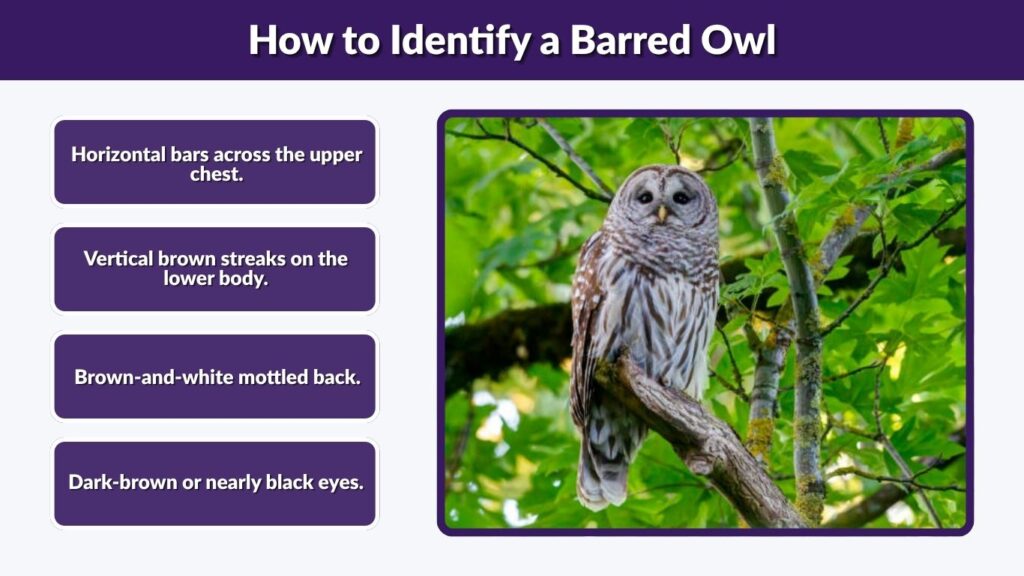
The Barred Owl has a mottled brown-and-white body. The upper chest displays horizontal brown bars, while the lower chest and belly have long vertical streaks.
Barred Owl Identification Features
- Horizontal bars across the upper chest
- Vertical brown streaks on the lower body
- Brown-and-white mottled back
- Dark-brown or nearly black eyes
- Yellow bill
- Rounded head without ear tufts
- Broad wings and rounded tail
- Large, stocky appearance
The combination of upper-chest bars and lower-body streaks is the easiest visual feature to recognize. By contrast, the Spotted Owl has rounded white spots rather than long vertical lines.
Spotted Owl vs Barred Owl Size
Both species are medium-to-large owls, and their measurements overlap considerably. The Barred Owl usually appears bulkier and may weigh much more than a Spotted Owl.
| Measurement | Spotted Owl | Barred Owl |
| Length | 18.5–18.9 inches | 16.9–19.7 inches |
| Weight | 17.6–24.7 ounces | 16.6–37 ounces |
| Wingspan | About 39.8 inches | 39–43.3 inches |
A small Barred Owl may not be noticeably larger than a Spotted Owl. Therefore, size should be combined with plumage, call, location, and body shape when identifying either species.
Spotted Owl vs Barred Owl Call
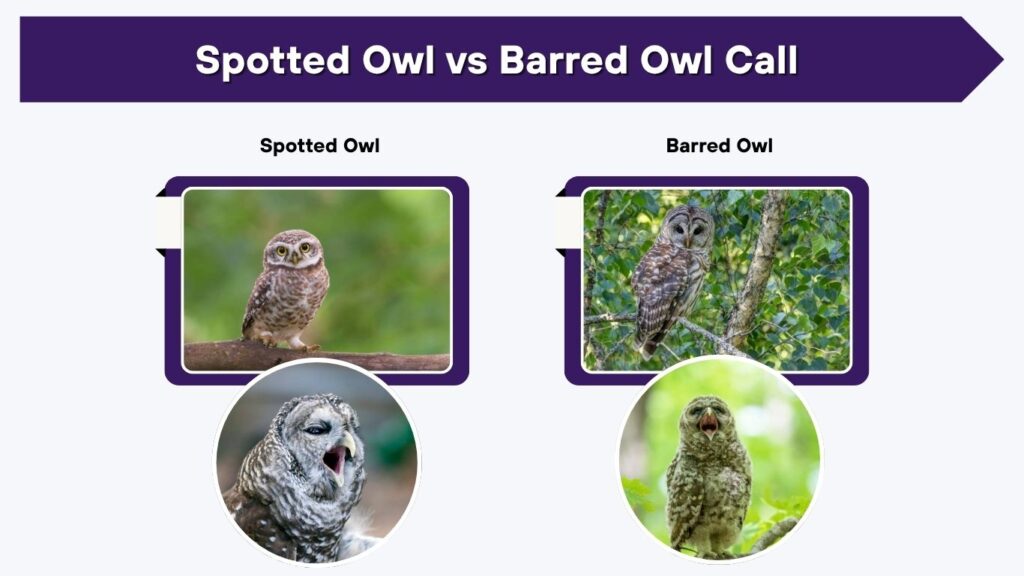
The two species produce different vocalizations, and sound can be especially useful because both are most active at night.
Barred Owl Call
The Barred Owl’s best-known call contains eight or nine notes and is often remembered as:
“Who cooks for you? Who cooks for you-all?”
Barred Owls also produce cackles, hoots, caws, screams, and gurgling sounds, particularly during energetic pair duets.
Spotted Owl Call
Spotted Owls produce deep hoots, whistles, barks, and other calls. Their territorial hooting generally sounds shorter and less rhythmically elaborate than the familiar Barred Owl phrase.
Because hybrids and individual birds can produce unusual sounds, recordings should ideally be combined with a visual observation when accurate identification is important.
Habitat and Range Differences
Spotted Owls are native to western North America. Their range extends from the Pacific Northwest through California and parts of the southwestern United States into Mexico.
Northern Spotted Owls depend heavily on extensive mature coniferous forests with large trees, complex canopies, snags, cavities, and woody debris. California and Mexican populations use somewhat different forests, including oak woodlands, pine-oak forests, mixed conifers, and forested canyons.
Barred Owls are native to eastern North America but expanded northward and westward during the twentieth century. They now occupy forests across much of Canada and the United States, including the Pacific Northwest and northern California.
Barred Owls are more flexible. They use mixed deciduous and evergreen forests, wooded swamps, stream edges, upland woods, younger forests, and some developed landscapes, provided suitable trees and prey are available.
Diet and Hunting Differences
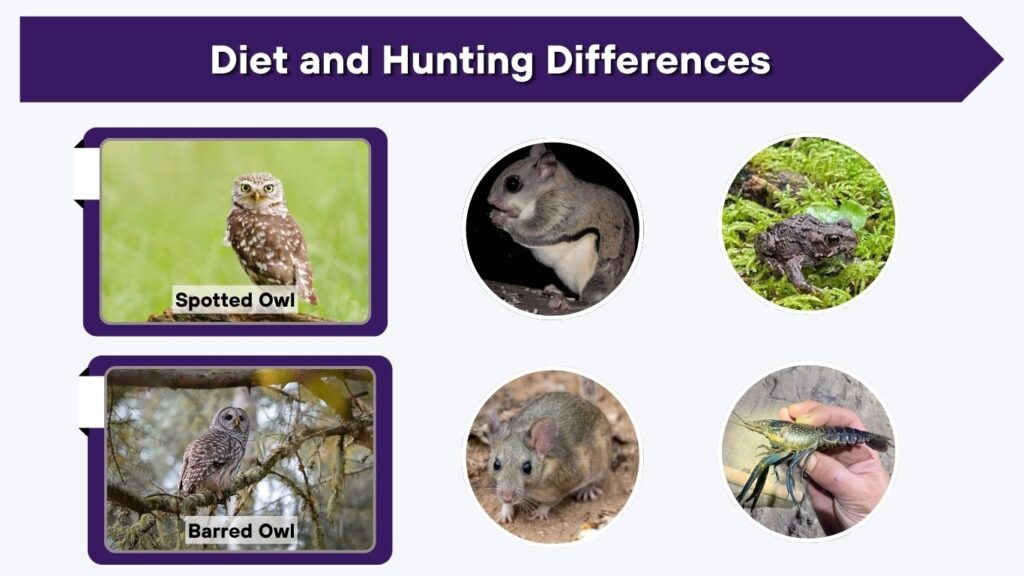
Both owls hunt mainly from perches, listening and watching before dropping silently onto prey.
Spotted Owl Diet
Spotted Owls specialize largely in small and medium-sized mammals, including:
- Flying squirrels
- Dusky-footed woodrats
- Other woodrats
- Mice and voles
- Rabbits
- Pocket gophers
- Bats
Their close association with woodrats and flying squirrels contributes to their dependence on particular forest conditions.
Barred Owl Diet
Barred Owls eat a much wider selection of prey:
- Mice, voles, and rats
- Squirrels and rabbits
- Birds and smaller owls
- Frogs and salamanders
- Snakes and other reptiles
- Fish and crayfish
- Insects, worms, slugs, and snails
This broad diet allows Barred Owls to survive in more habitat types and exploit more food sources than Spotted Owls.
Why Are Barred Owls a Threat to Spotted Owls?
Barred Owls are larger, more adaptable, and capable of living at higher densities. When they move into Spotted Owl territory, they compete for nesting sites, prey, roosting areas, and forest territory.
Their presence can cause Spotted Owls to leave otherwise suitable habitat. Barred Owls can also disrupt nesting and have occasionally killed Spotted Owls, although direct predation is less important than long-term competition and displacement.
Habitat loss remains another major cause of Spotted Owl declines. Managing Barred Owls does not eliminate the need to protect mature and old-growth forest habitat.
Do Barred Owls Kill or Eat Spotted Owls?
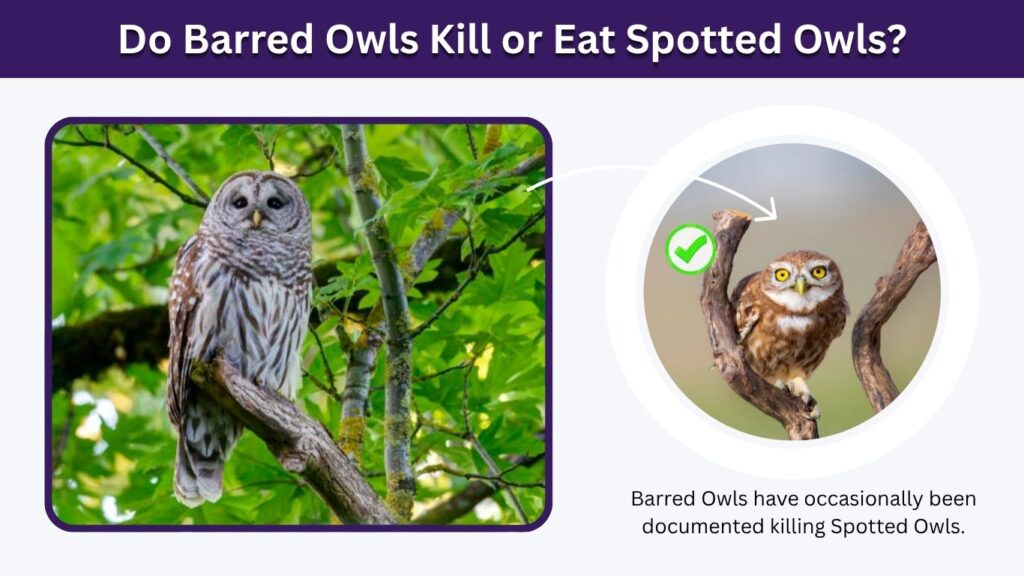
Barred Owls have occasionally been documented killing Spotted Owls. As opportunistic predators, they are physically capable of attacking smaller owls.
However, the larger population-level problem is competition. Barred Owls occupy territories, consume shared prey, and exclude Spotted Owls from areas where they previously lived and reproduced.
Can Barred and Spotted Owls Breed?
Yes. Barred Owls and Spotted Owls can occasionally interbreed where their ranges overlap.
Hybrid owls may display a mixture of spots, streaks, bars, facial patterns, and calls from both parent species. Because visual identification can be difficult, researchers may need detailed measurements, recordings, expert examination, or genetic testing to confirm a hybrid.
Interbreeding is considered an additional conservation concern, but it occurs much less frequently than direct competition and displacement.
Why Are Barred Owls Being Removed?
The U.S. Fish and Wildlife Service adopted a Barred Owl Management Strategy in 2024. It permits trained and authorized professionals to remove Barred Owls from selected areas in Washington, Oregon, and California to protect Northern and California Spotted Owls.
Removal experiments found that Spotted Owl populations stabilized in treatment areas while continuing to decline in comparable areas where Barred Owls remained.
The strategy does not create a public owl-hunting season. Only approved professionals working under permits and specific rules may conduct removals. Participation by eligible land managers is voluntary, and implementation is expected to increase gradually rather than begin everywhere at once.
The policy remains controversial. Supporters argue that intervention is necessary to prevent Spotted Owl extinction, while opponents object to killing one protected native North American bird to assist another. A 2025 Senate effort to overturn the strategy failed to advance.
FAQs
Are Spotted Owls and Barred Owls the Same Species?
No. The Spotted Owl is Strix occidentalis, while the Barred Owl is Strix varia. They are closely related and can occasionally hybridize, but they have different plumage, calls, ranges, diets, and ecological requirements.
Which Owl Is Bigger?
Barred Owls are generally stockier and heavier. Their size ranges overlap, but a large Barred Owl may weigh substantially more than a Spotted Owl and usually appears broader through the chest and body.
What Is the Easiest Way to Tell Them Apart?
Look at the belly. A Spotted Owl has rounded white spots over dark-brown feathers. A Barred Owl has horizontal bars on the upper chest and long vertical streaks across the lower chest and belly.
Are Barred Owls Invasive?
They are native to eastern North America. However, wildlife agencies describe them as non-native and invasive within the western ranges of Northern and California Spotted Owls, which they entered after expanding across the continent.
Which Owl Is Rarer?
The Spotted Owl is far rarer. Cornell estimates approximately 15,000 Spotted Owls globally, while Barred Owls number in the millions and are considered a species of relatively low conservation concern.