The Golden Masked Owl (Tyto aurantia) is a rare, poorly studied owl found only on New Britain, an island belonging to Papua New Guinea. It has rich golden-buff plumage, dark eyes, bold spotting, and a heart-shaped facial disc bordered in dark brown. Also known as the Bismarck Masked-owl or New Britain Masked-owl, this secretive nocturnal bird inhabits tropical forests from the lowlands into the hills. Much of its diet, breeding behavior, population, and lifespan remains uncertain because confirmed observations are uncommon.
Golden Masked Owl Quick Facts
The Golden Masked Owl belongs to the barn-owl family rather than the typical-owl family. Current taxonomic sources recognize it as a valid species within the genus Tyto.
| Feature | Description |
| Scientific name | Tyto aurantia |
| Other names | Bismarck Masked-owl, New Britain Masked-owl |
| Class | Aves |
| Order | Strigiformes |
| Family | Tytonidae |
| Genus | Tyto |
| Length | Approximately 27–33 cm |
| Weight | Not reliably documented |
| Range | New Britain, Papua New Guinea |
| Habitat | Lowland, hill and montane tropical forest |
| Diet | Small rodents; other prey remains poorly documented |
| Activity | Nocturnal |
| Conservation status | Vulnerable |
Published species accounts generally place its length at approximately 27–33 centimeters. Reliable body-mass and wingspan measurements remain limited, which reflects how little field research has been completed on this owl.
What Does a Golden Masked Owl Look Like?
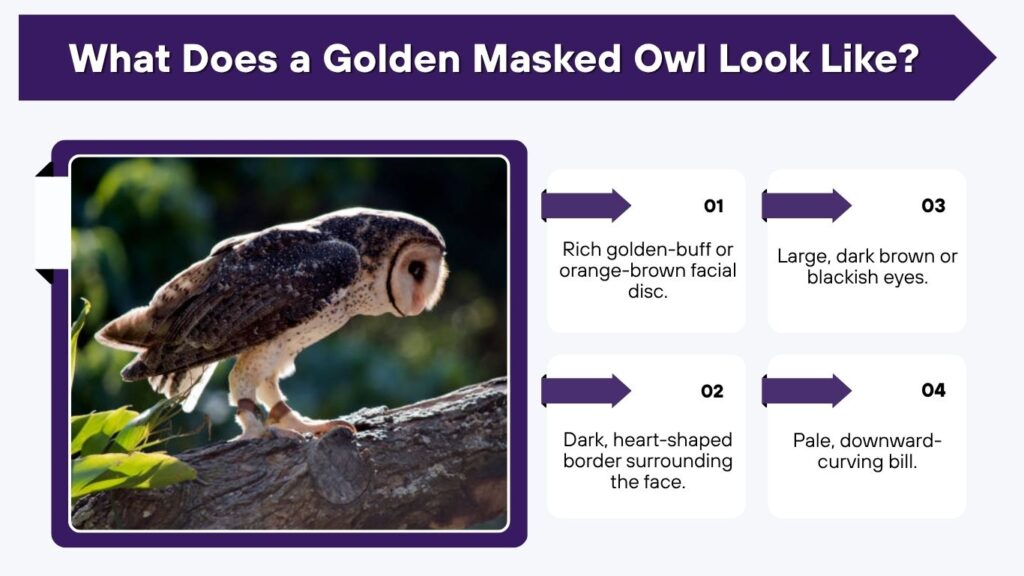
The Golden Masked Owl has the rounded head and heart-shaped face typical of barn owls, but its plumage is noticeably darker and more golden than that of the familiar Barn Owl.
Identification
- Rich golden-buff or orange-brown facial disc
- Dark, heart-shaped border surrounding the face
- Large, dark brown or blackish eyes
- Pale, downward-curving bill
- Golden-buff underparts covered with bold dark spots
- Dark brown upperparts with black blotches
- Buff patches and small white spots across the wings and back
- Long legs with powerful feet and curved talons
- No visible ear tufts
The combination of a dark-bordered face, golden underparts, and heavy spotting distinguishes it from the paler Eastern Barn Owl, which also occurs in the broader region.
Color and Camouflage
Its golden, brown, black, and cream-colored feathers blend naturally with bark, dead leaves, shadows, and filtered light inside tropical forests. This camouflage probably helps the owl remain concealed while resting during daylight and waiting for prey after dark.
The exact appearance can change with lighting. Photographs taken with a flash may make the owl appear bright yellow or orange, while individuals seen under natural forest light may look much darker and browner.
Golden Masked Owl Classification
The species was scientifically described in 1881 and was originally named Strix aurantia. It is now placed within the genus Tyto, alongside barn owls, grass owls, and other masked owls.
| Taxonomic rank | Classification |
| Kingdom | Animalia |
| Phylum | Chordata |
| Class | Aves |
| Order | Strigiformes |
| Family | Tytonidae |
| Subfamily | Tytoninae |
| Genus | Tyto |
| Species | Tyto aurantia |
Current classifications do not recognize separate subspecies, so the Golden Masked Owl is treated as a monotypic species.
Where Does the Golden Masked Owl Live?
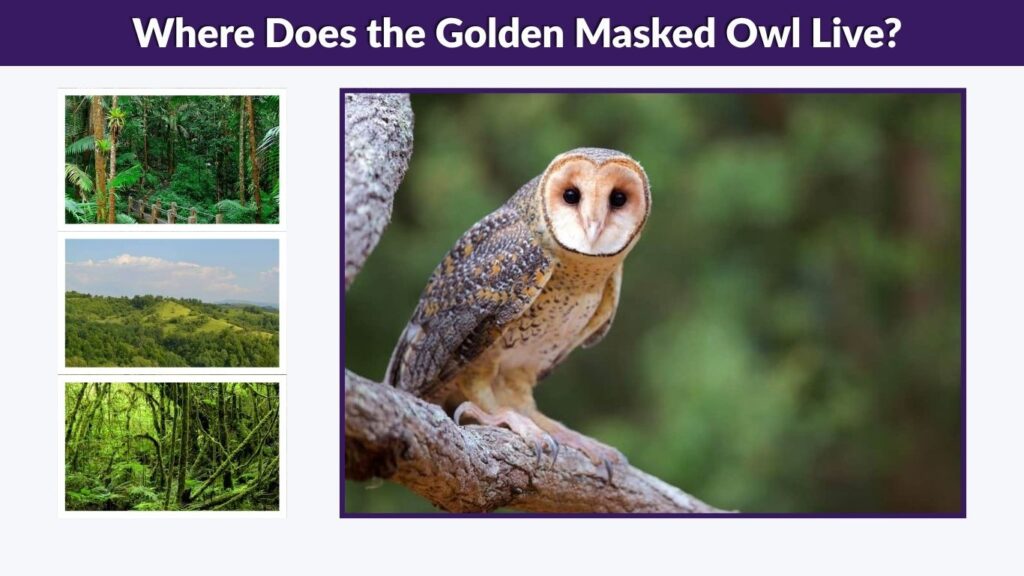
The Golden Masked Owl is endemic to New Britain in the Bismarck Archipelago of Papua New Guinea. “Endemic” means that it occurs naturally nowhere else in the world.
Forest Habitat
Its known habitats include:
- Tropical lowland rainforest
- Hill forest
- Moist montane forest
- Forest clearings
- Wooded ravines
- Forest edges
- Some plantations near remaining forest
Records extend from the lowlands to elevations of approximately 1,830 meters. However, its preferred elevation and dependence on old-growth forest remain uncertain because the bird is encountered so rarely.
Can It Live in Plantations?
Golden Masked Owls have been recorded in and around oil-palm plantations near Walindi. Researchers have suggested that the birds may forage in plantations, but it is not yet clear whether they can survive there without nearby natural forest.
Plantations do not necessarily provide suitable nesting trees, daytime roosts, or stable prey populations. Therefore, occasional plantation sightings should not be interpreted as proof that converted land can replace native forest.
What Does a Golden Masked Owl Eat?
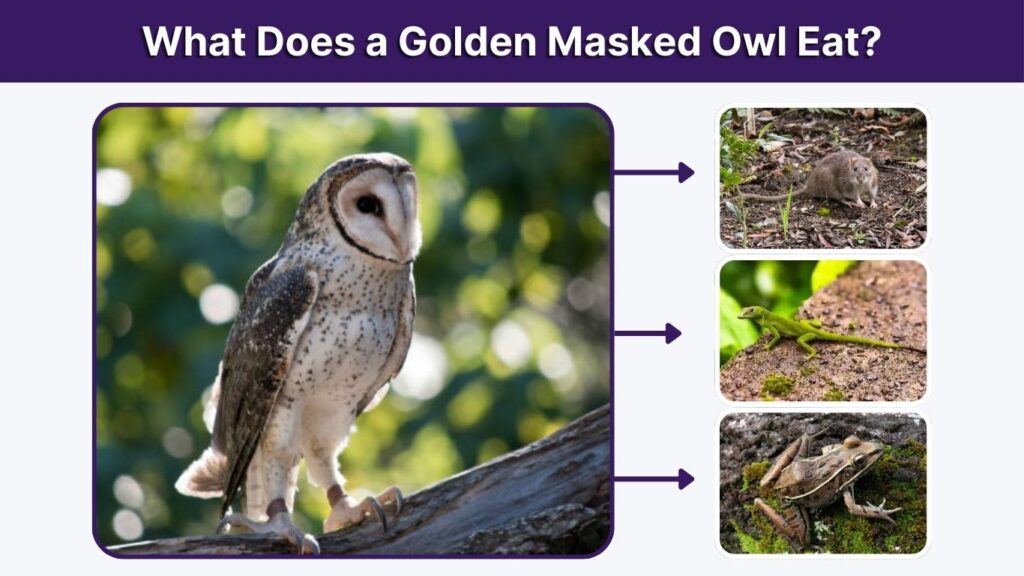
The species’ diet has not been studied extensively. Small rodents are the principal prey reported in available accounts. It may also capture insects and other small vertebrates, but these additional foods are based largely on limited reports and comparisons with related Tyto owls.
Possible prey may include:
- Rats and mice
- Other small mammals
- Large insects
- Small reptiles
- Frogs
- Small birds
Because few pellets, prey remains, or hunting events have been formally examined, a detailed food list cannot yet be presented with confidence.
How Does It Hunt?
As a member of the barn-owl family, the Golden Masked Owl is expected to hunt mainly at night using sensitive hearing, low-light vision, silent flight, and strong talons. Its facial disc likely helps direct sound toward the ears, while specialized wing feathers reduce noise during flight. These are well-established owl adaptations, although detailed hunting studies have not been conducted specifically on Tyto aurantia.
It probably searches from a perch or flies quietly through forest openings before dropping onto prey on or near the ground.
Behavior and Sounds
The Golden Masked Owl is nocturnal and extremely difficult to observe. It likely remains concealed in dense vegetation, tree cavities, or other protected forest locations during daylight.
Its vocalizations are still not firmly confirmed. Reported sounds include a long rising whistle, wheezing or screeching notes, and a rapidly repeated ascending “ka-ka” call. More recordings are needed before researchers can establish its complete vocal repertoire.
The lack of confirmed calls makes surveys difficult. Researchers cannot reliably locate the species by playing known recordings in the way they can with better-studied owls.
Breeding and Nesting
The Golden Masked Owl’s breeding biology remains largely unknown. Researchers have not established its normal nesting season, clutch size, incubation period, fledging age, or parental behavior.
It may nest in large tree cavities like related barn and masked owls, but this should be treated as a reasonable possibility rather than a confirmed species-specific fact. Protecting mature forest trees remains important because large cavities take many years to develop and are used by numerous forest animals.
How Long Does a Golden Masked Owl Live?
No reliable species-specific lifespan has been established for wild Golden Masked Owls. Claims that they live for a precise number of years are usually extrapolated from other owls or produced from generalized lifespan databases.
Until banding records or long-term field studies become available, its average and maximum lifespan should be considered unknown.
Conservation Status and Threats
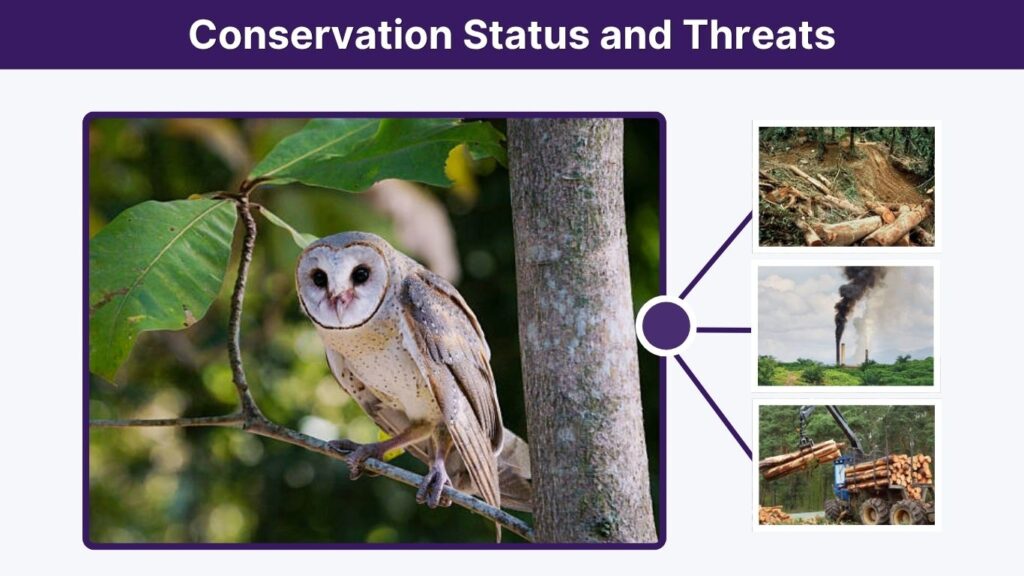
The Golden Masked Owl is currently classified as Vulnerable. A published assessment used an estimated population of approximately 2,500–10,000 mature individuals, but researchers emphasized that the species is very rarely recorded and needs further investigation.
Its main potential threats include:
- Clearing lowland forest for oil-palm plantations
- Commercial logging
- Loss of mature nesting trees
- Fragmentation of remaining forest
- Disturbance around roosting or nesting sites
- Limited information about its population and ecology
More than 20% of New Britain’s forest below 100 meters was lost between 1989 and 2000, largely through conversion to oil palm. Although forest loss later slowed, lowland habitats remain under pressure.
FAQs
Is the Golden Masked Owl a real species?
Yes. The Golden Masked Owl is a valid species with the scientific name Tyto aurantia. It is also called the Bismarck Masked-owl and New Britain Masked-owl.
Where can Golden Masked Owls be found?
They occur naturally only on New Britain in Papua New Guinea. They inhabit tropical lowland, hill, and montane forests and have occasionally been recorded around plantations.
What family does the Golden Masked Owl belong to?
It belongs to Tytonidae, the barn-owl family. It is placed in the genus Tyto with other barn and masked owls.
What does a Golden Masked Owl eat?
Small rodents are the best-documented food. It may also capture insects and other small vertebrates, but its complete diet remains poorly known.
Why is the Golden Masked Owl vulnerable?
Its entire range is limited to one island, and parts of New Britain’s forest have been cleared or degraded. Its small estimated population, restricted distribution, and limited ecological information increase its conservation risk.