Fish owls are large water-loving owls that hunt near rivers, lakes, swamps, wetlands, and forest streams. Unlike many owls that mainly catch rodents, fish owls are adapted to catching aquatic prey such as fish, frogs, crabs, crayfish, and other animals found near water. The name “fish owl” is often used for Asian Ketupa species, while “fishing owl” is commonly used for African Scotopelia species, but many readers use both names together.
What Are Fish Owls?
Fish owls are members of the true owl family, Strigidae. They are usually large, brownish, powerful owls with strong talons, heavy bodies, and a close connection to water. Blakiston’s fish owl is especially famous because it is often described as the largest living owl species and is native to northeast Asia, including Japan, China, and the Russian Far East.
These owls are different from typical forest owls because their survival depends heavily on healthy waterways. They need rivers, lakes, wetlands, or forested streams where aquatic prey is available.
Types of Fish Owls
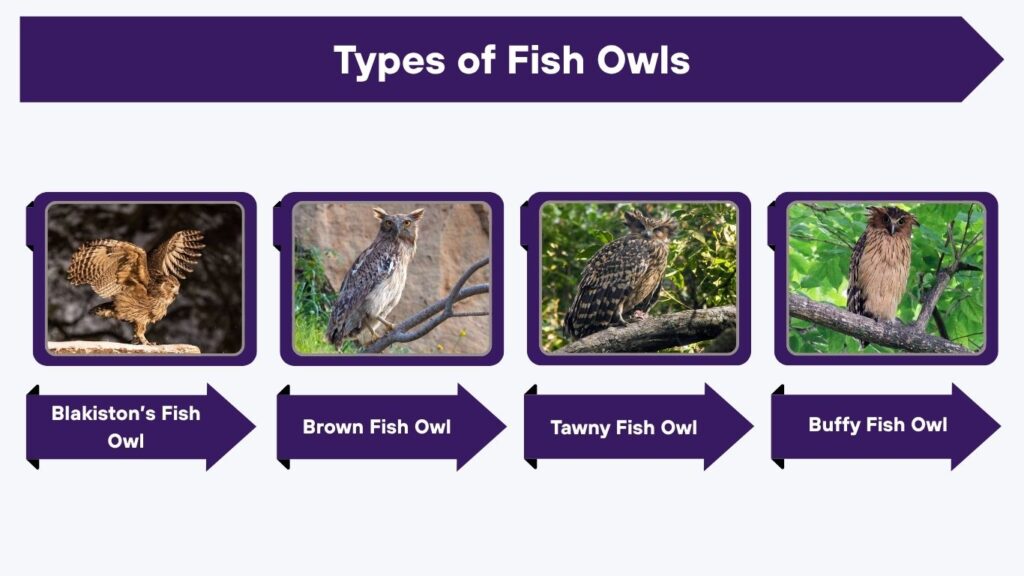
The term “fish owl” can be used narrowly for Asian fish owls or broadly to include African fishing owls. The main types include Asian Ketupa fish owls and African Scotopelia fishing owls.
| Common Name | Scientific Name | Main Region |
| Blakiston’s Fish Owl | Ketupa blakistoni | Japan, China, Russian Far East |
| Brown Fish Owl | Ketupa zeylonensis | Middle East to South and Southeast Asia |
| Tawny Fish Owl | Ketupa flavipes | Himalayas to parts of Southeast Asia |
| Buffy Fish Owl | Ketupa ketupu | Southeast Asia |
| Pel’s Fishing Owl | Scotopelia peli | Sub-Saharan Africa |
| Vermiculated Fishing Owl | Scotopelia bouvieri | Central and West Africa |
| Rufous Fishing Owl | Scotopelia ussheri | West Africa |
Blakiston’s Fish Owl
Blakiston’s fish owl is one of the most impressive fish owls. It lives in riparian forests with large old trees near rivers, lakes, springs, and winter-open water. Large tree cavities are important because this owl needs old-growth trees for nesting.
Brown Fish Owl
The brown fish owl has a wide range from the Middle East to eastern Asia. It lives near water in habitats such as forests, rocky shores, arid areas, and tropical regions, but the presence of water is essential.
Buffy Fish Owl
The buffy fish owl is a Southeast Asian fish owl often found around waterways, coastal areas, mangroves, and even urban canals with large fish. It has yellow eyes, ear tufts, buff-colored underparts, and mostly unfeathered legs.
Pel’s Fishing Owl
Pel’s fishing owl is a large African fishing owl found near rivers and lakes. It hunts mostly at night and catches fish and frogs from the surface of water. It prefers slow-moving rivers with large overhanging trees for roosting and hunting.
Fish Owl Habitat
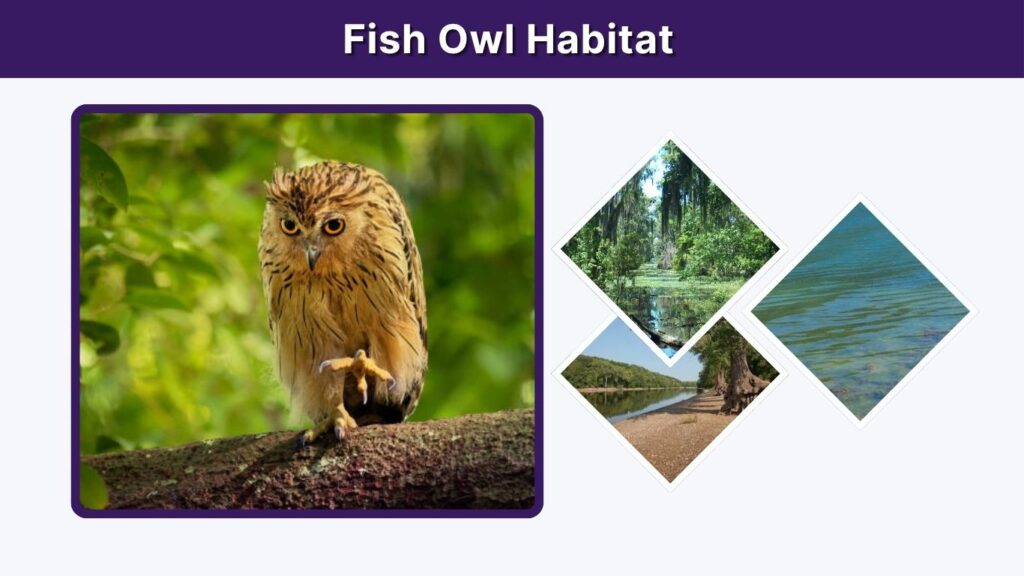
Fish owls are strongly tied to water. Their best habitats include forested riverbanks, lakesides, wooded wetlands, mangroves, swamps, slow-moving rivers, and streams with fish or crustaceans. They often need large trees for daytime roosting and nesting.
Main Habitat Features
- Rivers, lakes, swamps, or streams
- Large trees near water
- Quiet hunting areas
- Shallow water or open water edges
- Good fish, frog, or crab populations
- Low human disturbance
Blakiston’s fish owl is especially dependent on old forest near productive rivers that stay at least partly unfrozen in winter. This makes it vulnerable when old trees are removed or rivers are changed by development.
Fish Owl Diet
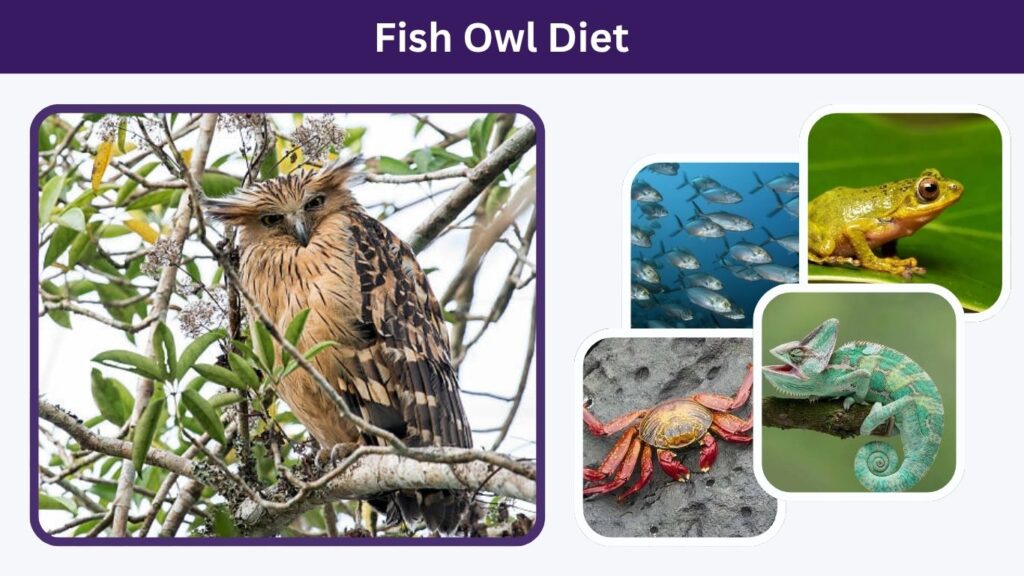
Fish owls are carnivores, and many are piscivores, meaning fish form an important part of their diet. However, they do not eat only fish. Brown fish owls feed on animals found in or near water, including fish, frogs, crabs, crayfish, reptiles, birds, mammals, and sometimes carrion.
| Food Type | Examples |
| Fish | Freshwater fish, small river fish |
| Amphibians | Frogs and toads |
| Crustaceans | Crabs, crayfish |
| Reptiles | Snakes and lizards |
| Birds | Waterbirds or small birds |
| Mammals | Rats and small mammals |
| Carrion | Occasionally scavenged food |
How Fish Owls Hunt
Fish owls usually perch near water and watch for movement. When prey appears, they may swoop down, skim the surface, or wade into shallow water. Brown fish owls have been recorded hunting from rocks or trees and also wading into water to catch prey.
Adaptations of Fish Owls
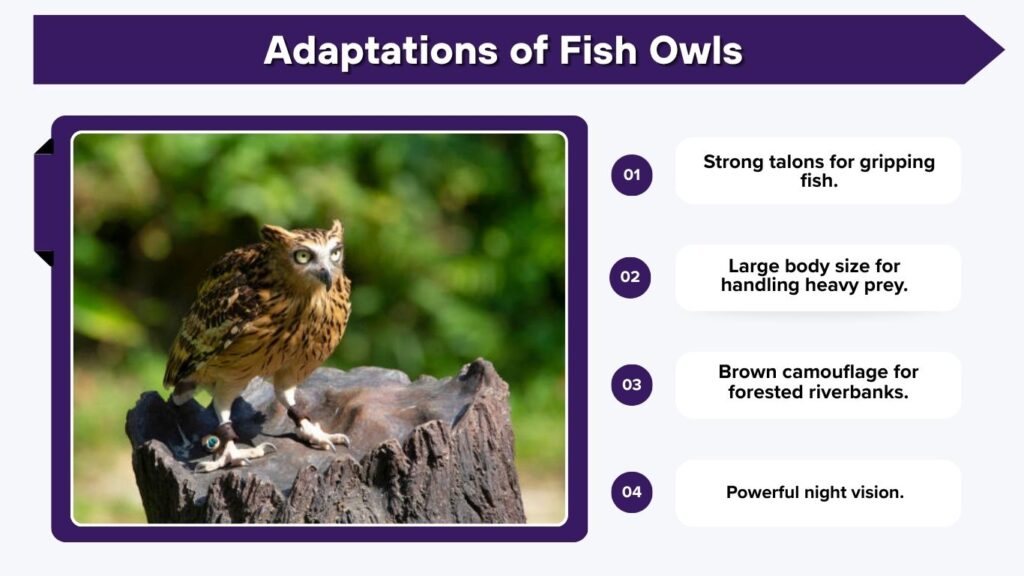
Fish owls have several features that help them hunt near water. Many have powerful feet, sharp talons, and less feathering on the lower legs than many other owls. Reduced leg feathering helps when they enter water or grab slippery prey.
Important Adaptations
- Strong talons for gripping fish
- Large body size for handling heavy prey
- Brown camouflage for forested riverbanks
- Powerful night vision
- Perching behavior near water
- Rough or specialized foot surfaces in some species
Pel’s fishing owl is noted for having unfeathered feet, an adaptation linked with catching fish and avoiding heavy waterlogged feathers around the feet.
Behavior and Breeding
Fish owls are usually nocturnal or mostly active at night, although some may be seen in cloudy daylight or quiet areas. Brown fish owls communicate with low calls and duets, and adults may use a “huu whoo huu” type song.
Most fish owls nest near water. They may use tree cavities, large tree forks, old nests, or rock crevices depending on the species and habitat. Brown fish owls commonly lay 1–2 eggs, and breeding often happens in the dry season when prey is easier to catch in lower water.
Conservation Status
Conservation status varies by species. Brown fish owl and buffy fish owl are generally listed as Least Concern because of their large ranges, while Blakiston’s fish owl has a much smaller global population. BirdLife notes that Blakiston’s fish owl has an estimated 900–1,700 mature individuals.
Major threats include river development, dam construction, deforestation, loss of old nesting trees, pollution, disturbance near waterways, and conflict with fish farms. Protecting fish owls means protecting river forests, wetlands, and clean freshwater systems.
Interesting Fish Owl Facts
- Blakiston’s fish owl is among the largest owls in the world.
- Fish owls often have a weaker facial disc than many rodent-hunting owls.
- They are usually found close to water, even in forest habitats.
- Some species catch crabs and frogs as often as fish.
- Fish owls are important signs of healthy river and wetland ecosystems.
- Many fish owls need large old trees for nesting and roosting.
FAQs
Are fish owls real owls?
Yes, fish owls are real owls in the true owl family, Strigidae. They are called fish owls because they often hunt near water and catch fish, frogs, crabs, crayfish, and other aquatic prey.
How many types of fish owls are there?
There are four main Asian fish owls in the genus Ketupa: Blakiston’s, brown, tawny, and buffy fish owl. If African fishing owls are included, Pel’s, vermiculated, and rufous fishing owls are also part of the broader fish owl group.
What do fish owls eat?
Fish owls mainly eat fish and other animals found near water. Their diet can include frogs, crabs, crayfish, reptiles, birds, small mammals, and sometimes carrion. Diet changes depending on species, season, and habitat.
Where do fish owls live?
Fish owls live near rivers, lakes, swamps, wetlands, mangroves, and forest streams. Asian species are found across parts of Asia, while African fishing owls live in sub-Saharan Africa near rivers and lakes.
Are fish owls endangered?
Some fish owls are not globally endangered, but Blakiston’s fish owl is a major conservation concern because it has a small population and depends on old-growth river forests. Habitat loss, river disturbance, and loss of nesting trees are serious threats.