
Scops owls are small, secretive owls known for their short ear tufts, bark-like camouflage, and soft nighttime calls. These owls belong mainly to the genus Otus and are found across Europe, Asia, Africa, and many island habitats. Some species, such as the Eurasian Scops Owl and Oriental Scops Owl, have wide ranges, while others, like the Serendib Scops Owl and Seychelles Scops Owl, are rare and highly restricted. This guide covers 18 types of scops owls, including their identification features, habitats, behavior, diet, breeding habits, and conservation status for easy comparison and learning.
1. Eurasian Scops Owl
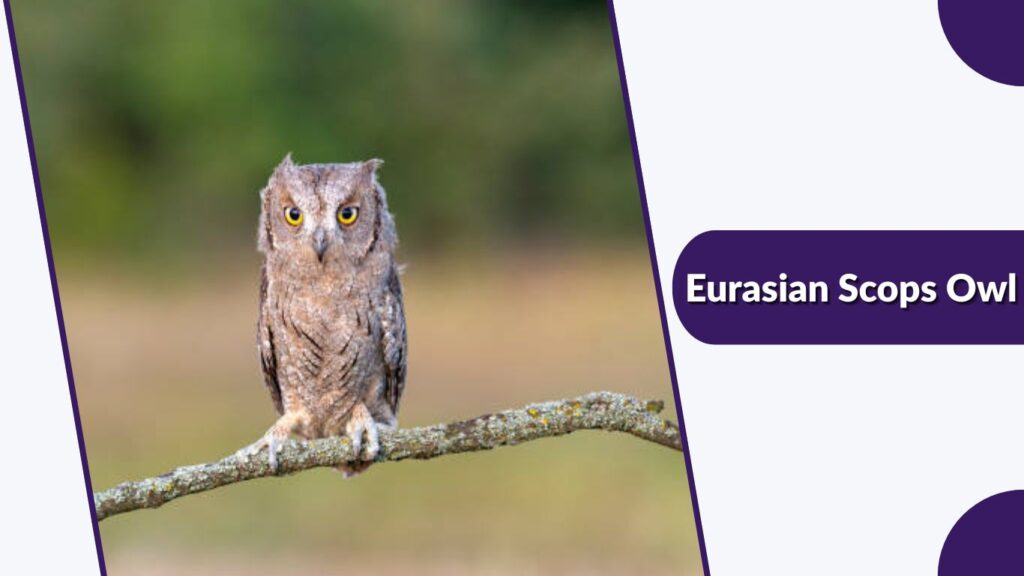
The Eurasian Scops Owl is a small, secretive owl found across parts of Europe, Asia, and Africa during migration and winter. It is also called the European Scops Owl or Common Scops Owl. This owl is known for its tiny ear tufts, yellow eyes, bark-like camouflage, and soft repeated call. It is mostly active at night and often hides quietly in trees during the day.
Identification
- Small owl with a slim body
- Yellow eyes with a sharp expression
- Small erectile ear tufts
- Grey-brown or rufous-brown plumage
- Dark streaks and mottling like tree bark
- Relatively long wings and short tail
- Well-camouflaged when roosting on branches
- Soft, repeated whistling call at night
Habitat and Distribution
The Eurasian Scops Owl breeds from southern Europe eastward into parts of Asia, reaching southern Siberia and the western Himalayas. Many populations are migratory and spend winter in Africa south of the Sahara, while some birds remain year-round in parts of Mediterranean Europe. It usually prefers open woodland, orchards, groves, parks, gardens, farmland edges, and scattered trees rather than dense closed forest.
Behavior and Diet
This owl is mainly nocturnal and hunts from perches. It often waits quietly, then flies down to catch prey on the ground or among vegetation. Its diet is strongly insect-based, especially during summer. Studies show that grasshoppers, crickets, beetles, moths, and other large insects are important foods, although it may also take small mammals, reptiles, and small birds when available.
Breeding and Conservation
The Eurasian Scops Owl usually nests in holes, tree cavities, old woodpecker holes, wall crevices, or nest boxes. A breeding study in China found an average clutch size of about 3.85 eggs in nest boxes. Globally, the species is listed as Least Concern because it has a very large range, but local populations may be affected by habitat loss, pesticide use, and decline of large insects.
2. Pallid Scops Owl
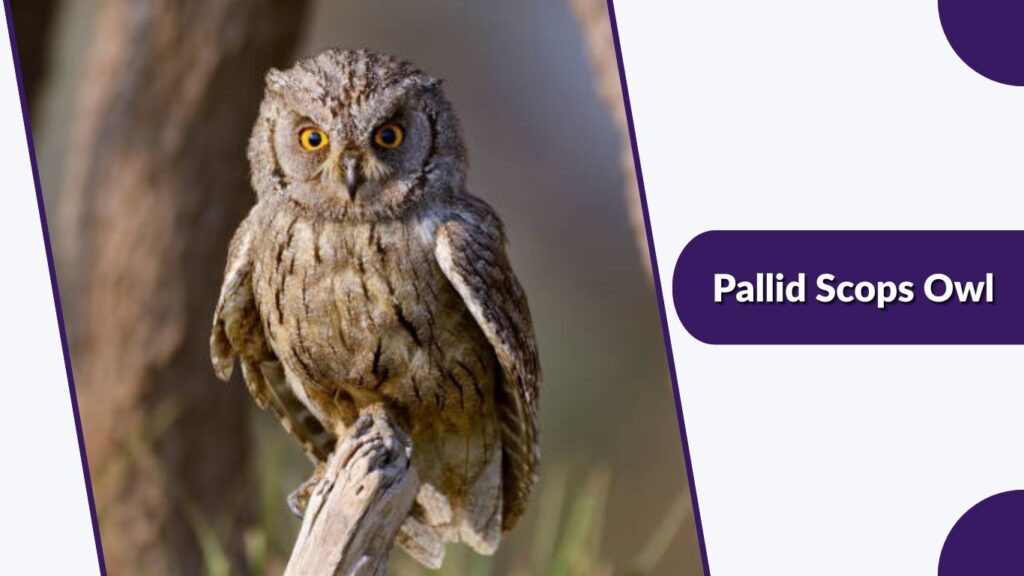
The Pallid Scops Owl is a small, pale scops owl found from the Middle East into western and central Asia. It is also called the Striated Scops Owl in some sources. This owl is similar to the Eurasian Scops Owl, but it usually looks paler, cleaner, and more finely streaked. It lives mainly in semi-open dry country with trees, bushes, palm groves, orchards, and wooded desert edges.
Identification
- Small owl with a pale greyish or sandy-brown body
- Short, narrow ear tufts
- Yellow eyes with a dark facial outline
- Fine dark streaks on the crown, back, and underparts
- Less heavily patterned than the Eurasian Scops Owl
- Bark-like camouflage when roosting on branches or trunks
- Slim body with relatively long wings
- Low, hollow, dove-like call
Habitat and Distribution
The Pallid Scops Owl ranges from the Middle East to western and central Asia. Some populations migrate south in winter, reaching areas such as the Arabian Peninsula, Egypt, and Pakistan. It prefers semi-open habitats with trees and bushes, including palm groves, orchards, cultivated areas, semi-desert, stony foothills, rocky gorges, parks, and large gardens.
Behavior and Diet
This owl is mainly nocturnal, though it may occasionally hunt during the day. It feeds mostly on insects, making it an important predator of beetles, moths, grasshoppers, and other large insects. Its diet can also include lizards, spiders, small mammals, and sometimes bats or flying insects caught on the wing.
Breeding and Conservation
Breeding usually takes place from April to June. The Pallid Scops Owl nests in tree cavities, including old woodpecker holes, and may lay about four to six eggs. Incubation lasts around 27 days, and young birds fledge after about 30 days. The species is currently listed as Least Concern, but local populations may still depend on mature trees, nest cavities, and healthy insect-rich habitats.
3. Oriental Scops Owl

The Oriental Scops Owl is a small Asian scops owl with bright eyes, tiny ear tufts, and excellent bark-like camouflage. It occurs across a wide part of South, East, and Southeast Asia, using open woodland, forest edges, parks, orchards, and wooded riversides. This owl is mostly nocturnal, roosting quietly by day and hunting insects and other small prey at night.
Identification
- Small owl with a compact body
- Short but visible ear tufts
- Yellow eyes and pale eyebrows
- Grey-brown, reddish-grey, or rufous color morphs
- Dark streaks on the crown and body
- Banded wings and tail
- Feathered legs down to the base of the toes
- Camouflages well against tree bark and foliage
Habitat and Distribution
The Oriental Scops Owl is found from northern Pakistan, India, Nepal, Bangladesh, and Sri Lanka eastward through East Asia, including Japan, eastern Siberia, Manchuria, Taiwan, eastern China, and the Malay Peninsula. It also lives on the Andaman and Nicobar Islands. Its preferred habitats include open and semi-open woodland, parks, savannas with scattered trees, wooded riverside belts, and forest edges.
Behavior and Diet
This owl is mainly active at dusk and night. During the day, it may roost alone or sometimes in small groups, hiding in dense foliage, tree holes, or against trunks. It feeds mostly on insects and spiders, but it can also take small vertebrates. Hunting is done both from a perch and in flight, especially near forest edges and open spaces.
Breeding and Conservation
The Oriental Scops Owl usually nests in holes in trees, walls, or artificial nest boxes. In the Indian subcontinent, breeding is reported from February to May, and the female lays about three to four white eggs in the nest cavity. Northern populations are migratory, while southern populations may be resident. The species is currently listed as Least Concern, and populations are generally considered stable across its wide range.
4. Collared Scops Owl
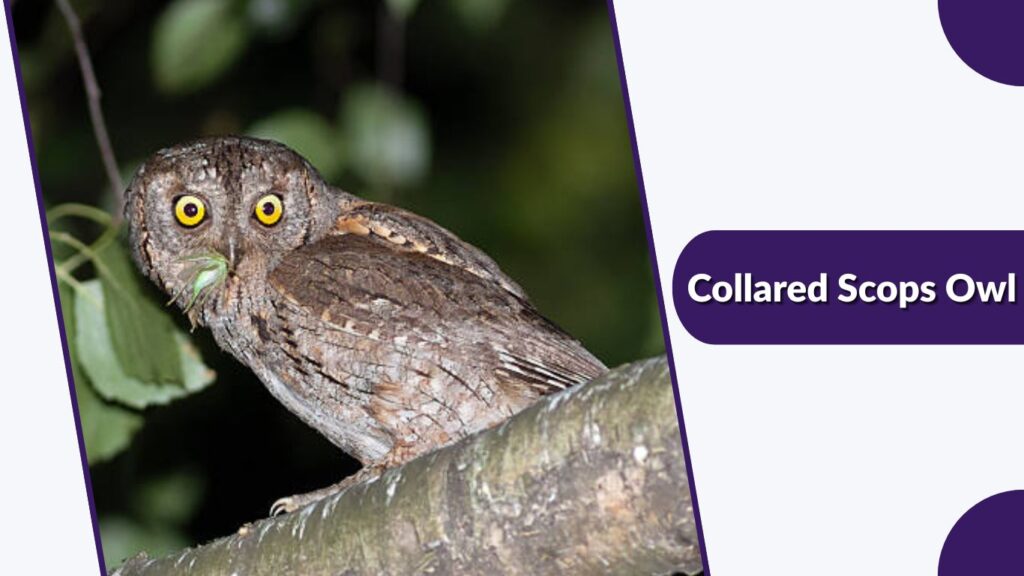
The Collared Scops Owl is a small but relatively large scops owl found across South and Southeast Asia. It is a resident breeder in well-wooded areas, forests, parks, and gardens, and it is often easier to hear than see. With its dark eyes, short ear tufts, mottled bark-like plumage, and soft nighttime call, this owl blends extremely well into tree cover.
Identification
- Small owl, but large compared with many scops owls
- Dark brown eyes
- Short, raised ear tufts
- Grey-brown or rufous-brown plumage
- Pale facial disc with darker border
- Streaked and mottled body like tree bark
- Compact shape with rounded head
- Often confused with Oriental and Indian Scops Owls
Habitat and Distribution
The Collared Scops Owl occurs from northern Pakistan, northern India, Nepal, Bangladesh, and the Himalayas eastward to southern China and Taiwan. Some birds may move seasonally, with winter records from India, Sri Lanka, and Malaysia. It prefers forests and other well-wooded habitats, including wooded gardens, parks, orchards, and areas with mature trees.
Behavior and Diet
This owl is mainly nocturnal and usually hunts after dark. During the day, it roosts quietly in trees, relying on its bark-like plumage for camouflage. Insects form a major part of its diet, especially beetles, moths, grasshoppers, and other large insects. It may also take small mammals, birds, frogs, and lizards when available.
Breeding and Conservation
The Collared Scops Owl usually nests in tree cavities, tree hollows, stumps, and sometimes artificial nest boxes. It commonly lays about three to five eggs in a sheltered cavity. The species is currently listed as Least Concern, but forest loss and decline of mature tree cover can still affect local populations because it depends on wooded habitats and nesting cavities.
5. Japanese Scops Owl
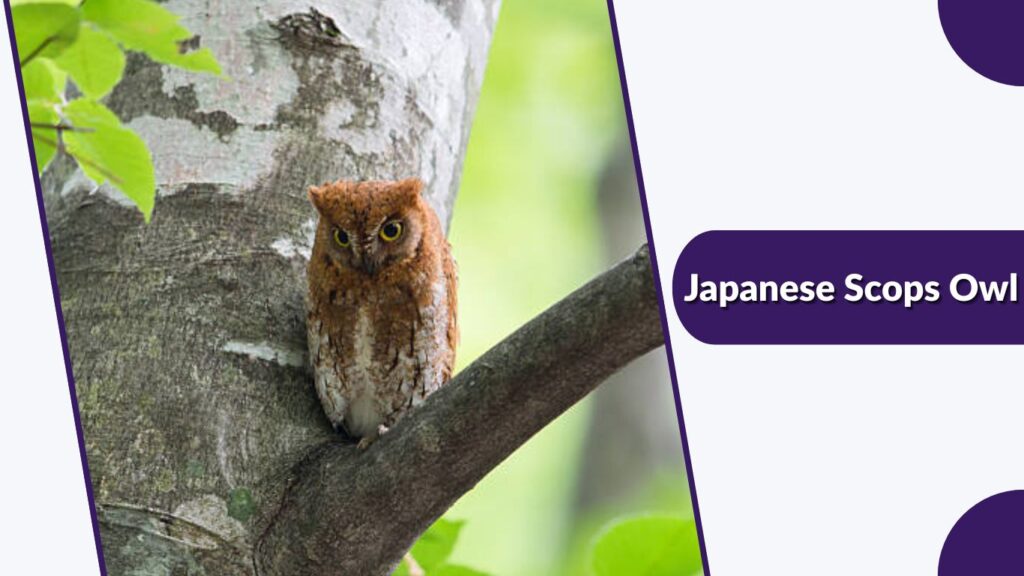
The Japanese Scops Owl is a small owl from East Asia, known for its long ear tufts, bark-like camouflage, and reddish to orange eyes. It is found from southeast Siberia to Japan and is considered widespread and not uncommon in suitable habitat. This owl usually lives in forests, wooded areas, plantations, rural gardens, and sometimes urban green spaces.
Identification
- Small owl with a compact body
- Long, prominent ear tufts
- Reddish-orange to dark reddish eyes
- Grey-brown mottled plumage
- Dark streaks and bark-like markings
- Pale facial disc with darker edges
- Broad wings for its size
- Often sits upright and blends into tree bark
Habitat and Distribution
The Japanese Scops Owl occurs in Japan, Korea, parts of China, and southeastern Russia. Its range includes areas from southeast Siberia to Japan, with several island populations in the Japanese region. It uses temperate forest, wooded hills, plantations, rural gardens, and urban areas with suitable trees. It is especially linked with places that provide roosting cover and natural cavities for nesting.
Behavior and Diet
This owl is mostly nocturnal and is more often heard than seen. During the day, it hides against tree trunks or among branches, where its mottled plumage helps it disappear into the bark. At night, it hunts from perches and likely feeds on insects, small rodents, and other small animals. Like many scops owls, it uses sharp hearing, quick flight, and surprise attacks to catch prey in wooded habitats.
Breeding and Conservation
The Japanese Scops Owl usually nests in tree hollows or similar cavities. Oiseaux.net lists the species as Least Concern and gives its size as about 25 cm, with a wingspan of 60–66 cm and a weight of 130–142 g. Although it is not globally threatened, it still depends on mature trees, wooded habitat, and safe nesting cavities, so local habitat loss can affect some populations.
6. Sunda Scops Owl
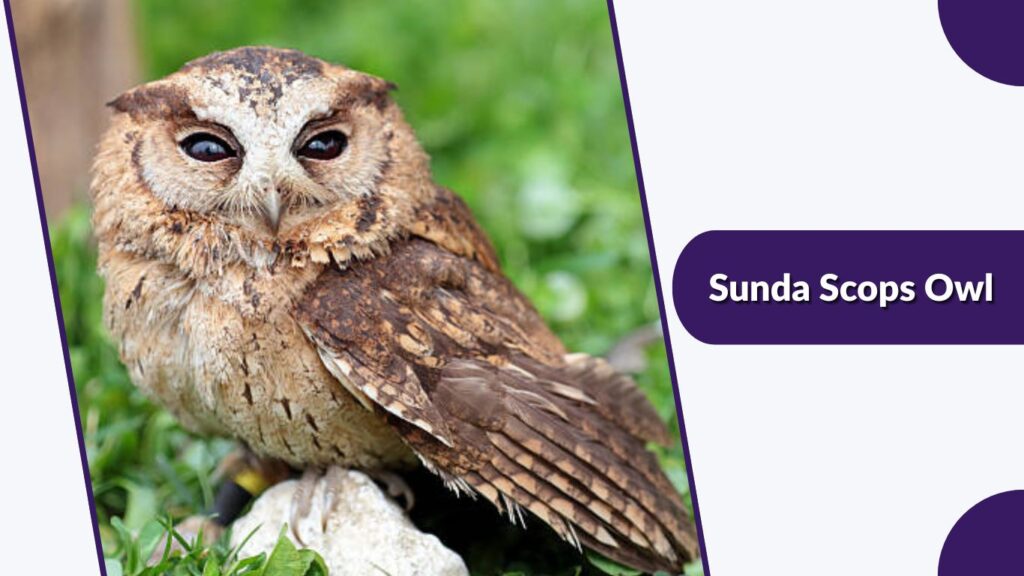
The Sunda Scops Owl is a small brown owl native to the Sunda region of Southeast Asia. It is found in places such as the Malay Peninsula, Singapore, Borneo, Sumatra, and Java, where it lives in forests, wooded gardens, and other tree-rich habitats. This owl is mostly active at night and is recognized by its dark eyes, short ear tufts, mottled plumage, and soft repeated call.
Identification
- Small scops owl with a compact body
- Dark brown eyes
- Short but noticeable ear tufts
- Brown, grey-brown, or rufous-brown plumage
- Speckled upperparts with darker markings
- Streaked underparts with fine dark lines
- Pale collar around the neck
- Excellent bark-like camouflage while roosting
Habitat and Distribution
The Sunda Scops Owl occurs across the Malay Peninsula, Singapore, Borneo, Sumatra, and Java. It mainly lives in forests and wooded areas, but it can also appear in gardens and sometimes near buildings. In Malaysia, researchers have recorded the species in several wooded habitat types, including lowland forest and oil palm smallholdings, showing that it can use both natural and modified landscapes when suitable trees and prey are available.
Behavior and Diet
This owl is nocturnal and usually hunts after dark. It often waits from a perch, watches for movement, then drops down or flies out to catch prey. Its diet is mainly made up of insects, including beetles, crickets, grasshoppers, and cockroaches, but it can also eat small birds, lizards, rodents, and other small animals.
Breeding and Conservation
The Sunda Scops Owl nests in tree hollows and may line the nest with plant fibers. Breeding is reported from January to April, though it may sometimes extend into June or July. The female can lay up to three eggs. The species is currently listed as Least Concern and is described as common in suitable habitat, but local populations still depend on healthy wooded areas and nesting cavities.
7. Mountain Scops Owl

The Mountain Scops Owl is a small forest owl found across parts of South and Southeast Asia. It is also known as the Spotted Scops Owl because of the pale markings on its head and body. This owl prefers humid hill forests, shady ravines, dense vegetation, and montane rainforest. It is mostly nocturnal and is often detected by its short, high-pitched two-note call.
Identification
- Small scops owl with a compact body
- Short ear tufts
- Golden-yellow or greenish-yellow eyes
- Rufous-brown facial disc
- Dark tawny-brown or rufous-brown upperparts
- Whitish underparts with rufous barring
- Pale spots and dark markings on the crown
- Densely feathered legs and toes
- Short, high-pitched “plew-plew” style call
Habitat and Distribution
The Mountain Scops Owl is mainly linked with humid forest habitats. In the northern part of its range, it uses temperate hill evergreen forests with trees such as oak, pine, and chestnut. Farther south, it occurs in montane tropical rainforest and dense forest edges. Its range includes Pakistan, Nepal, the Himalayas, northeast India, Myanmar, southeast China, Taiwan, Southeast Asia, the Malay Peninsula, Sumatra, and Borneo.
Behavior and Diet
This owl is active at night, usually beginning activity around dusk. It often stays in deep, shady gullies and dense forest vegetation, where it hunts below the canopy or near the ground. Its diet is mainly insect-based, especially beetles and moths. It may catch insects in the air or search for prey from hidden perches inside thick forest cover.
Breeding and Conservation
Northern populations usually breed from March or April to June. The Mountain Scops Owl nests in holes in dead trees, natural cavities, or abandoned woodpecker and barbet holes. The female normally lays three to four white eggs directly on the cavity floor, while the male brings food during incubation. The species is currently listed as Least Concern, but it still depends on healthy forest habitat and mature trees with nesting cavities.
8. Indian Scops Owl
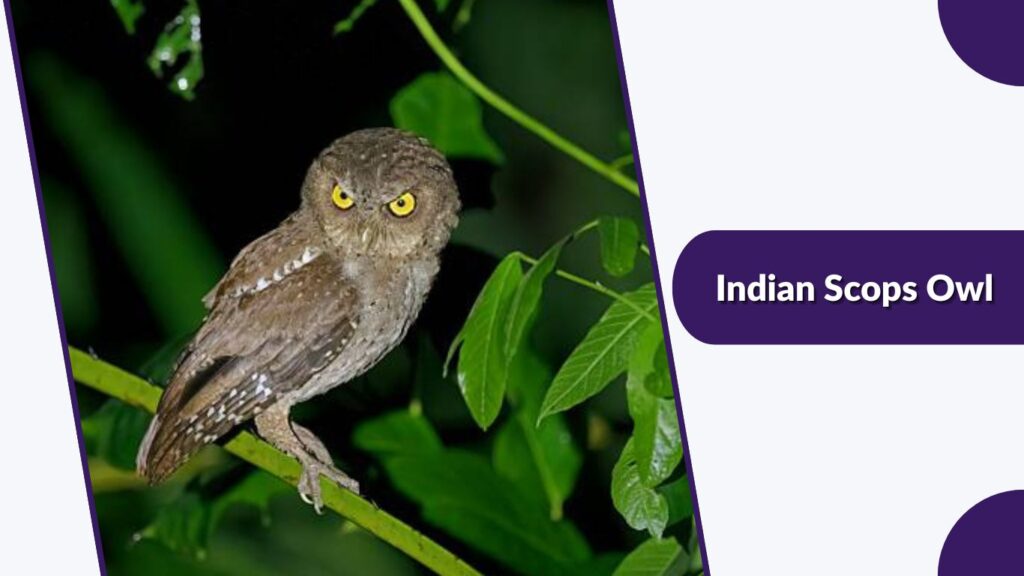
The Indian Scops Owl is a small nocturnal owl native to South Asia. Although small, it is one of the larger scops owls and is often recognized by its ear tufts, mottled bark-like plumage, orange-brown eyes, and soft single-note call. It is mostly resident and often hides in tree cover during the day, making it difficult to spot.
Identification
- Small owl with a compact body
- Short but clear ear tufts
- Orange, brown, or dark-looking eyes
- Grey-brown or brown plumage
- Fine streaking on the underparts
- Pale buff or whitish facial disc
- Buff neckband around the collar area
- Excellent camouflage against tree bark
- Soft single-note “whuk” style call
Habitat and Distribution
The Indian Scops Owl occurs mainly across the Indian subcontinent and nearby South Asian regions, though it is absent from the far north. It uses lowlands, dry woodland, groves, orchards, gardens, village trees, and areas with dense foliage. The species may also occur up to about 2,200 meters in the Himalayas, especially where suitable trees and roosting cover are available.
Behavior and Diet
This owl is nocturnal and usually rests quietly in trees during the day. Its camouflage makes it hard to see, but small birds may reveal its hiding place by mobbing it. At night, it hunts mainly insects, including beetles, grasshoppers, moths, and moth larvae. It may also take small rodents, birds, lizards, and rarely bats.
Breeding and Conservation
The Indian Scops Owl usually nests in tree cavities and may reuse the same hole year after year. It commonly lays about three to five eggs in a cavity. BirdLife lists the species as Least Concern, and its population trend appears stable, although local habitat loss and reduction of old nesting trees can still affect breeding sites.
9. Andaman Scops Owl
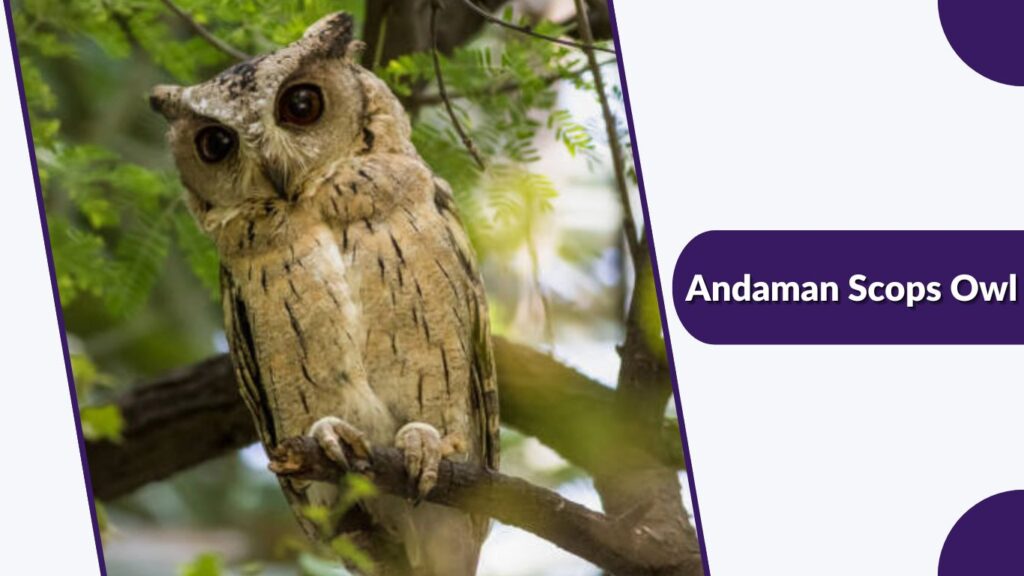
The Andaman Scops Owl is a small island owl found only in the Andaman Islands of India. It is a nocturnal species with bright yellow eyes, small ear tufts, and brown or rufous-brown plumage that helps it blend into trees. Because it has no confirmed range outside the Andaman Islands, it is considered an endemic owl with a restricted distribution.
Identification
- Small scops owl, about 18–19 cm tall
- Bright yellow, brown, or hazel-looking eyes
- Small but noticeable ear tufts
- Brown, grey-brown, or rufous-brown morphs
- White speckles on the upperparts
- Pale underparts with greyish tones
- Yellowish bill and greenish-yellow or grey feet
- Bark-like camouflage when perched in trees
Habitat and Distribution
The Andaman Scops Owl is native to the Andaman Islands and has no confirmed sightings outside this island group. It usually lives in trees in semi-open areas, cultivated land, gardens, and places near human settlements. It may also occur around wooded village edges and plantations where tree cover, roosting sites, and insect prey are available.
Behavior and Diet
This owl is mainly nocturnal and hunts at night. During the day, it hides quietly in leafy cover or tree branches, relying on camouflage to avoid detection. Its diet is mostly insect-based, including caterpillars, beetles, and other insects. When hunting, it may wait among leaves and move silently toward prey before striking.
Breeding and Conservation
The Andaman Scops Owl usually breeds from February to April. It nests in tree hollows or abandoned woodpecker and barbet holes, often a few meters above the ground, and may lay two to three eggs. The species is currently listed as Least Concern, but its limited island range means deforestation and habitat loss remain important local concerns.
10. Philippine Scops Owl

The Philippine Scops Owl is a small to medium-sized owl endemic to the Philippines. It is also known as the Luzon Lowland Scops Owl in some references, especially when related island forms are treated separately. This owl is mostly nocturnal, forest-loving, and well camouflaged, with large ear tufts, orange-brown eyes, and mottled plumage that blends into branches and tree trunks.
Identification
- Small to medium-sized scops owl
- Large upright ear tufts
- Yellowish-brown to orange-brown eyes
- Greyish-brown or reddish-brown color morphs
- Whitish V-shaped eyebrow markings
- Dark barring on the upperparts
- Light brown breast and abdomen
- Short tail and feathered-looking body
- Strong camouflage in forest understory
Habitat and Distribution
The Philippine Scops Owl is found in the Philippine archipelago and is especially associated with Luzon and nearby islands in many taxonomic treatments. It lives mainly in rainforest, mature secondary forest, forest edges, and wooded understory. It is usually recorded in lowland forest and is often seen below 1,000 meters, though some records come from higher elevations such as Mount Data on Luzon.
Behavior and Diet
This owl is mostly nocturnal and spends the day hidden in the forest understory. At night, it hunts from low perches, watching and listening for prey before making a quick attack. Its diet includes insects and small mammals, and like many scops owls, it likely takes prey from branches, foliage, and the forest floor. Its secretive behavior makes it easier to hear than see in many wooded areas.
Breeding and Conservation
The Philippine Scops Owl is believed to be monogamous and nests in tree cavities. Both parents provide care for the young, and the species depends on forested areas with suitable nesting holes. It is currently listed as Least Concern, but its population is thought to be declining because of deforestation, forest fragmentation, logging, agricultural conversion, mining, and capture for the pet trade.
11. Luzon Scops Owl
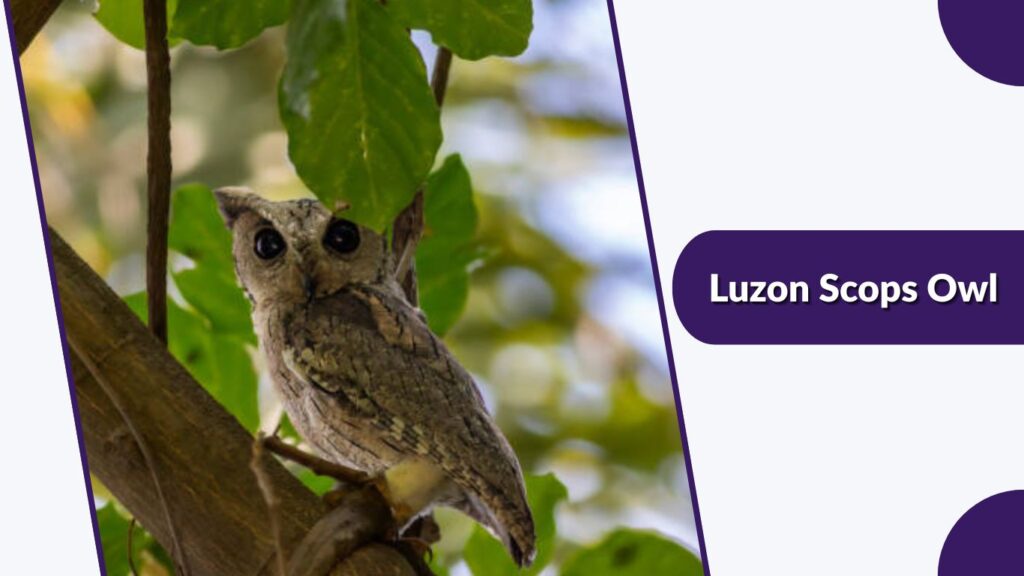
The Luzon Scops Owl, also called the Luzon Highland Scops Owl, is a small owl found only on Luzon Island in the Philippines. It is a montane forest species, meaning it is mostly linked with higher-elevation forests rather than lowland habitats. This owl has long ear tufts, bright eyes, mottled plumage, and a secretive nocturnal lifestyle. It is often easier to detect by its call than by sight.
Identification
- Very small scops owl
- Long, noticeable ear tufts
- Bright yellow to orange-yellow eyes
- Grey-brown, brown, and whitish mottled plumage
- Pale facial markings around the eyes
- Streaked and barred underparts
- Short tail and compact body shape
- Strong bark-like camouflage in forest trees
- Often confused with other Philippine scops owls
Habitat and Distribution
The Luzon Scops Owl is endemic to Luzon in the northern Philippines. It is mainly associated with montane forest, rainforest, and tropical pine forest. It has been recorded at elevations from about 350 to 1,800 meters, and sometimes even higher. Its distribution is patchy because it depends strongly on suitable highland forest habitat.
Behavior and Diet
This owl is mostly nocturnal and appears to be sedentary, staying in the same general habitat year-round. It usually calls at night, producing a single-note whistle separated by pauses. Its diet is not fully studied, but stomach records suggest it mainly eats insects and other invertebrates. Like many scops owls, it probably hunts from hidden perches inside forest cover.
Breeding and Conservation
Breeding information for the Luzon Scops Owl is limited. Available records suggest it nests in tree holes, where the female may lay two to three eggs. Chicks have been observed in May with pale grey down feathers. The species is currently treated as Least Concern by recent assessments, but habitat loss from logging, mining, farming, and forest disturbance can still threaten local populations.
12. Mindanao Scops Owl
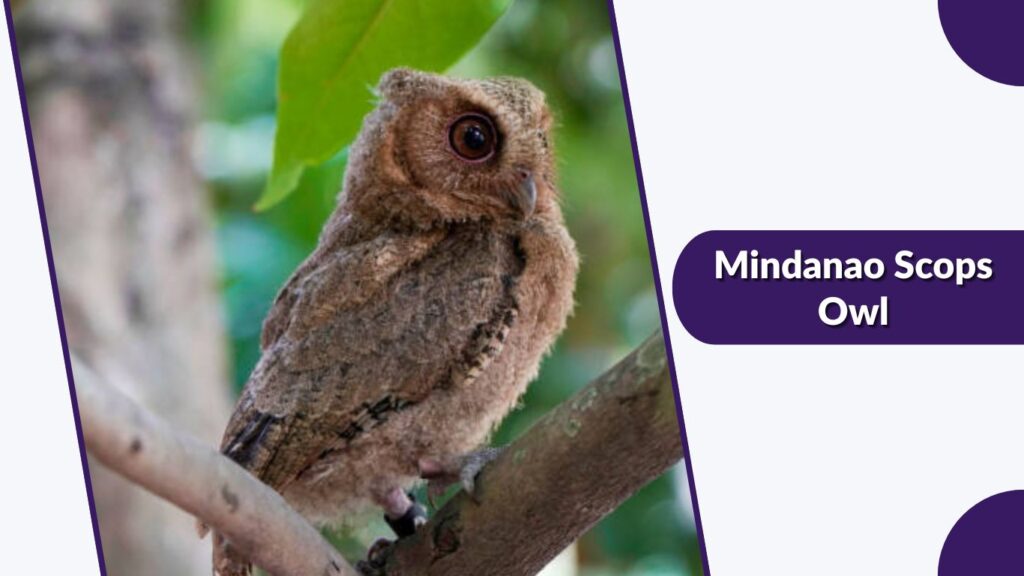
The Mindanao Scops Owl, also called the Mindanao Highland Scops Owl, is a small owl found only on Mindanao Island in the Philippines. It is a montane forest species, usually associated with high-elevation mossy forest. This owl is poorly known compared with many other scops owls, but it is recognized by its bright yellow eyes, mottled brown-and-white plumage, and secretive nighttime behavior.
Identification
- Small scops owl, about 19 cm long
- Bright yellow eyes
- Small pale or whitish ear tufts
- Brown and white mottled front
- Heavily barred wings and back
- Compact body with a short tail
- Bark-like camouflage in mossy forest
- Smaller than Everett’s Scops Owl where their ranges overlap
Habitat and Distribution
The Mindanao Scops Owl is endemic to Mindanao in the southern Philippines, meaning it naturally occurs nowhere else. It is mainly found in montane and mossy forests at higher elevations. BirdLife notes that the species occurs in montane forests above about 1,500 meters, while other sources describe its habitat as tropical montane forest above 1,000 meters.
Behavior and Diet
This owl is nocturnal and is usually active at night inside mountain forest. During the day, it likely roosts quietly in dense vegetation, relying on its mottled plumage for camouflage. Its diet is not well studied, but it is believed to feed mainly on insects, similar to many other Otus scops owls. It may hunt from hidden perches and capture prey in the forest understory.
Breeding and Conservation
Little is known about the breeding habits of the Mindanao Scops Owl. Breeding is presumed to occur around February to March because specimens with enlarged gonads were recorded during that period. The species is currently assessed as Least Concern, but its population is believed to be decreasing. Deforestation and habitat destruction remain important threats, although some of its rugged mountain habitat is less accessible than lowland forest.
13. Mindoro Scops Owl
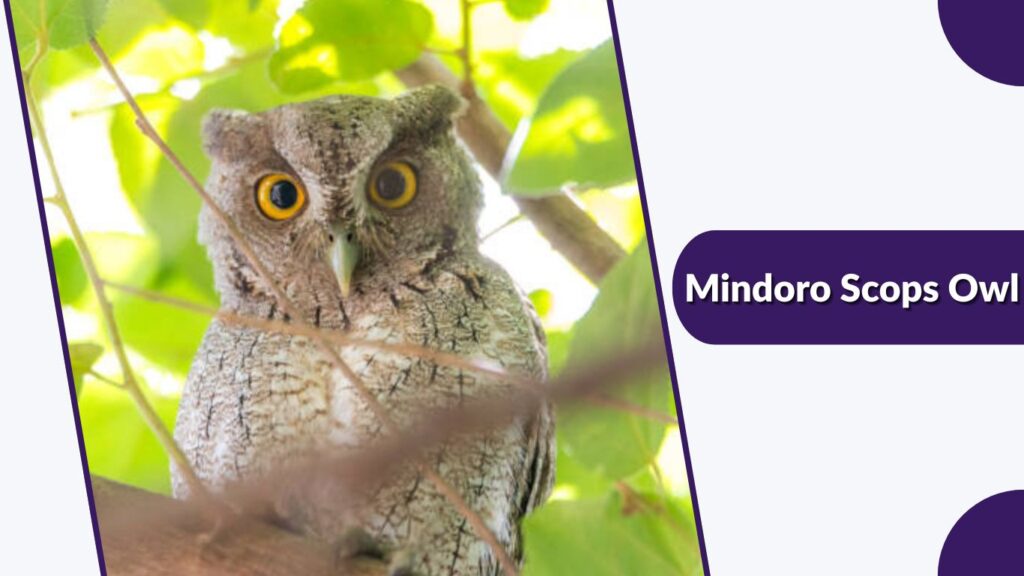
The Mindoro Scops Owl is a small island owl found only on Mindoro in the Philippines. It is a highland forest species, closely linked with tropical moist montane forest. This owl has medium-length ear tufts, bright eyes, mottled brown plumage, and strong camouflage that helps it hide in dense mountain forests. It is currently considered Near Threatened because of its restricted range and pressure from habitat loss.
Identification
- Very small scops owl
- Medium-length ear tufts
- Bright yellowish eyes
- Brown, grey-brown, and rufous mottled plumage
- Bark-like markings on the head and body
- Compact body with short tail
- Blends well into mossy branches and forest cover
- Similar to other Philippine highland scops owls
Habitat and Distribution
The Mindoro Scops Owl is endemic to Mindoro Island in the Philippines, meaning it naturally occurs nowhere else. It is mainly associated with tropical and subtropical moist montane forest, especially higher-elevation forest. Oiseaux.net lists its habitat as subtropical or tropical moist montane forest, while other sources describe it as a highland specialist scops owl.
Behavior and Diet
The Mindoro Scops Owl is nocturnal and is usually active after dark. During the day, it likely rests quietly in dense forest cover, using its mottled plumage to avoid detection. Its diet is not well studied, but it is generally presumed to feed mainly on insects, similar to many other small Otus owls. Because it is rarely observed, many details of its hunting behavior remain poorly known.
Breeding and Conservation
Breeding details for the Mindoro Scops Owl are still limited. Historical specimen records suggest breeding condition in some birds, but its eggs and nest have not been fully described. Conservation concern is higher than for many widespread scops owls because the species is restricted to one island and is listed as Near Threatened. Continued forest clearance, habitat degradation, and loss of mature montane forest are the main concerns for its future.
14. Reddish Scops Owl
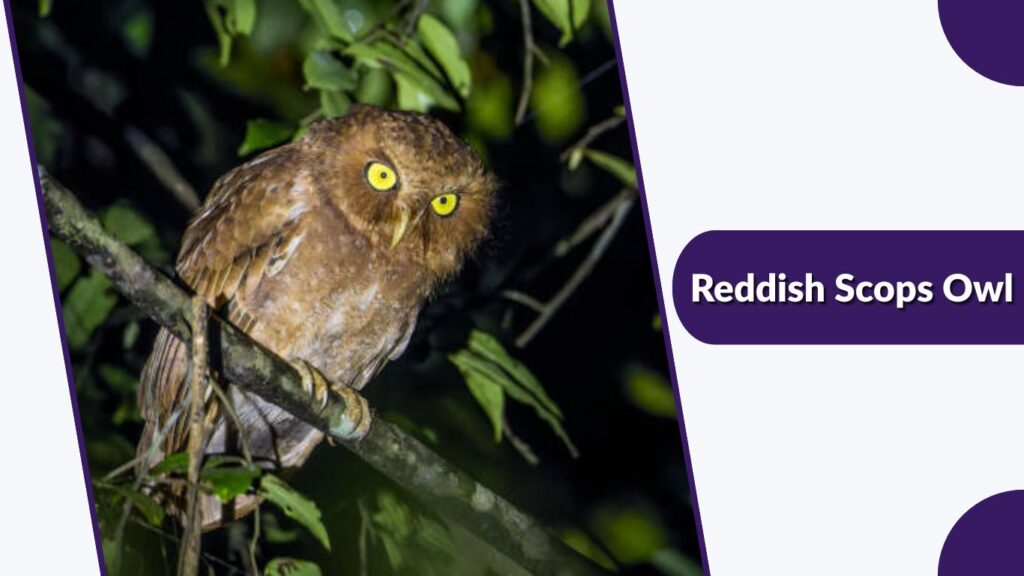
The Reddish Scops Owl is a small forest owl from Southeast Asia. It is named for its warm reddish-brown plumage, which helps it blend into tropical forest shadows. This owl is mainly associated with lowland evergreen forest, foothill forest, submontane forest, and swampy rainforest habitats. It is a Sundaic species found in areas such as southern Thailand, the Malay Peninsula, Sumatra, Java, Borneo, and Brunei.
Identification
- Small scops owl, about 15–18 cm long
- Warm reddish-brown overall appearance
- Pale face with small ear tufts
- Dark eyes with a rounded facial expression
- Black spotting across the chest
- White spotting along the back and wings
- Short tail and compact body
- Juveniles look similar to adults but may show less spotting
Habitat and Distribution
The Reddish Scops Owl lives mainly in lowland evergreen forest, foothill forest, submontane forest, logged primary forest, secondary forest, and swamp forest. It has been recorded mostly in lowlands, but some records reach about 1,350 meters in elevation. Its range includes southern peninsular Thailand, the Malay Peninsula, Sumatra, Java, and Borneo, making it closely tied to the Sunda region of Southeast Asia.
Behavior and Diet
This owl is nocturnal and usually stays hidden in forest cover during the day. At night, it calls from dense woodland and hunts small prey. Its diet is not fully studied, but available information suggests it feeds mainly on arthropods and small vertebrates. A radio-tracking study in Malaysia described it as a Near Threatened Sunda endemic associated with lowland closed-canopy forests, showing how closely its behavior is linked to intact forest habitat.
Breeding and Conservation
The Reddish Scops Owl nests in tree cavities, including old barbet or woodpecker holes. In Java, eggs have been recorded in March and April, and a downy nestling has been observed in mid-July. The species is listed as Near Threatened, with habitat loss from logging and forest clearance as major concerns. It is also affected by illegal wildlife trade in some areas.
15. White-fronted Scops Owl
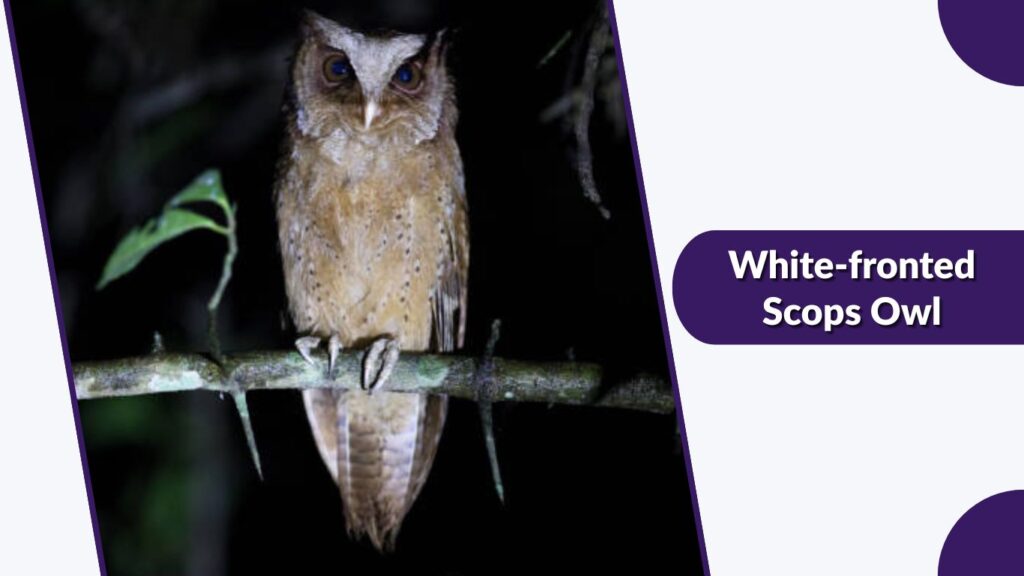
The White-fronted Scops Owl is a rare Southeast Asian owl known for its pale white forehead, dark eyes, and warm rufous-brown plumage. It is relatively large for a scops owl and is usually found in lowland and hill forests. This species is secretive, nocturnal, and currently listed as Vulnerable because its forest habitat is declining.
Identification
- Relatively large scops owl
- Prominent white forehead extending toward the ear tufts
- Dark brown to dark honey-brown eyes
- Pale rufous facial disc
- Rufous-chestnut upperparts with pale spotting
- Pale underparts with dark shaft spots
- Rounded wings and relatively long tail
- Feathered legs and flesh-pink toes
Habitat and Distribution
The White-fronted Scops Owl is found in parts of Southeast Asia, including Peninsular Myanmar, Peninsular Thailand, and the Malay Peninsula. It mainly lives in evergreen forest, rainforest, degraded swampy forest, and tall secondary forest in lowland and hill areas. Owl Pages notes that it occurs around 600–700 meters in parts of the Malay Peninsula, while BirdLife describes it as a resident nocturnal owl of old-growth and regenerating evergreen or mixed deciduous forests.
Behavior and Diet
This owl is little known and elusive, so many details of its behavior are still poorly documented. It is nocturnal and usually stays hidden during the day in dense forest cover. At night, it hunts small prey, especially insects. Available species accounts describe moths as an important part of its diet, which fits the insect-heavy feeding habits of many scops owls.
Breeding and Conservation
Breeding information for the White-fronted Scops Owl is limited. Records from Thailand and the Malay Peninsula suggest breeding from February to March. It nests in tree holes, where the clutch may contain three to four white eggs. The species is listed as Vulnerable, with a declining population linked mainly to rapid loss and degradation of lowland and foothill forest.
16. Serendib Scops Owl
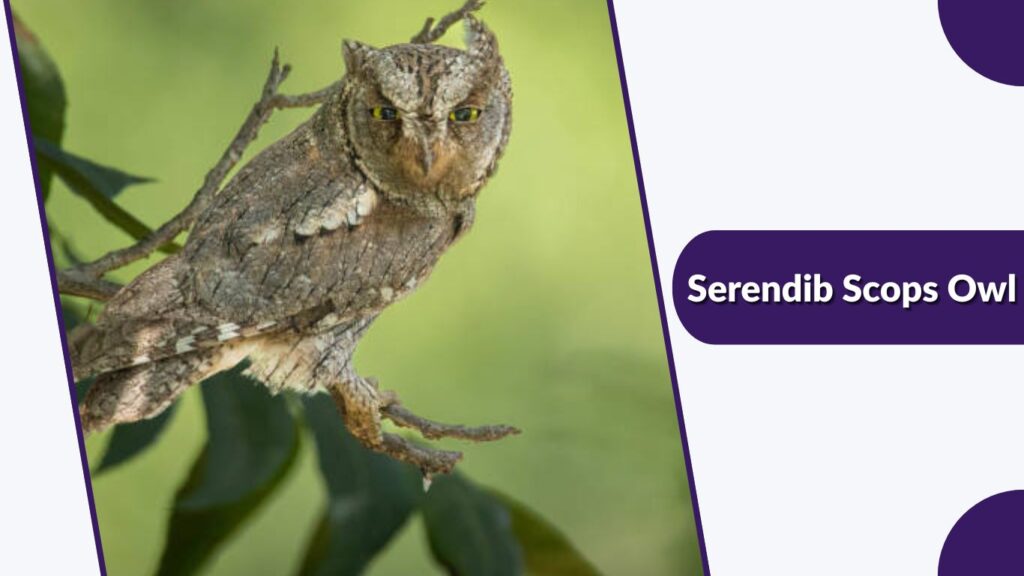
The Serendib Scops Owl is a rare scops owl found only in Sri Lanka. It is one of the most recently described owl species, formally named in 2004 after being discovered through its unusual call in Sri Lankan rainforest. This small owl is secretive, nocturnal, and strongly tied to wet-zone forest habitats such as Sinharaja and Kitulgala. It is currently listed as Endangered because its population is small and declining.
Identification
- Small, short-tailed scops owl
- No obvious ear tufts
- Weakly defined facial disc
- Reddish-brown overall plumage
- Paler underparts with fine black spotting
- Tawny-yellow to orange-yellow eyes
- Pale ivory bill and claws
- Pale fleshy feet
- Very secretive and hard to see in forest shade
Habitat and Distribution
The Serendib Scops Owl is endemic to Sri Lanka, meaning it naturally occurs nowhere else. It is mainly found in wet-zone rainforests, including Sinharaja Forest Reserve and Kitulgala. The species has also been recorded in other forested areas such as Runakanda Reserve and Eratna-Gilimale. Its dependence on rainforest makes it vulnerable to forest loss, fragmentation, and disturbance in Sri Lanka’s remaining wet-zone forests.
Behavior and Diet
This owl is mostly nocturnal and highly secretive. It usually roosts low in the forest during the day and begins calling around dusk, though it may remain hidden until darkness. Its call was important in the original discovery of the species. Detailed diet information is limited, but like many small scops owls, it is believed to feed mainly on insects and other small forest prey.
Breeding and Conservation
Very little is known about the breeding behavior of the Serendib Scops Owl because it is rare and difficult to observe. Its conservation status is more serious than many other scops owls. BirdLife lists it as Endangered because the population is believed to number fewer than 1,000 mature individuals and is slowly declining. Protecting Sri Lanka’s remaining rainforest is essential for this species.
17. Sokoke Scops Owl
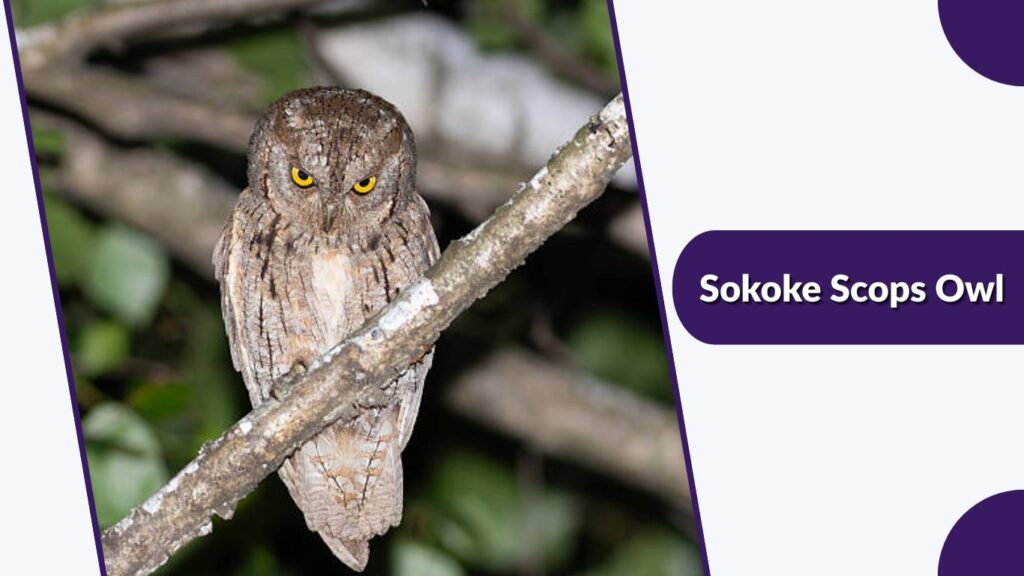
The Sokoke Scops Owl is a very small and rare scops owl found in coastal East Africa. It is best known from Kenya’s Arabuko-Sokoke Forest and Dakatcha Woodlands, with another population in Tanzania’s East Usambara Mountains. This owl has small ear tufts, yellow eyes, grey or rufous-brown color forms, and a secretive nocturnal lifestyle. It is currently listed as Endangered because of its restricted range and habitat loss.
Identification
- Very small scops owl
- Small ear tufts
- Large pale yellow eyes
- Grey, dark brown, or rufous color morphs
- Fine spots and wavy markings on the body
- Short tail and compact body shape
- Pale bill with a slight pinkish wash
- Camouflages well in dense woodland
- Repeated whistling call at night
Habitat and Distribution
The Sokoke Scops Owl is found only in Kenya and Tanzania. In Kenya, it is mainly associated with Arabuko-Sokoke Forest and Dakatcha Woodlands, while in Tanzania it is known from the East Usambara Mountains. It prefers dense coastal woodland, especially areas with low canopy, thick vines, brush, and tree species such as Cynometra. Owl Pages describes its habitat as forest and woodland with trees taller than 3–4 meters.
Behavior and Diet
This owl is nocturnal and usually roosts during the day in the lower canopy. It is territorial, and pairs may use small home ranges with little overlap between neighboring pairs. Its diet is mainly insect-based, especially beetles, but it also eats crickets, grasshoppers, ants, stick insects, and other arthropods. It often hunts from a perch, dropping down on prey before returning to feed.
Breeding and Conservation
The breeding biology of the Sokoke Scops Owl is still poorly known. Researchers believe it probably nests in tree cavities, especially in large old trees, but details about eggs, chicks, and nesting behavior remain limited. The species is listed as Endangered, mainly because of habitat loss, forest degradation, and climate-related pressure on its already small range. Protecting coastal forests and old cavity-bearing trees is essential for its survival.
18. Seychelles Scops Owl
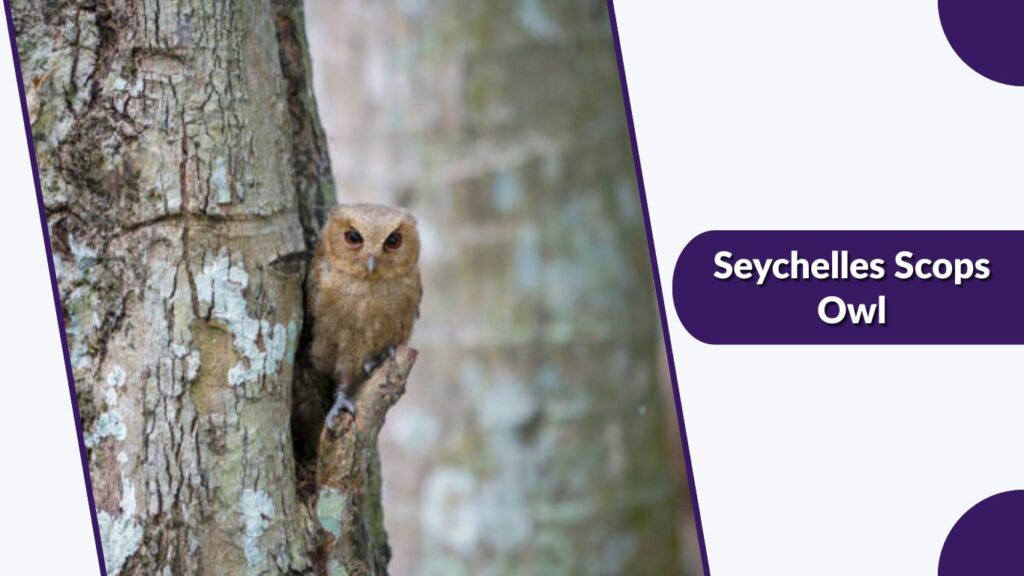
The Seychelles Scops Owl is a rare island owl found only on Mahé Island in the Seychelles. It is also known as the Bare-legged Scops Owl or Syer in Creole. This small nocturnal owl lives mainly in highland forests, where it is much more often heard than seen. Its restricted range, small population, and dependence on upland forest make it one of the most conservation-sensitive scops owls.
Identification
- Small scops owl, about 19–22 cm long
- Golden-yellow eyes
- Very small, inconspicuous ear tufts
- Dark brown-chestnut upperparts with mottling
- Rufous facial disc and faint rufous underparts
- Whitish barring and broad dark streaks below
- Bare yellow legs with long toes
- Rasping, frog-like call, often heard after dark
Habitat and Distribution
The Seychelles Scops Owl is endemic to Mahé Island and is mainly found in upland forest and wooded valleys, often near water. It was formerly present more widely in the Seychelles, but deforestation and introduced predators pushed the species close to extinction. Today, much of its remaining habitat is within Morne Seychellois National Park, which gives the owl some protection.
Behavior and Diet
This owl is strictly nocturnal and usually rests quietly in trees or bushes during the day. At night, it hunts insects, spiders, and possibly frogs and small lizards. Its call is one of the best ways to detect it, sounding like a frog or a rasping saw-like noise from tall trees. Because of its cryptic plumage and secretive habits, it is rarely seen even where it occurs.
Breeding and Conservation
The Seychelles Scops Owl nests in hollow trees and usually lays one white egg. Breeding information is limited, but available records show that tree cavities are important nesting sites. Nature Seychelles lists its population in Seychelles at about 249–300, while BirdLife notes earlier estimates of 90–180 pairs. The species remains at risk because it has a very small island range and depends on protected highland forest.
FAQs
What are scops owls?
Scopus owls are small owls, mostly from the genus Otus. They usually have short ear tufts, compact bodies, excellent camouflage, and soft nighttime calls. Most scops owls are nocturnal and feed mainly on insects, although some also eat small mammals, reptiles, frogs, and birds.
Where do scops owls live?
Scops owls live in many habitats, including forests, woodlands, orchards, gardens, plantations, mountains, and island forests. Some species prefer lowland rainforest, while others live in dry open woodland or high-elevation montane forests. Their habitat depends on the species and available nesting cavities.
What do scops owls eat?
Most owls eat insects such as beetles, moths, crickets, grasshoppers, and cicadas. Some species also catch spiders, lizards, frogs, small birds, bats, and rodents. Because they are small owls, many species rely heavily on insects and other small nighttime prey.
Are scops owls rare?
Some scops owls are common and widespread, such as the Eurasian Scops Owl and Oriental Scops Owl. Others are rare because they live only on small islands or limited forest areas. Species like the Serendib Scops Owl, Sokoke Scops Owl, and Seychelles Scops Owl need strong conservation protection.
How do you identify a scops owl?
Scops owls are usually identified by their small size, ear tufts, mottled bark-like feathers, eye color, call, range, and habitat. Many species look very similar, so location is important. Their calls are often the easiest way to separate one scops owl species from another.