
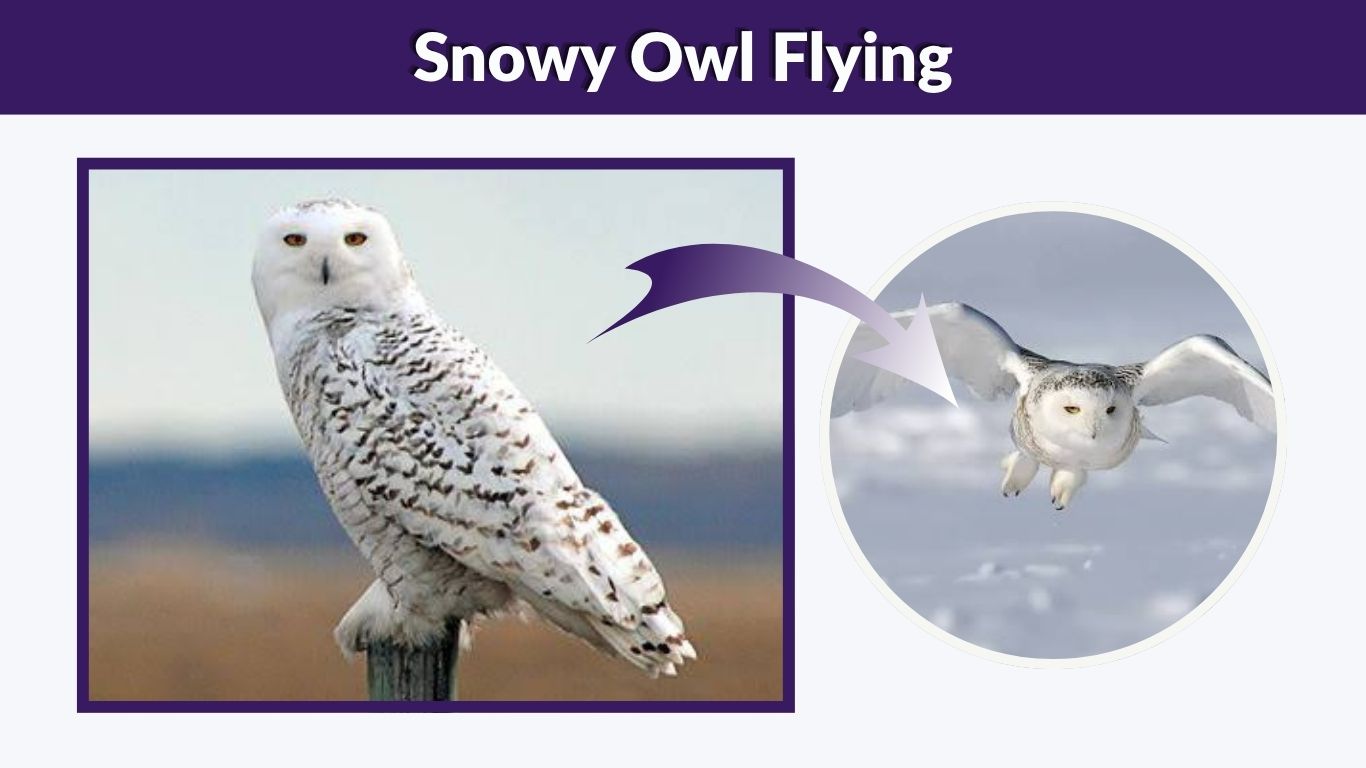
A snowy owl flying across a snowy landscape is one of the most impressive sights in the Arctic. With broad white wings, powerful muscles, and specialized feathers, these birds move gracefully through open skies while searching for prey. Snowy owls can fly during the day or night, often traveling close to the ground to hunt small mammals and birds. Their flight abilities also allow them to cover enormous distances during seasonal movements. Understanding snowy owl flying speed, wing structure, hunting techniques, and migration patterns reveals how these remarkable birds survive.
How Do Snowy Owls Fly?
Snowy owls (Bubo scandiacus) are powerful flying birds adapted to open Arctic environments. Their broad wings allow them to travel across tundra, grasslands, and coastal landscapes while searching for prey.
Unlike many forest-dwelling owls, snowy owls frequently fly across large, treeless areas. They combine steady wingbeats with gliding to move efficiently through the air.
Snowy Owl Flight Characteristics
Several physical features contribute to their impressive flying abilities:
- Wingspan: Approximately 49.6–57.1 inches (126–145 cm).
- Wing shape: Broad, rounded wings support controlled flight.
- Flight pattern: A combination of flapping, gliding, and occasional hovering.
- Body weight: Approximately 3.5–6.5 pounds, depending on sex and individual size.
- Tail feathers: Help control direction and maintain stability.
- Powerful muscles: Provide strength for takeoff and maneuvering.
- Flight height: Often relatively close to the ground when hunting.
These characteristics allow snowy owls to navigate open landscapes while maintaining control during sudden changes in direction.
How Fast Can a Snowy Owl Fly?
Snowy owls are capable of swift, powerful flight, particularly when pursuing prey or defending their territory.
However, their exact maximum flight speed has not been firmly established through widely accepted scientific measurements. Estimates sometimes published online should not be treated as verified maximum speeds.
What Determines Snowy Owl Flying Speed?
Several factors influence how quickly a snowy owl travels.
During ordinary hunting, snowy owls often fly at controlled speeds while scanning the ground. When pursuing moving prey, they can accelerate and maneuver rapidly.
Wind direction, weather conditions, body weight, and flight purpose also influence speed.
During migration, maintaining efficient movement may be more important than flying at maximum speed.
Do Snowy Owls Fly Silently?
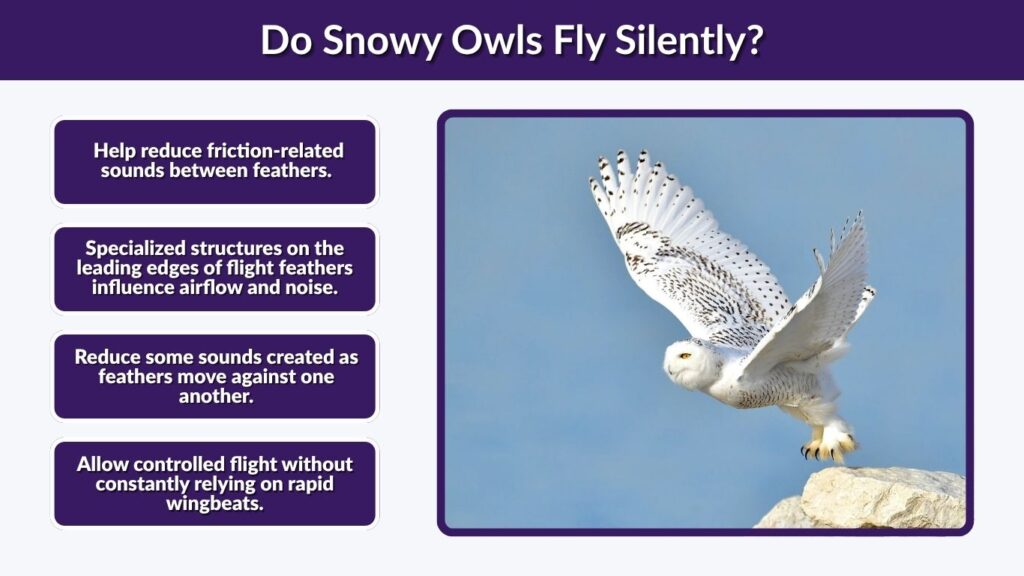
Snowy owls can fly relatively quietly because their wing feathers have adaptations that help reduce flight noise.
Like other owls, they possess specialized feather structures that limit some of the sounds produced during flight.
However, quiet flight does not mean their wings produce absolutely no sound.
How Do Snowy Owls Fly Quietly?
Several feather adaptations contribute to reduced flight noise:
- Soft feather surfaces: Help reduce friction-related sounds between feathers.
- Serrated wing edges: Specialized structures on the leading edges of flight feathers influence airflow and noise.
- Feather fringes: Reduce some sounds created as feathers move against one another.
- Broad wings: Allow controlled flight without constantly relying on rapid wingbeats.
- Flexible feathers: Help accommodate movement during flight.
Quiet flight can help owls detect prey and reduce the chance of being noticed while approaching.
Scientists continue studying how these structures reduce noise and how their effectiveness differs among owl species.
Why Do Snowy Owls Fly Low to the Ground?
Snowy owls frequently fly close to the ground while searching for small mammals and birds.
This behavior allows them to inspect open terrain and approach prey quickly.
They commonly hunt in tundra, agricultural fields, coastal dunes, and other landscapes with limited tall vegetation.
Low-Flying Hunting Techniques
Snowy owls often begin hunting from an elevated perch or small mound.
After identifying a potential target, an owl may fly low across the landscape before approaching with its talons extended.
Some snowy owls also hover briefly while examining the ground for prey.
Their sharp eyesight and hearing help locate rodents moving through grass, snow, or other vegetation.
Low flight is particularly useful when hunting lemmings and voles.
Do Snowy Owls Fly at Night?
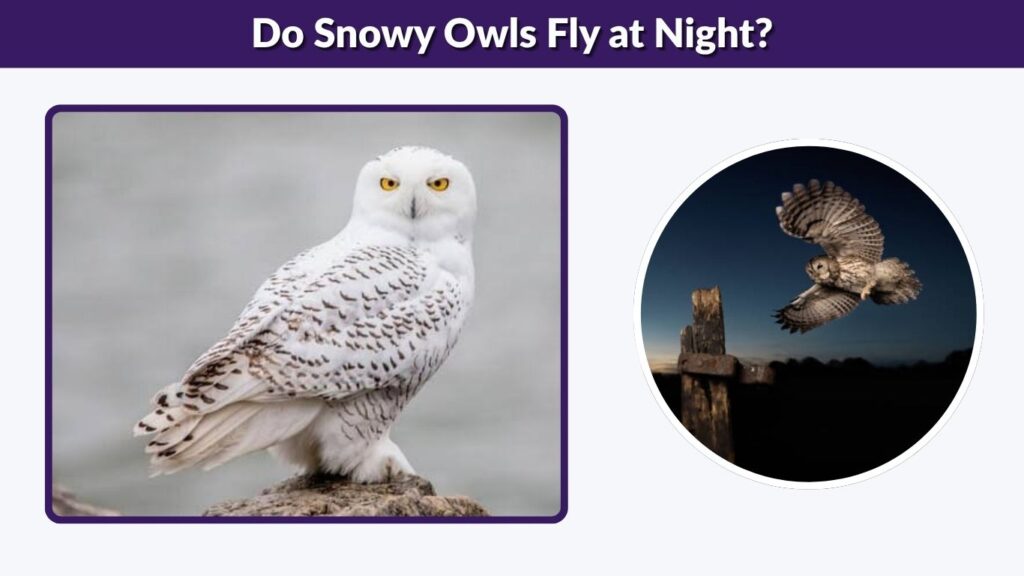
Yes, snowy owls can fly and hunt at night. However, unlike many owl species, they are also highly active during daylight.
This unusual behavior is an adaptation to their Arctic breeding environment, where summer daylight can continue for 24 hours.
Snowy Owl Flying During the Day
Snowy owls frequently hunt during daylight in the Arctic tundra.
During summer, they may remain active throughout the day while searching for food for themselves and their chicks.
Their excellent vision allows them to locate prey in bright conditions.
Snowy Owl Flying at Night
During winter, snowy owls may hunt after sunset, especially around coastal areas and open fields.
Some individuals become particularly active around dawn and dusk.
Their activity patterns depend on prey availability, weather, and local lighting conditions.
How Far Can a Snowy Owl Fly?
Snowy owls can travel considerable distances, especially during migration and movements between breeding areas.
Unlike many birds that follow predictable routes, snowy owls frequently move according to food availability.
Their movements can vary substantially between individuals and years.
Snowy Owl Migration Distance
Tracking studies have revealed several remarkable facts:
- Some snowy owls travel hundreds of miles within a few weeks.
- Individuals may move between Arctic breeding territories and southern winter habitats.
- Researchers have documented spring breeding dispersal exceeding 2,000 kilometers.
- Snowy owls sometimes travel across frozen lakes, coastal environments, and open water.
- Individual migration routes can change considerably between years.
Project SNOWstorm has documented extensive movements using GPS transmitters.
However, there is no established universal distance that every snowy owl can fly in a single day or without landing.
How High Can Snowy Owls Fly?
Snowy owls generally prefer low-altitude flight when hunting because their prey frequently moves across the ground.
They may fly higher while migrating, crossing large landscapes, or performing territorial displays.
Snowy Owl Flying Height
During hunting, snowy owls often remain close enough to the ground to detect small mammals.
They also perch on elevated locations, including mounds, fence posts, and rocks, before launching into flight.
During courtship, males may rise into the air using exaggerated wingbeats before descending toward females.
Although tracking devices record flight altitude, a consistent maximum flying height has not been established for the species.
Male vs Female Snowy Owl Flying
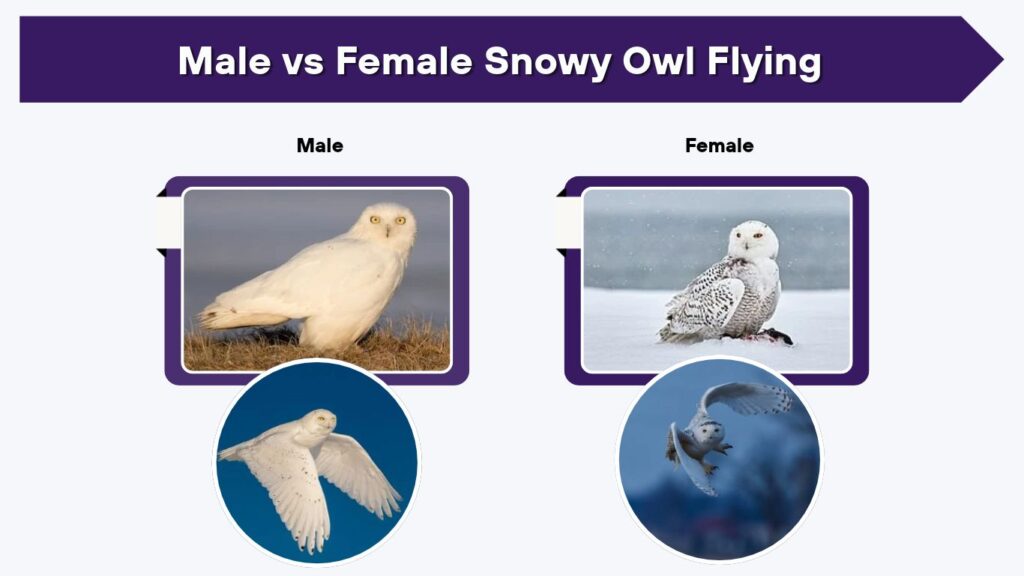
Male and female snowy owls are both capable of strong, controlled flight. However, their sizes, coloration, and breeding responsibilities differ.
Females are generally larger and heavier than males, while adult males often have whiter feathers.
Male Snowy Owl Flying
Male snowy owls frequently perform aerial displays during courtship.
A male may carry prey while flying with exaggerated wingbeats before approaching a female.
During nesting, males also hunt and deliver food to females and developing chicks.
Female Snowy Owl Flying
Female snowy owls are generally larger and often have more dark markings across their wings and bodies.
They hunt effectively and can defend nesting territories when threatened.
Both sexes use their powerful wings to travel between hunting areas and respond to potential predators.
Do Snowy Owls Fly in Groups?
Snowy owls are generally solitary birds and do not usually form organized flying flocks.
During the breeding season, adults defend nesting territories. Outside breeding periods, individuals may occupy separate hunting areas.
Occasionally, several snowy owls gather in locations where prey is abundant, but this does not mean they are traveling as a coordinated group.
Do Snowy Owls Carry Babies While Flying?

Snowy owls do not normally carry their chicks on their backs while flying.
Young snowy owls remain in or near their ground nests during early development.
Parents bring food to their chicks until the young birds become increasingly independent.
As their feathers and muscles develop, juvenile snowy owls begin practicing movement and eventually learn to fly.
Interesting Facts About Snowy Owl Flight
Snowy owls possess several remarkable flying characteristics that distinguish them from many other birds of prey.
Their flight abilities support hunting, reproduction, migration, and survival in harsh Arctic environments.
Snowy Owl Flying Facts
- Snowy owls regularly fly during daylight.
- Their wingspan can exceed four feet.
- They frequently hunt by flying low over open ground.
- They can briefly hover while searching for prey.
- Males perform aerial courtship displays.
- Their specialized feathers help reduce flight noise.
- They can travel thousands of kilometers during seasonal movements.
- Both males and females are powerful flyers.
- They may pursue birds while airborne.
- Their migration patterns are influenced by prey availability.
These abilities make snowy owls highly adaptable predators across Arctic and temperate environments.
FAQs
1. How fast can a snowy owl fly?
Snowy owls can fly swiftly when hunting or traveling, but a reliable maximum speed has not been firmly established. Their speed varies with wind, prey pursuit, and flight conditions. They often prioritize controlled movement and efficient hunting rather than continuous high-speed flight.
2. Do snowy owls fly silently?
Snowy owls fly relatively quietly because specialized wing feathers reduce certain flight sounds. These adaptations help them approach prey and detect sounds while hunting. However, their flight is not completely silent, and noise levels vary with flying conditions.
3. Can snowy owls fly at night?
Yes, snowy owls can fly and hunt at night. Unlike many nocturnal owl species, they are also active during daylight. Their behavior changes with seasonal light conditions, food availability, and habitat, particularly during the Arctic summer and winter.
4. How far can snowy owls fly without stopping?
The maximum nonstop flying distance of a snowy owl is not well established. Tracking studies show that snowy owls can cover enormous distances during migration, but those journeys may involve resting and hunting stops along the way.
5. Why do snowy owls fly close to the ground?
Snowy owls often fly close to the ground because they hunt small mammals and birds living in open landscapes. Low flight allows them to inspect the terrain, approach prey, and strike efficiently with their powerful talons.