
Where do great grey owls live, and what makes their habitat suitable for survival? These magnificent birds inhabit northern forests, mountain woodlands, and open meadows across North America, Europe, and Asia. The great grey owl habitat provides essential nesting sites, shelter, and access to small mammals. Although they prefer dense forests for protection, they frequently hunt in nearby open spaces. Understanding their habitat range, nesting preferences, and seasonal movements reveals how these remarkable owls survive in some of the world’s coldest environments.
What Is the Natural Habitat of a Great Grey Owl?
The great grey owl (Strix nebulosa) primarily inhabits boreal forests, mountain woodlands, and landscapes containing both trees and open hunting areas. These environments provide suitable nesting sites and access to small mammals. Unlike some owl species that adapt readily to urban settings, great grey owls are closely associated with relatively undisturbed forest ecosystems.
Boreal and Coniferous Forests
Boreal forests represent one of the most important habitats for great grey owls. These northern ecosystems contain extensive evergreen forests dominated by spruce, fir, and pine trees.
The forest canopy provides shelter from severe weather, while large trees offer resting and nesting opportunities.
In Canada and Alaska, great grey owls frequently inhabit taiga forests containing scattered wetlands and grassy openings.
Meadows, Bogs, and Forest Openings
Although these owls depend on forests, open spaces are equally important for hunting.
Their preferred habitat often includes:
- Mountain meadows: Open grassy areas supporting voles and other rodents.
- Forest edges: Transitional areas offering convenient hunting perches.
- Bogs and wetlands: Moist environments supporting small mammals.
- Muskegs: Northern wetlands surrounded by coniferous forests.
- Woodland clearings: Open patches where owls can locate moving prey.
These habitats provide a combination of cover, nesting opportunities, and accessible food.
Great Grey Owl Habitat Range and Distribution
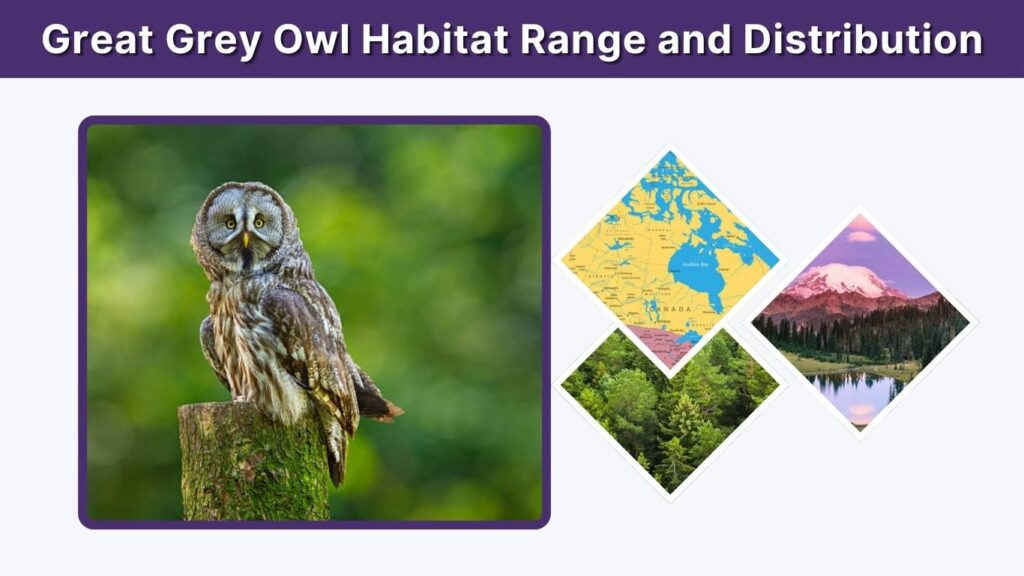
Great grey owls have a broad distribution across the Northern Hemisphere. They occur in North America, northern Europe, and Asia, primarily where extensive forests provide suitable nesting and hunting conditions. Although their worldwide range is large, populations are unevenly distributed because local habitat quality and prey availability influence where these birds establish territories.
Great Grey Owl Habitat in North America
In North America, great grey owls inhabit Alaska, much of Canada, and selected regions of the United States.
Important locations include:
- Alaska and northern Canada.
- British Columbia and Alberta.
- Northern Minnesota.
- Montana and Idaho.
- Wyoming and the northern Rocky Mountains.
- Oregon and Washington.
- California’s Sierra Nevada mountains.
Great grey owls are generally more widespread in northern forests than in the southern portions of their range.
Great Grey Owl Habitat in Europe and Asia
Outside North America, great grey owls inhabit northern European and Asian forests.
Their range includes Scandinavia, Finland, Russia, Siberia, and parts of Mongolia.
These populations occupy boreal woodlands and forest openings where rodents are abundant. Like their North American relatives, they depend on suitable nesting trees and accessible hunting grounds.
Great Grey Owl Habitat Map: Understanding Their Range
A great grey owl habitat map illustrates their broad distribution across northern forests and scattered western mountain regions.
The Cornell Lab of Ornithology provides a species range map showing the owl’s North American distribution.
However, a range map indicates where the species may occur, not that every forest within the shaded area contains resident owls.
Food availability and habitat conditions strongly influence local distribution.
Great Grey Owl Habitat in California and Wyoming
California and Wyoming contain important great grey owl populations near the southern limits of the species’ North American range. These owls rely heavily on mountain forests surrounded by meadows and other open areas. Their habitat requirements differ somewhat from northern populations because of local climate, elevation, forest structure, and the availability of nesting locations.
Great Grey Owl Habitat in California
California’s great grey owls primarily occupy the Sierra Nevada, including Yosemite National Park.
They favor mature coniferous forests bordering moist mountain meadows. These openings support voles and pocket gophers, which provide essential food.
The Sierra Nevada population is genetically distinct from other western North American great grey owls, making habitat protection particularly important.
Great Grey Owl Habitat in Wyoming
In Wyoming, great grey owls inhabit forested mountain environments, especially around the Greater Yellowstone ecosystem and Grand Teton National Park.
These areas contain mature coniferous forests, forest edges, and open hunting grounds.
Research within Grand Teton National Park has examined nesting success, territory occupancy, and year-round habitat use to support conservation planning.
Where Do Great Grey Owls Build Their Nests?
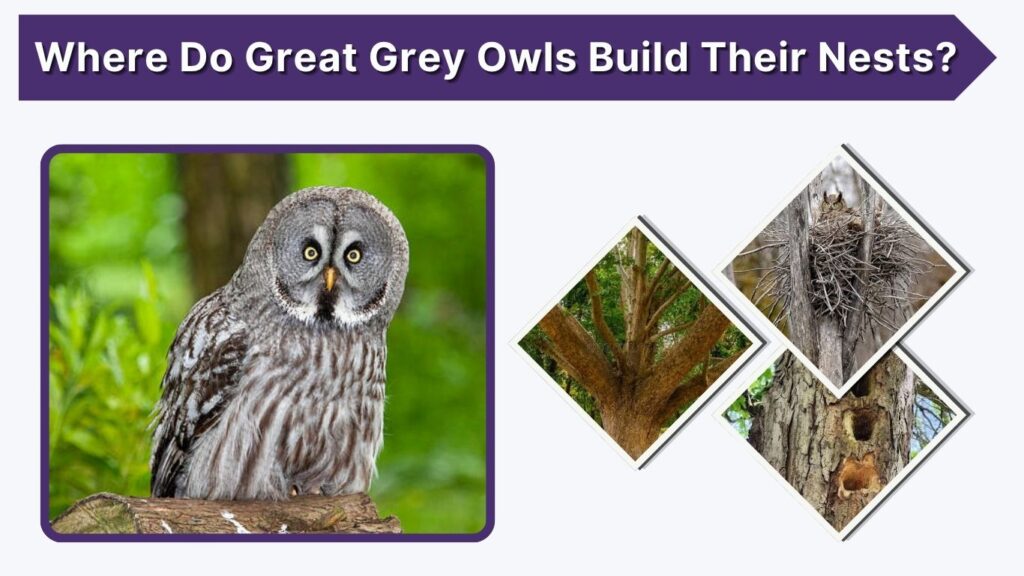
Nesting habitat is an essential component of the great grey owl’s survival. These birds usually occupy mature forests containing large trees, broken trunks, or abandoned nests built by other birds. Unlike some smaller owls, great grey owls generally do not nest inside tree cavities. Instead, they use elevated platforms that provide space and protection for their eggs and young.
Preferred Nesting Locations
Great grey owls often reuse abandoned nests constructed by hawks and other large birds.
They may also nest on the broken tops of dead trees or naturally occurring platforms.
Suitable nesting sites are commonly located near meadows, allowing adults to collect food without traveling excessive distances.
Important Nesting Habitat Features
Several characteristics make a forest suitable for nesting:
- Mature trees with strong branches.
- Broken-topped snags suitable for nesting.
- Abandoned nests from large birds of prey.
- Nearby meadows supporting small mammals.
- Limited human disturbance during breeding.
The availability of suitable nesting structures can influence local population density and reproductive success.
How Does Great Grey Owl Habitat Support Hunting?
Great grey owls are specialized predators that primarily hunt small mammals. Their habitat must provide enough open ground for locating prey and nearby trees for resting or surveying hunting areas. Forest edges and meadows are particularly valuable because rodents frequently inhabit grassy vegetation. These owls use their exceptional hearing to detect prey even when animals remain hidden.
Hunting in Meadows and Open Forests
Great grey owls frequently perch along meadow edges while listening for moving rodents.
Voles are among their most important prey species, although they also capture mice, pocket gophers, and other small mammals.
Open hunting grounds allow them to glide quietly toward prey without navigating dense vegetation.
Hunting in Snow-Covered Habitats
During winter, great grey owls continue hunting in snowy forests and meadows.
Their large facial discs and asymmetrical ear openings help them locate rodents moving beneath snow.
Once prey is detected, an owl may plunge feet-first through the snow to capture it.
This remarkable ability allows them to survive in northern environments where prey is often invisible beneath the surface.
Do Great Grey Owls Change Their Habitat Seasonally?
Great grey owls are generally considered nonmigratory birds, but their movements can vary considerably. Some individuals remain within established territories throughout the year, while others travel to different areas when prey becomes scarce. Snow depth, seasonal temperatures, and rodent population changes influence where these owls hunt and spend time.
Spring and Summer Habitat
During spring and summer, great grey owls often remain near nesting territories in mature forests.
Adults frequently hunt in nearby grassy meadows to provide food for developing chicks.
These environments are particularly important because successful reproduction requires dependable prey populations.
Autumn and Winter Habitat
Winter conditions can influence great grey owl movements.
In California and Oregon, some individuals move to lower elevations, including mixed forests and oak woodlands.
In northern regions, periods of reduced rodent availability may cause owls to move farther south than usual.
Such movements are often associated with food shortages rather than regular long-distance migration.
Threats to Great Grey Owl Habitats
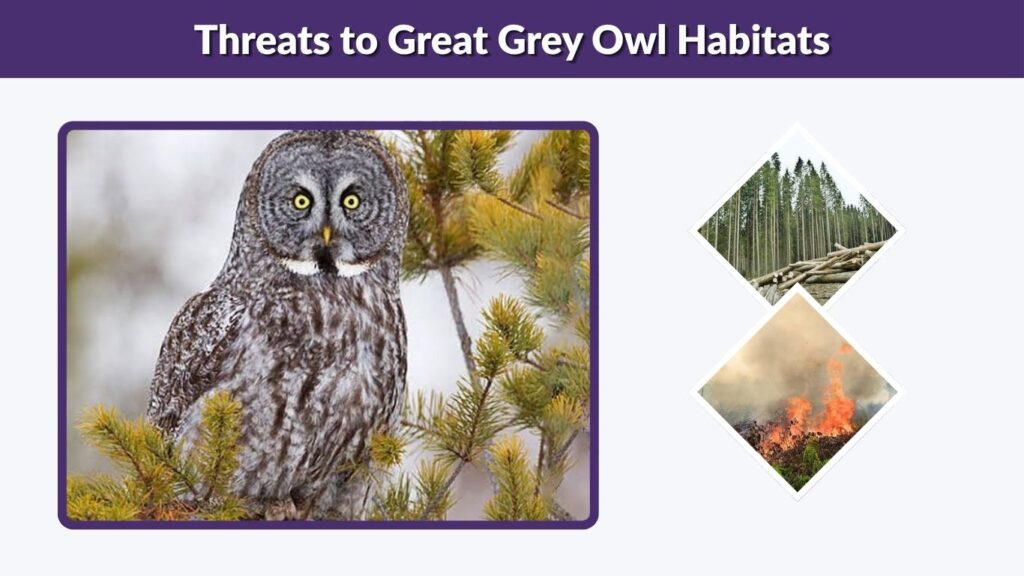
Although great grey owls occupy an extensive global range, some regional populations face significant habitat challenges. Forest management practices, meadow degradation, and disturbances around nesting locations can reduce habitat suitability. Because these owls require both nesting forests and productive hunting openings, protecting only one part of their environment may not provide sufficient support for long-term survival.
Habitat Loss and Forest Changes
Extensive logging may remove mature nesting trees and established raptor nests.
Forest encroachment into natural meadows can reduce hunting opportunities, while excessive grazing may affect vegetation and small mammal populations.
Severe wildfires can also destroy nesting structures, although certain natural disturbances may create beneficial habitat conditions over time.
How Can Great Grey Owl Habitats Be Protected?
Effective conservation involves preserving essential habitat features:
- Protect mature forests and established nesting trees.
- Maintain natural meadows and forest openings.
- Preserve large dead trees where they do not pose safety risks.
- Reduce disturbance around active nesting sites.
- Maintain healthy rodent populations through responsible habitat management.
Protecting connected forests and meadows helps preserve both nesting and hunting opportunities.
FAQs
1. What type of habitat do great grey owls prefer?
Great grey owls prefer boreal and mountain forests near open meadows, bogs, or wetlands. These environments provide nesting trees and suitable hunting grounds.
2. Where are great grey owls most commonly found?
Great grey owls occur throughout northern Canada, Alaska, and the boreal forests of northern Europe and Asia. Smaller populations inhabit western mountain regions of the United States.
3. Do great grey owls live in the mountains?
Yes. Great grey owls inhabit mountain forests, including parts of the Rocky Mountains and Sierra Nevada, where suitable forests and open meadows occur together.
4. Do great grey owls live in snowy habitats?
Yes. They are well adapted to snowy northern forests and can detect and capture small mammals beneath snow using their exceptional hearing.
5. Do great grey owls live in the same habitat year-round?
Many remain in their general range throughout the year, but some move to lower elevations or different locations when food availability or winter conditions change.