
The Spotted Owlet (Athene brama) is a small, round-headed owl widely found across the Indian subcontinent and parts of Southeast Asia. Known for its bright yellow eyes, white-spotted brown plumage, expressive face, and noisy calls, this adaptable owl often lives surprisingly close to people. It commonly roosts in tree cavities, old buildings, gardens, farmland, and village groves. This guide covers Spotted Owlet identification, size, habitat, diet, call, breeding, juveniles, conservation status, and important differences from the Pearl-spotted and Forest owlets.
What Does a Spotted Owlet Look Like?
The Spotted Owlet is a compact owl with a large rounded head, short tail, and no ear tufts. Its brownish-gray plumage is covered with conspicuous white spots, while the underparts are paler with brown markings. Bright yellow eyes and prominent whitish eyebrows give the bird an alert expression. Males and females look very similar, although females are generally somewhat larger.
Spotted Owlet Identification
Important identification features include:
- Scientific name: Athene brama
- Family: Strigidae
- Rounded head without ear tufts
- Bright golden-yellow eyes
- Brown to gray-brown upperparts
- Numerous white spots on the back and wings
- Pale underparts with brown bars or spots
- Distinctive white eyebrows
- Whitish collar around the back of the neck
- Short, barred tail
These features help distinguish the species from many other small Asian owls.
Spotted Owlet Size
An adult Spotted Owlet is generally about 19–21 cm long and weighs roughly 110–114 grams, although measurements vary between geographic forms and sexes. Its size is often compared with that of a myna.
Despite its small body, it has powerful feet and sharp talons suited to catching insects, rodents, and other small prey.
Male and Female Spotted Owlets
Male and female Spotted Owlets have very similar plumage, making sex identification difficult by appearance alone. Females tend to average slightly larger than males.
Pairs often roost together during the day and may become particularly vocal around their territory during the breeding period. Their strong pair association is one reason two owlets are frequently seen occupying the same tree or cavity.
Spotted Owlet Habitat and Distribution
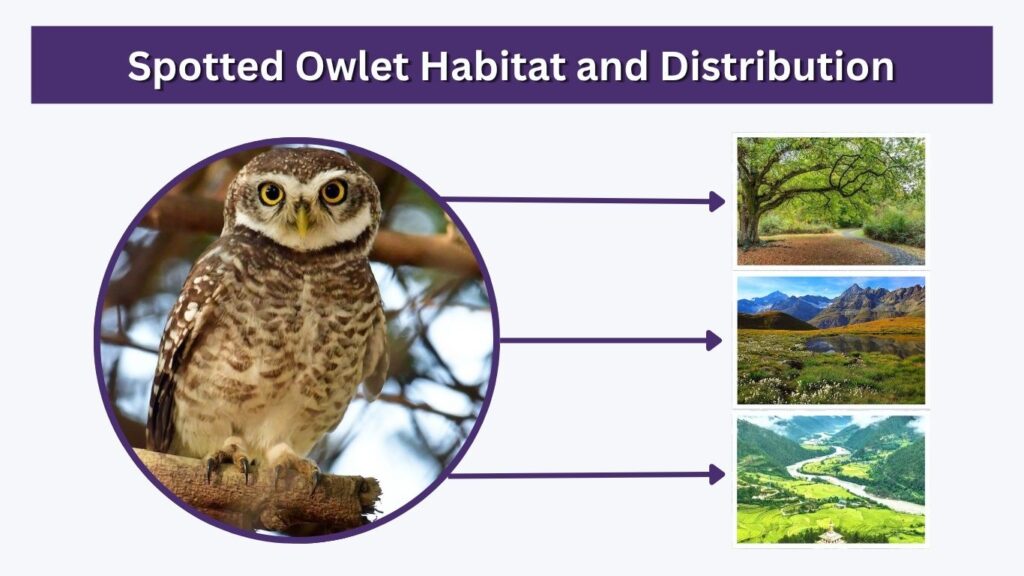
The Spotted Owlet is highly adaptable and frequently occupies landscapes modified by people. It favors open and semi-open environments rather than dense, wet forest. Large old trees are especially valuable because natural hollows provide daytime roosting and nesting places. The species can also use holes in buildings, ruins, cliffs, and other structures when suitable cavities are available.
Where Do Spotted Owlets Live?
Common habitats include:
- Agricultural fields
- Village groves
- Gardens and parks
- Dry open woodland
- Semi-desert landscapes
- Orchards
- Large roadside trees
- Old buildings and ruins
- Forest edges
- Urban and suburban areas with mature trees
They generally avoid thick forest and particularly wet environments.
Spotted Owlet in India
The Spotted Owlet is a familiar resident across much of India. It occurs in plains and foothills and is commonly encountered near villages, cultivation, gardens, old mango trees, banyans, tamarinds, and other mature trees with cavities.
Historical Indian ornithological accounts describe it as one of the country’s most familiar owls, often living comfortably near human settlements.
Is the Spotted Owlet Found in Dense Forest?
Usually not. Although it may occur around woodland and forest edges, the species tends to prefer more open environments.
This is important when interpreting searches such as “forest spotted owlet.” A Spotted Owlet seen near a forest should not automatically be confused with the Forest Owlet, which is a separate species with different appearance, range, and conservation concerns.
Spotted Owlet Diet and Hunting
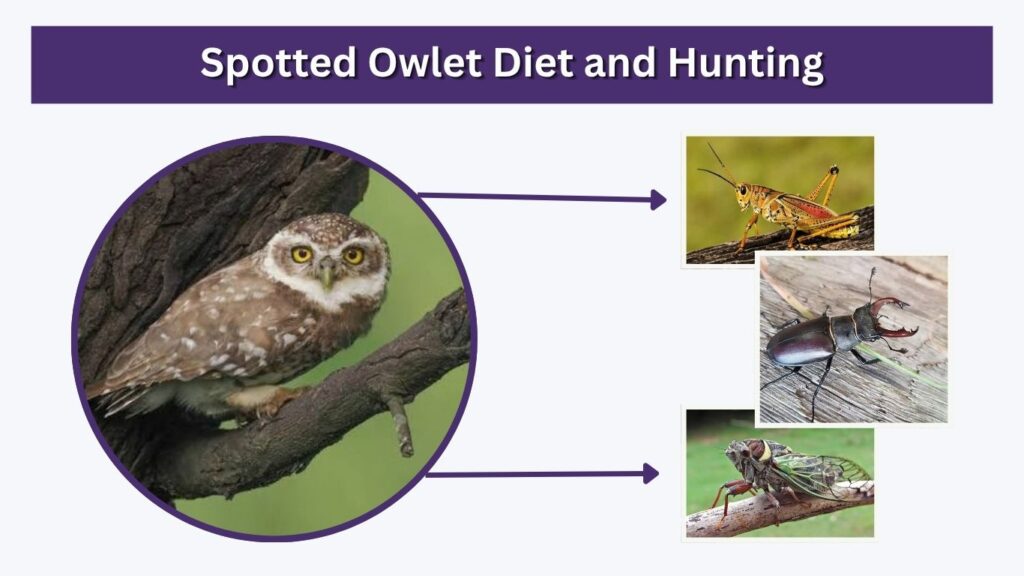
Spotted Owlets are opportunistic predators. Insects make up a major part of their food, particularly where beetles, moths, and other night-flying insects are abundant. However, they are capable of tackling small vertebrates as well. Their willingness to hunt around villages and artificial lighting helps explain why they adapt so successfully to human-dominated environments.
What Does a Spotted Owlet Eat?
Its diet can include:
- Beetles
- Moths
- Other large insects
- Earthworms
- Lizards
- Mice and other small rodents
- Small birds
- Other small available prey
Insects are particularly important, but diet changes with local prey availability.
How Does the Spotted Owlet Hunt?
The Spotted Owlet commonly waits on a perch and watches for movement below. Once prey is detected, it drops or flies rapidly toward it and captures it with its feet.
It may also catch flying insects. Streetlights can create productive hunting areas because moths and other insects gather around artificial light, providing the owl with concentrated feeding opportunities.
Spotted Owlet Call and Sound
The Spotted Owlet call is one of the easiest ways to detect the species. These birds can be surprisingly noisy, especially around dusk and dawn. Rather than producing only the stereotypical deep “hoot” associated with many owls, Spotted Owlets use harsh calls, squeals, whistles, chuckles, and repeated vocal sequences. Pairs may also call from trees or buildings near their roost.
What Does a Spotted Owlet Sound Like?
The best-known call is a loud, repeated, harsh “chirurr-chirurr-chirurr” sequence. Other vocalizations include high-pitched whistles, screeches, chuckling notes, and repeated calls.
These sounds can seem surprisingly loud for such a small bird and often reveal the owl’s presence before it can be seen.
When Do Spotted Owlets Call?
They are mainly crepuscular and nocturnal, so vocal activity often increases around sunset, nighttime, and early morning.
However, Spotted Owlets may occasionally be active during daylight. A bird disturbed from a daytime roost can sometimes emerge from a tree hollow and watch nearby activity with its characteristic wide-eyed expression.
Spotted Owlet Nest, Baby and Life Cycle
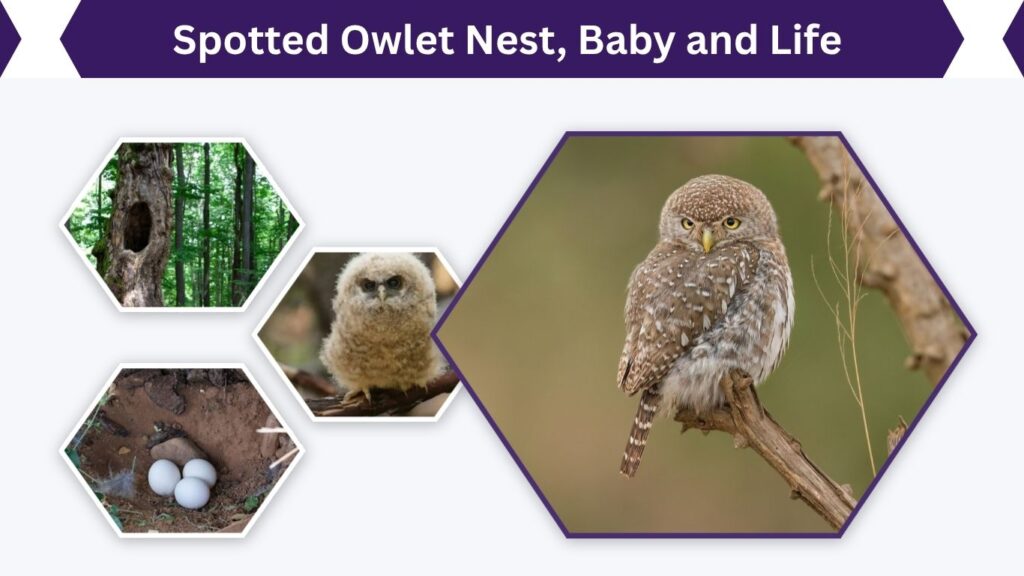
Spotted owlets are cavity nesters and usually depend on existing holes rather than constructing exposed nests. Mature trees therefore provide essential breeding habitat. In landscapes where natural cavities are limited, the birds may use holes in buildings or other structures. Breeding season differs geographically, with northern and southern populations nesting at somewhat different times of year.
Where Does a Spotted Owlet Nest?
Typical nesting locations include:
- Natural tree hollows
- Old woodpecker-type cavities
- Holes in buildings
- Ruins
- Earth cliffs and ravines
- Large mature roadside or village trees
A clutch commonly contains 2–3 eggs, although as many as five may occur. The eggs are white and hatch asynchronously because incubation can begin before the clutch is complete.
Spotted Owlet Juvenile
Young Spotted Owlets initially appear softer and fluffier than adults. As they grow, their plumage develops the spotted and barred pattern characteristic of mature birds.
Juveniles remain dependent on their parents while developing hunting and flight skills. Family groups may stay together around the nesting and roosting area for a period after the young leave the cavity.
Spotted Owlet vs Pearl-Spotted Owlet
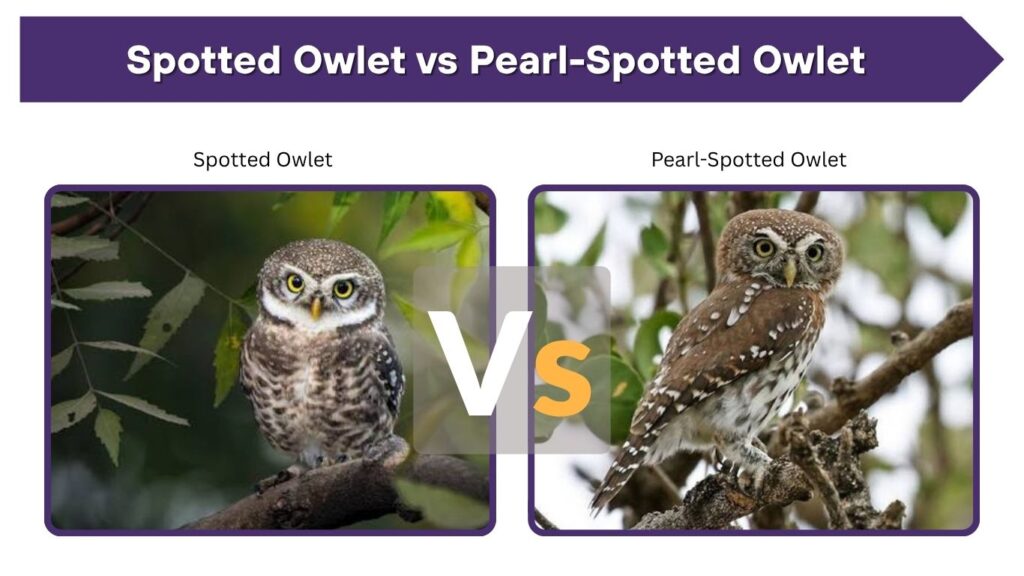
Despite their similar names, the Spotted Owlet and Pearl-spotted Owlet are completely different species from different regions. The Spotted Owlet (Athene brama) is primarily an Asian species, whereas the Pearl-spotted Owlet (Glaucidium perlatum) is an African owl. Their plumage, calls, geographic distribution, and genus all differ.
Main Differences
- Spotted Owlet: Athene brama
- Pearl-spotted Owlet: Glaucidium perlatum
- Spotted Owlet occurs mainly in South and parts of Southeast Asia
- Pearl-spotted Owlet occurs in sub-Saharan Africa
- Spotted Owlet has conspicuous white spotting and white eyebrows
- Pearl-spotted Owlet has distinctive markings and different vocalizations
- Both prey heavily on insects but can also capture small vertebrates
The similar common names should therefore not be used interchangeably.
Spotted Owlet Conservation and Human Interaction
The Spotted Owlet’s ability to live around farms, villages, parks, and buildings has helped it remain widespread. Its use of old trees and cavities means that mature vegetation remains particularly important in developed landscapes. Although the bird may appear approachable while roosting, it is still a wild predator and should be observed without disturbing its nest or young.
Spotted Owlet IUCN Status
The Spotted Owlet is currently categorized as Least Concern on the global conservation listing summarized by BirdLife International.
Its relatively broad distribution contributes to this status, but local populations can still be affected by loss of mature cavity-bearing trees, disturbance of nesting sites, and changes in prey availability.
Can You Keep a Spotted Owlet as a Pet?
A Spotted Owlet is a wild bird, not a domesticated pet species. Keeping native wildlife can also be regulated or prohibited depending on the country.
Owlets found outside a nest should not automatically be taken into captivity because recently fledged young may still be cared for by adults nearby. Injured birds are best handled through an appropriate wildlife rescue or rehabilitation service.
FAQs
Spotted owlets are among the small owls most commonly encountered around human settlements in South Asia. Their bright eyes, loud calls, and habit of living inside old trees often lead to questions about identification and behavior. The answers below cover five of the most common searches about this adaptable owl.
1. What Is a Spotted Owlet?
The Spotted Owlet is a small owl scientifically known as Athene brama. It belongs to the typical owl family Strigidae and is widespread across much of South Asia and neighboring regions.
2. How Big Is a Spotted Owlet?
Adults are generally around 19–21 cm long, with females usually somewhat larger than males.
3. What Does a Spotted Owlet Eat?
Its diet consists mainly of insects such as beetles and moths, but it can also eat earthworms, lizards, mice, and small birds.
4. Is the Spotted Owlet Endangered?
No. It is currently listed as Least Concern, meaning it is not presently considered globally threatened.
5. What Is the Difference Between a Spotted Owlet and Forest Owlet?
The Spotted Owlet is Athene brama, a widespread species often found around villages and open landscapes. The Forest Owlet is a separate Indian species associated with a much more restricted range and different habitat requirements.