
The Western Screech-Owl (Megascops kennicottii) is a small, well-camouflaged owl found across western North America. Despite its name, its most familiar call is not a harsh screech but a rapid series of hollow whistles or toots that gradually speed up. These nocturnal hunters live in woodlands, deserts, parks, streamside forests, and even residential neighborhoods. Their small size hides impressive hunting ability: Western Screech-Owls capture rodents, insects, birds, amphibians, and other prey while using tree cavities for daytime roosting and nesting.
Western Screech-Owl Identification
Western Screech-Owls are compact birds with stocky bodies, short tails, rounded wings, conspicuous feather tufts, and brilliant yellow eyes. Their patterned plumage allows them to almost disappear against tree bark during daylight hours.
What Does a Western Screech-Owl Look Like?
Important identification features include:
- Length of about 7.5–9.8 inches
- Wingspan of about 21.6–24.4 inches
- Weight of approximately 3.5–10.8 ounces
- Yellow eyes
- Dark bill
- Prominent ear-like feather tufts
- Gray, brown, or sometimes reddish-brown plumage
- Pale underparts covered with dark streaking
Their feathers are heavily patterned with streaks, bars, and spots that imitate bark. Pacific Northwest birds tend to show more reddish coloration, while individuals in the Desert Southwest are often grayer.
Male vs. Female Western Screech-Owl
Male and female Western Screech-Owls look very similar, so plumage alone usually cannot reliably determine sex.
Females tend to be somewhat larger and heavier than males. Vocal behavior can sometimes provide clues because males commonly give the characteristic territorial call, although females also vocalize and pairs may call together.
Western Screech-Owl Sound and Call
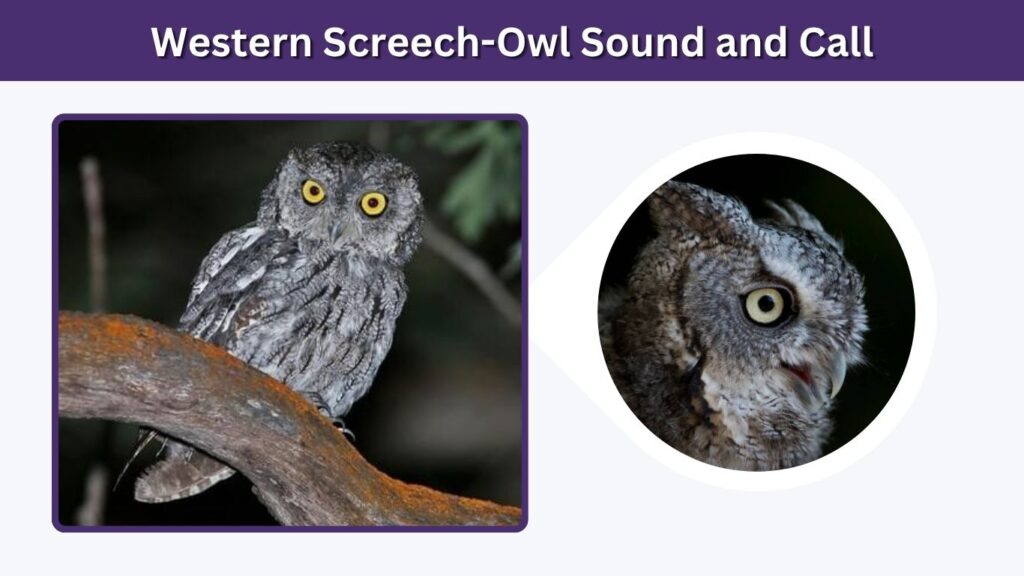
Hearing this owl is considerably easier than seeing one. Western Screech-Owls spend daylight hours hidden in cavities or camouflaged against tree trunks and become active around sunset.
What Does a Western Screech-Owl Sound Like?
Its signature call consists of a series of clear, hollow whistles or toots that accelerate toward the end. The rhythm is frequently compared to a bouncing ball that gets progressively faster.
Despite the name “screech-owl,” the Western Screech-Owl does not normally produce the dramatic descending screech people may expect. Males most frequently give the accelerating call, although females sometimes join them in duets.
Why Do Western Screech-Owls Call at Night?
Calling helps owls communicate with their mates and advertise territories.
Vocal activity can occur throughout much of the year, not only during breeding season. Because these owls are nocturnal, nighttime calls are often the first indication that one lives nearby.
During courtship, a male and female may perform vocal duets, and males may bring food to females.
Western Screech-Owl Size
Western Screech-Owls are relatively small compared with familiar species such as Great Horned Owls and Barred Owls.
Adults measure approximately 19–25 cm (7.5–9.8 inches) long, with wingspans around 55–62 cm (21.6–24.4 inches). Their recorded weights range from roughly 100–305 grams.
Their compact appearance can be deceptive. Western Screech-Owls are powerful predators capable of capturing surprisingly substantial prey relative to their body size.
Western Screech-Owl Habitat and Range
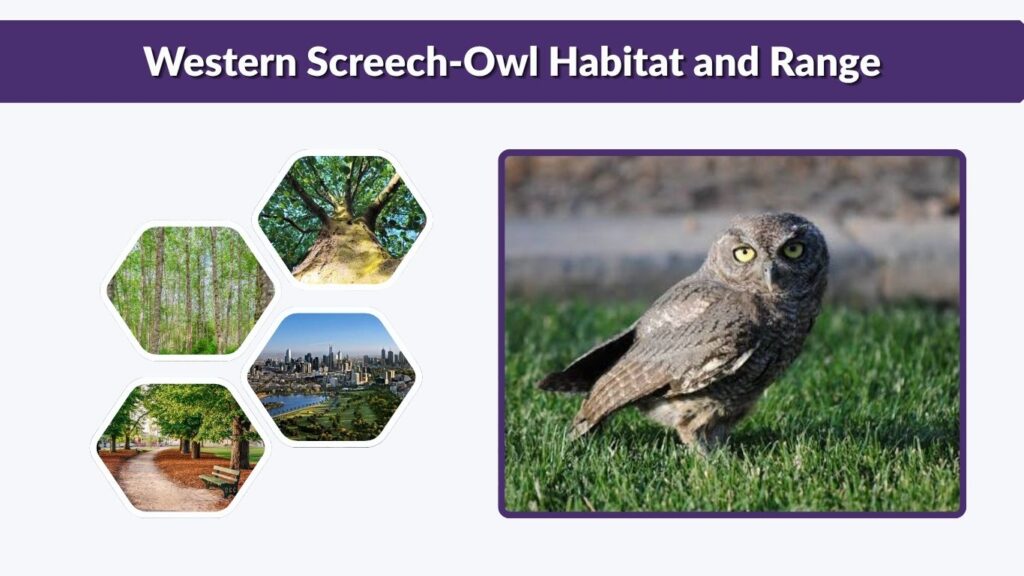
Western Screech-Owls inhabit a surprisingly diverse collection of environments.
Where Does the Western Screech-Owl Live?
They occur through western North America and are associated particularly with wooded habitats. Streamside forests containing cottonwoods, alders, maples, oaks, aspens, and other deciduous trees provide excellent habitat.
They also occur in deserts, mountains, parks, suburbs, and residential landscapes containing mature trees. Cornell reports them in forested environments at elevations reaching roughly 6,000 feet.
Western Screech-Owls are generally resident rather than migratory, meaning individuals typically remain within their geographic range throughout the year.
Western Screech-Owls in California, Arizona and Oregon
The species is particularly familiar across parts of the western United States, including California, Arizona, Oregon, Washington, and neighboring regions.
Southwestern populations may inhabit desert washes and wooded canyons, while Pacific Northwest birds frequently occupy forests and streamside vegetation.
Their willingness to occupy parks and residential neighborhoods means people sometimes hear them without realizing an owl is living nearby.
Western Screech-Owl Diet and Hunting Behavior
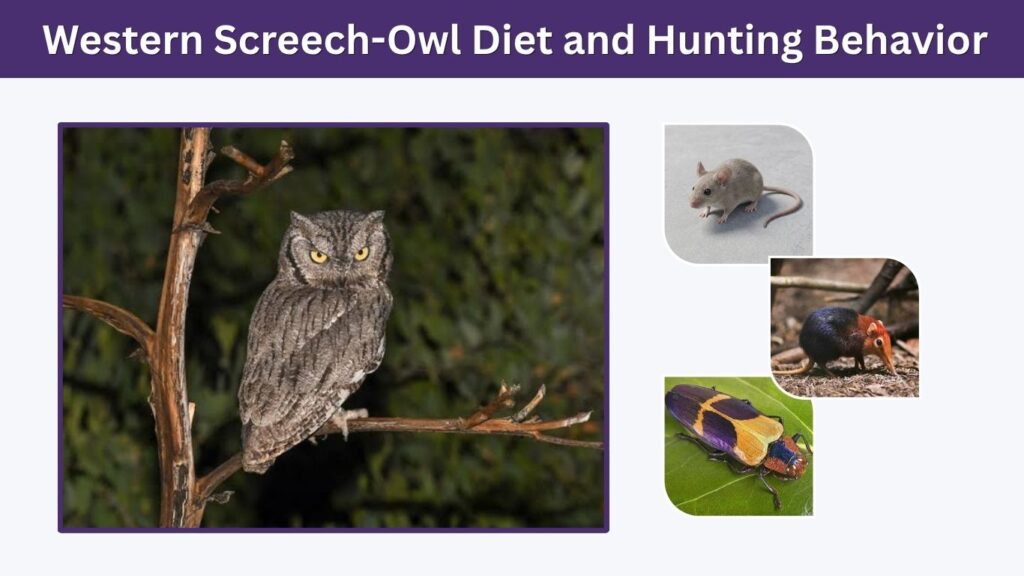
Western Screech-Owls are carnivorous opportunists that consume whatever appropriately sized prey is locally available.
What Do Western Screech-Owls Eat?
Small mammals are important prey, including mice, shrews, woodrats, and kangaroo rats. Their diet may also contain birds, bats, insects, worms, amphibians, fish, crayfish, snails, and other invertebrates.
They typically hunt from a perch, watching and listening before dropping toward prey. They can also capture flying insects in the air, search vegetation for invertebrates, and hunt around streams for aquatic prey such as crayfish.
Western Screech-Owl Behavior
These owls are primarily nocturnal. They generally leave daytime roosts around sunset and return near sunrise.
During daylight they may hide completely inside a cavity or sit at its entrance. Their feather pattern provides extraordinary camouflage, allowing an owl to resemble broken bark when it presses close to a tree trunk.
Western Screech-Owl Nest and Eggs
Western Screech-Owls are cavity nesters, but they do not excavate their own holes.
Where Do Western Screech-Owls Nest?
Natural tree cavities and abandoned woodpecker holes provide important nest sites. Occasionally, the owls use cavities in banks or cliffs.
They also accept properly constructed nest boxes, which can be valuable where suitable mature cavity trees are limited.
Unlike many songbirds, a Western Screech-Owl does not construct a conventional nest. The female lays her eggs on existing material at the bottom of the cavity.
Eggs and Breeding
A typical clutch can contain 2–7 white eggs, with incubation lasting approximately 26–34 days.
The female handles most incubation and early brooding while the male supplies much of the food. Both parents participate in protecting the nest.
Newly hatched owlets are covered with white down and have closed eyes.
Juvenile and Fledgling Western Screech-Owls
Young Western Screech-Owls gradually replace their fluffy down with juvenile feathers as they develop.
Interestingly, young owls can leave the nesting cavity before becoming strong flyers. They may climb and move through nearby branches while continuing to depend on their parents.
After leaving the nest site, juveniles remain associated with their parents for about another five weeks while developing hunting and flying skills.
People who encounter a young owl on a branch should therefore avoid assuming it has been abandoned.
Western Screech-Owl Lifespan
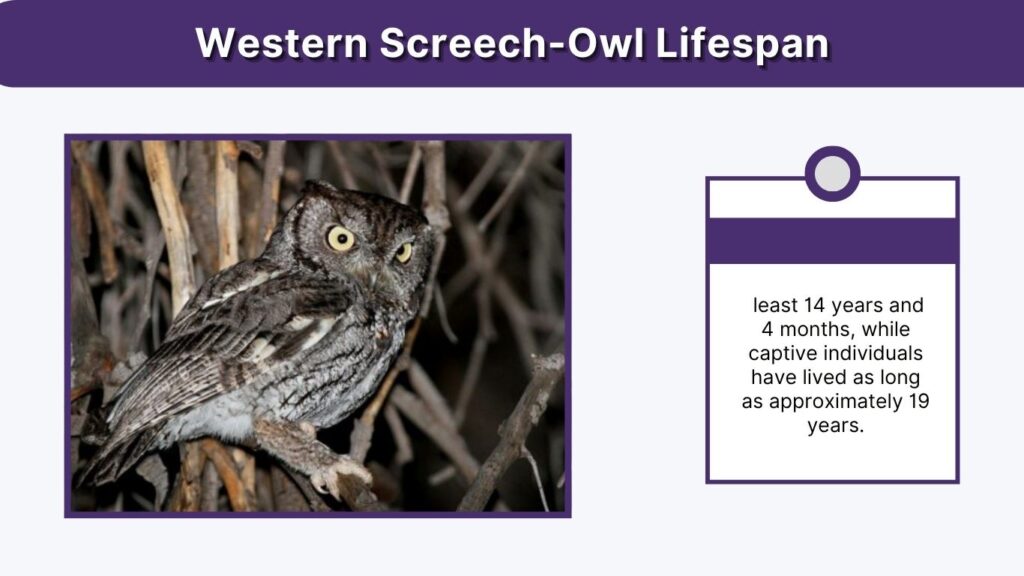
Western Screech-Owls can survive for many years when they avoid predators, collisions, habitat loss, and other hazards.
Cornell reports a wild individual that reached at least 14 years and 4 months, while captive individuals have lived as long as approximately 19 years.
Not every owl approaches these ages, especially because mortality can be high among young birds.
Eastern vs. Western Screech-Owl
Eastern and Western Screech-Owls are close relatives with similar sizes, feather tufts, yellow eyes, and cryptic plumage.
Their voices are among the easiest ways to separate them. Western Screech-Owls typically produce an accelerating sequence of hollow toots. The Eastern Screech-Owl is well known for a descending, horse-like whinny as well as a long tremolo.
Geography also helps: Western Screech-Owls occur primarily in western North America, while Eastern Screech-Owls dominate much of eastern North America.
Are Western Screech-Owls Endangered?
Western Screech-Owls are currently considered a species of relatively low conservation concern overall, although populations are not equally secure everywhere.
Threats include removal of mature and dead trees containing nesting cavities, development of streamside habitat, forest clearing, and predation by Barred Owls in parts of the Pacific Northwest. Population monitoring has also suggested some long-term declines.
Preserving mature trees, riparian woodland, and nesting cavities can benefit local populations.
Western Screech-Owl Nest Boxes
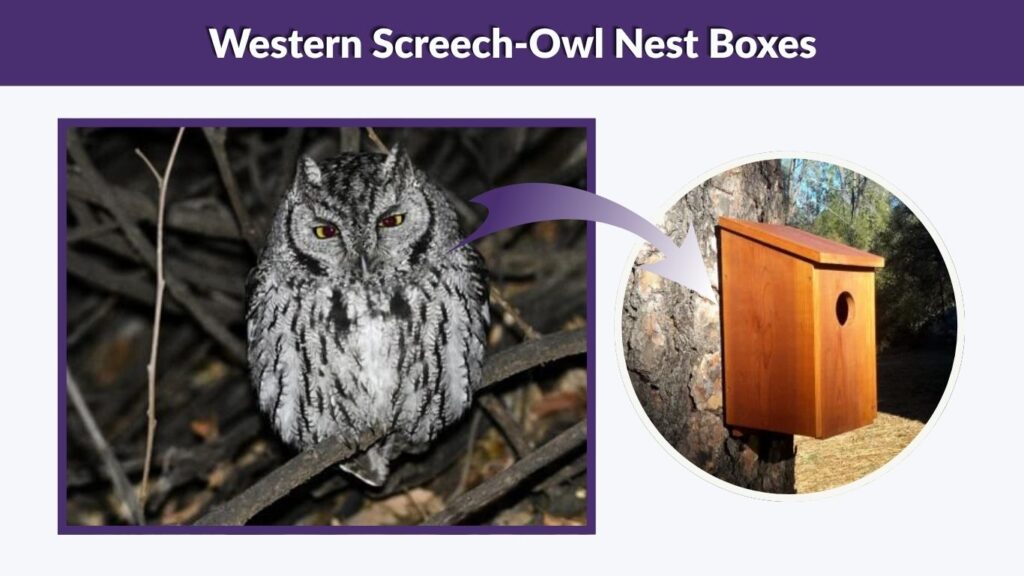
Western Screech-Owls readily use suitable nest boxes, making them one of the owl species homeowners may be able to encourage in wooded yards.
A box should be installed before breeding begins and placed in appropriate habitat with nearby trees and hunting areas. Predator guards can help prevent mammals and other animals from reaching eggs or nestlings.
Avoid repeatedly opening or approaching an occupied box because unnecessary disturbance can interfere with breeding.
FAQs
1. Does a Western Screech-Owl Actually Screech?
Not usually. Its characteristic sound is a sequence of hollow, high-pitched toots that speeds up toward the end.
2. How Big Is a Western Screech-Owl?
Adults are approximately 7.5–9.8 inches long and have wingspans of roughly 21.6–24.4 inches.
3. What Does a Western Screech-Owl Eat?
Its diet includes mice and other small mammals as well as birds, insects, amphibians, crayfish, worms, snails, bats, and occasionally other prey.
4. Are Western Screech-Owls Active During the Day?
They are primarily nocturnal. During daylight hours they normally rest in tree cavities or sheltered roosts, although one may occasionally be visible sitting near a cavity entrance.
5. Can Western Screech-Owls Live in Backyards?
Yes. They can inhabit wooded suburban areas and parks and may use properly designed nest boxes where adequate habitat, food, and mature trees are available.