The Tasmanian masked owl is a large, secretive nocturnal owl found only in Tasmania. Known scientifically as Tyto novaehollandiae castanops, it is a Tasmanian subspecies of the Australian masked owl and is noticeably larger and darker than mainland forms. Its heart-shaped facial disc, powerful build, husky screeching call, and dependence on old hollow-bearing trees make it distinctive. Unfortunately, habitat loss and other threats have placed this remarkable owl under considerable conservation pressure.
What Is a Tasmanian Masked Owl?
The Tasmanian masked owl belongs to the barn owl family, Tytonidae. The Tasmanian government recognizes it as Tyto novaehollandiae subsp. castanops, a subspecies occurring only in Tasmania. It is regarded as the largest nocturnal forest owl in Tasmania and one of the larger members of the Tytonidae family.
Tasmanian Masked Owl Identification
Important features include:
- Large, strongly built body
- Heart- or mask-shaped facial disc
- Dark eyes
- Brown, grey and chestnut-toned plumage
- Darker overall coloration than mainland masked owls
- Strong legs and talons for capturing prey
- Large wings suited to nocturnal hunting
- Noticeably robust appearance
Individual birds can vary in coloration, so identifying one should involve more than plumage alone. Its shape, habitat, size and distinctive call can all provide useful clues.
Male vs Female Tasmanian Masked Owl
Females tend to be larger than males, as occurs in many birds of prey. Color can vary considerably between individuals, so plumage alone is not always a dependable way to determine sex.
Researchers studying Tasmanian masked owls have recorded adult females weighing around one kilogram, illustrating how substantial these owls can be compared with many other nocturnal birds.
Where Do Tasmanian Masked Owls Live?
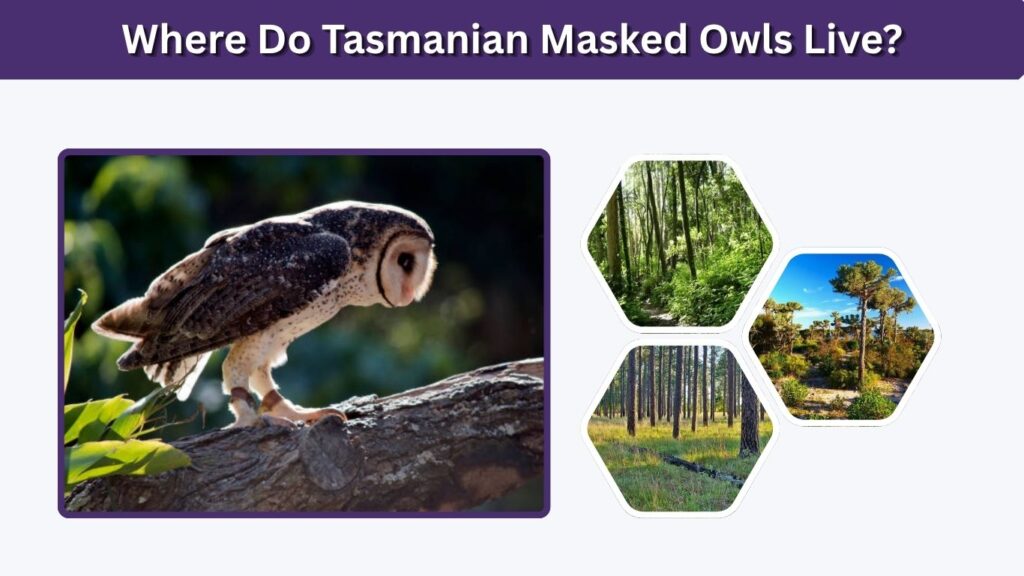
The Tasmanian masked owl is endemic to Tasmania. Its recognized range covers most of the state, excluding King Island and the Furneaux Group. Densities appear to be lower in higher-elevation areas, while important habitat occurs particularly below about 600 meters.
Tasmanian Masked Owl Habitat
They can occur in several environments, including:
- Native eucalypt forests
- Open woodlands
- Mature dry forests
- Forest edges
- Agricultural landscapes
- Forest-pasture mosaics
- Riparian areas
- Landscapes containing isolated old trees
Research using radio-tracked birds found frequent foraging around forest edges, small forest patches, riparian zones and open pasture boundaries. These habitats may make ground-dwelling prey easier for the owls to locate and capture.
Why Old Trees Are Important
Old trees are particularly valuable because Tasmanian masked owls depend heavily on large hollows for nesting and roosting.
Suitable hollows take a very long time to develop naturally. Tasmanian forestry guidance notes that larger trees have a higher probability of containing hollows suitable for masked owls. Even isolated old trees in farmland can therefore have conservation value.
What Does the Tasmanian Masked Owl Eat?
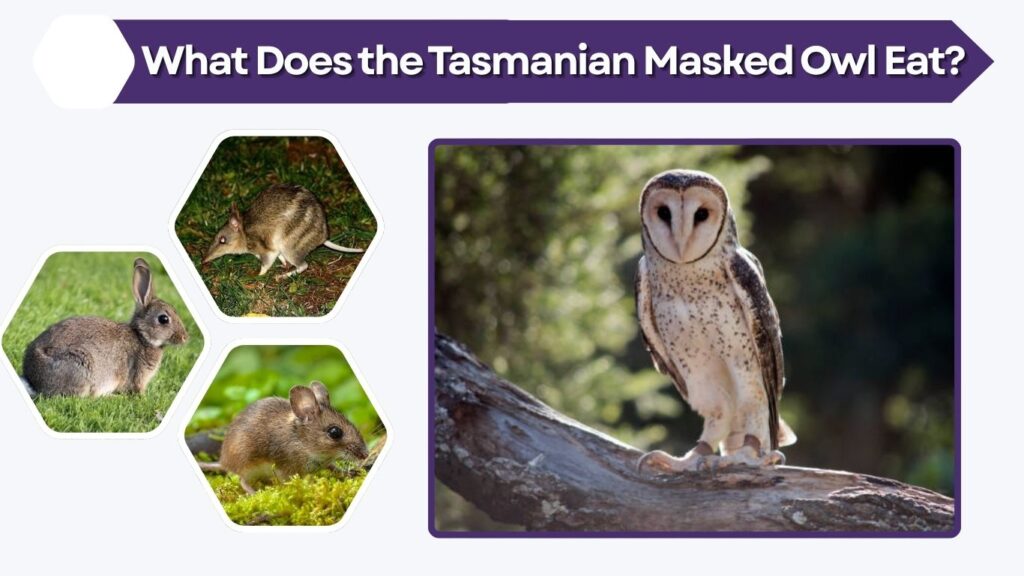
Tasmanian masked owls are powerful predators that hunt primarily at night. Their diet is dominated by mammals, although birds can also be taken.
A detailed Tasmanian study examining regurgitated pellets found both native and introduced mammals in their diet.
Tasmanian Masked Owl Diet
Prey recorded during the study included:
- Eastern barred bandicoots
- Southern brown bandicoots
- Tasmanian pademelons
- Brushtail possums
- Swamp antechinus
- Australian swamp rats
- Black rats
- House mice
- European rabbits
- Small birds
The exact diet varies according to which prey animals are locally available. Researchers concluded that the studied owls’ diets were dominated by locally abundant native and introduced ground-dwelling mammals and marsupials.
How Does a Tasmanian Masked Owl Hunt?
Tasmanian masked owls forage across large areas at night. Radio-tracking research found that individual females used home ranges of roughly 1,900–2,000 hectares when calculated by one commonly used method.
The studied birds frequently used open forest edges and pasture boundaries where prey could be relatively accessible. This shows why protecting only a nest tree is insufficient—the owl also requires a much larger landscape in which to hunt.
Tasmanian Masked Owl Sound and Call
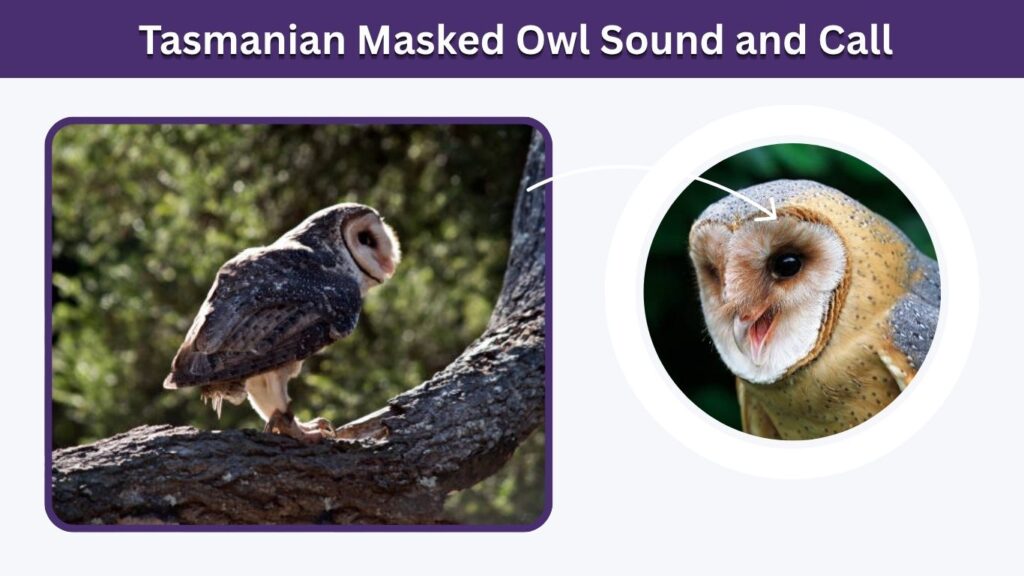
Hearing a Tasmanian masked owl may be more likely than seeing one. The species is cryptic, hunts at night and is rarely observed during daylight.
The Tasmanian government describes its voice as a distinctive husky, screeching sound. Surveys may use recordings because wild birds sometimes answer with a prolonged rasping call described approximately as “cush-cush-sh-sh.”
Why Do Tasmanian Masked Owls Call?
Calls are important for communication between owls and can help birds maintain contact within their territories. Researchers and conservation workers also use calls to detect this difficult-to-observe species.
However, a silent survey does not prove that no owl is present. The Tasmanian government notes that even known birds may fail to respond to playback, making the species challenging to survey reliably.
Tasmanian Masked Owl Pellets
Like other owls, Tasmanian masked owls produce pellets containing prey material that they cannot digest.
Pellets are particularly valuable to scientists because bones, teeth and hair can reveal what an owl has recently eaten.
Are Owl Pellets Vomit?
An owl pellet is better described as a compact mass of indigestible material that is regurgitated rather than ordinary vomit.
In one Tasmanian study, researchers collected pellets beneath daytime roosts. The pellets were separated and examined for bones, teeth and hair, allowing researchers to identify prey species and reconstruct the owls’ diet.
Pellets can therefore provide valuable evidence even when the owl itself is difficult to observe.
Tasmanian Masked Owl Breeding
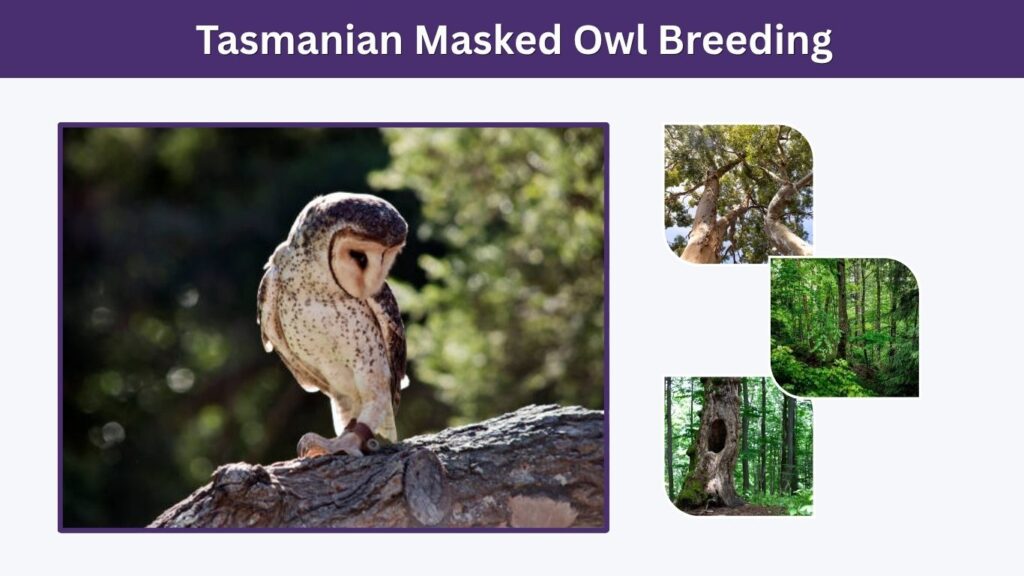
Tasmanian masked owls depend strongly on mature hollow-bearing trees for reproduction. The Tasmanian government describes birds as forming long-term pairs that occupy permanent territories.
Where Do They Nest?
Nesting habitat typically includes:
- Large old eucalypts
- Mature forest and woodland
- Large natural tree hollows
- Isolated old hollow-bearing trees in some agricultural landscapes
The owl may remain associated with the same general territory, making the preservation of nesting and nearby roosting habitat especially important. Research on radio-tracked birds found nest and important roost sites located relatively close to one another.
Is the Tasmanian Masked Owl Endangered?
The conservation status depends on the legislation being considered. In Tasmania, the subspecies is listed as Endangered under the Threatened Species Protection Act 1995. Nationally, it is listed as Vulnerable under Australia’s Environment Protection and Biodiversity Conservation Act 1999.
Main Threats
Major threats include:
- Loss of hollow-bearing nesting trees
- Clearing of foraging habitat
- Removal of old trees from agricultural landscapes
- Secondary poisoning from rodenticides
- Competition for suitable nesting hollows
- Collisions with human-made structures
The Tasmanian government currently estimates the population at approximately 500 breeding pairs, highlighting why protection of remaining habitat is important.
Interesting Facts About the Tasmanian Masked Owl
Several characteristics make this owl particularly unusual:
- It occurs naturally only in Tasmania.
- It is larger and darker than mainland masked owl forms.
- It can use very large home ranges.
- Old tree hollows are essential nesting resources.
- Scientists can study its diet from regurgitated pellets.
- It feeds on surprisingly large prey for an owl.
- Its call is a harsh, rasping screech rather than a classic “hoot.”
- It may hunt successfully in landscapes containing both forest and farmland.
FAQs
What is the scientific name of the Tasmanian masked owl?
Its scientific name is Tyto novaehollandiae castanops. Tasmanian authorities currently treat it as a subspecies of the Australian masked owl. It is endemic to Tasmania and differs from mainland forms in characteristics including its generally larger size and darker appearance.
What does a Tasmanian masked owl sound like?
Its most characteristic vocalization is a strong, husky or rasping screech rather than a typical hooting call. Tasmanian survey guidance describes a drawn-out call resembling “cush-cush-sh-sh,” which researchers may reproduce during surveys to encourage nearby owls to respond.
What does the Tasmanian masked owl eat?
It mainly feeds on mammals. Tasmanian studies have recorded bandicoots, rats, mice, rabbits, antechinus, pademelons and possums among its prey, along with occasional birds. Its actual diet varies according to which prey species are available within its territory.
Where does the Tasmanian masked owl live?
It occurs across much of Tasmania and uses forests, woodlands, forest edges, riparian areas and agricultural landscapes containing native vegetation. Low-elevation areas below approximately 600 meters are especially important, while large old trees containing suitable hollows provide crucial nesting habitat.
Why is the Tasmanian masked owl threatened?
Loss of old hollow-bearing trees and suitable foraging habitat is a major problem. Other threats include secondary poisoning from rodenticides, competition for nesting hollows and collisions with human-made structures. Protecting mature trees and connected feeding habitat is therefore central to its conservation.