
The barred eagle-owl is a large Southeast Asian forest owl distinguished by long horizontal ear tufts, enormous dark eyes, a bright yellow bill and finely barred plumage. Also known as the Malay or Malaysian eagle-owl, it is primarily nocturnal and spends daylight hours hidden in dense vegetation. Although its secretive behavior makes it difficult to observe, the owl may inhabit mature forests, plantations and well-wooded urban parks. Habitat loss remains an important concern across its range.
Barred Eagle-Owl Quick Facts
| Feature | Details |
| Common name | Barred eagle-owl |
| Other names | Malay eagle-owl, Malaysian eagle-owl |
| Scientific name | Ketupa sumatrana |
| Former name | Bubo sumatranus |
| Family | Strigidae |
| Length | Approximately 40–46 cm |
| Activity | Primarily nocturnal |
| Diet | Carnivorous |
| Clutch size | Usually one egg |
| Range | Southeast Asia |
| Global status | Near Threatened |
Current Cornell and IOC-based taxonomy places the species in the genus Ketupa. The older name Bubo sumatranus remains widely used in field guides, older research and regional wildlife databases.
What Does a Barred Eagle-Owl Look Like?
The barred eagle-owl has an unusual expression created by its large black eyes and long feather tufts. Unlike the upright “horns” of many eagle-owls, its tufts often extend sideways above the eyes.
Identification Features
Look for the following characteristics:
- Long, outward-pointing ear tufts
- Very large, dark brown or black-looking eyes
- Large yellow or orange-yellow bill
- Gray-brown upperparts with dark markings
- Pale chest and belly covered with narrow dark bars
- Broad, rounded wings
- Short barred tail
- Strong yellowish feet and sharp talons
- Upright posture when perched
Adults are especially distinctive because of their finely barred underparts and almost horizontal ear tufts. These features separate them from most other large owls in their range.
What Does a Juvenile Look Like?
A juvenile barred eagle-owl is much paler than an adult. Young birds may appear creamy white or pale gray with fine dark barring. Their ear tufts are initially shorter and softer, while the wings and back are darker than the head and underparts.
As the juvenile matures, its plumage becomes darker and more heavily marked. A juvenile recorded in Singapore in August 2018 was observed calling for its parents, providing evidence that the species had bred locally.
Barred Eagle-Owl Size
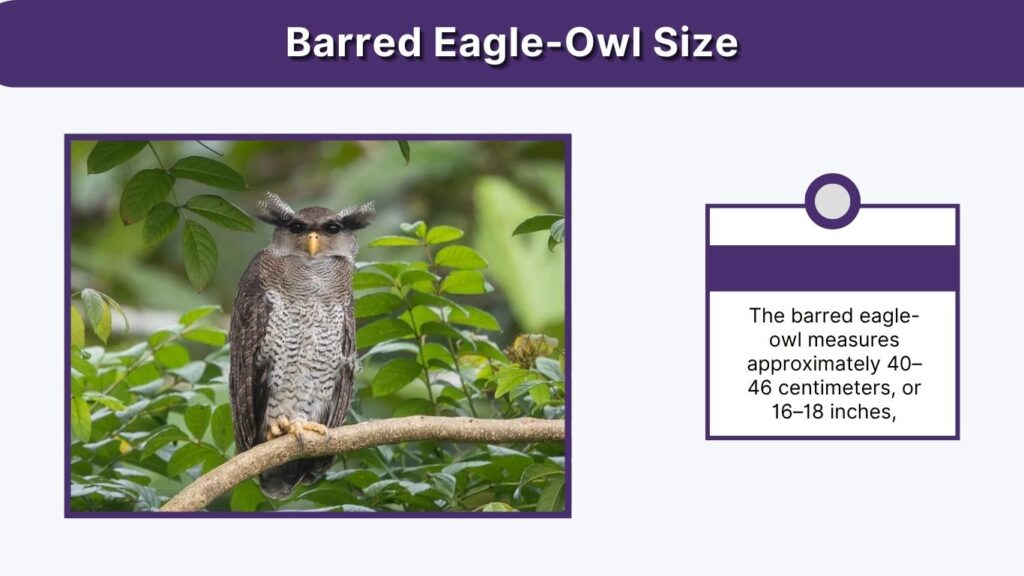
The barred eagle-owl measures approximately 40–46 centimeters, or 16–18 inches, in length. Singapore’s National Parks Board describes it as about 45 centimeters tall and one of the country’s largest owls. Some recorded individuals have weighed around 1.5 kilograms.
A dependable average wingspan is not consistently provided in major public species references. It is therefore safer to identify the bird using body length, ear-tuft shape, eye color and plumage rather than an uncertain wingspan figure.
Where Does the Barred Eagle-Owl Live?
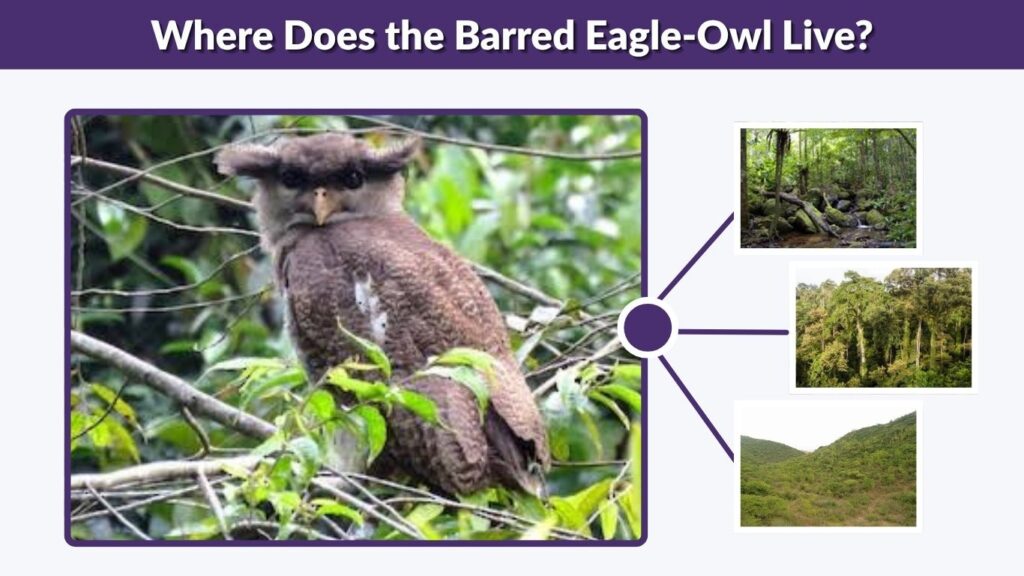
The barred eagle-owl occurs in Southeast Asia. Its range includes southern Myanmar, southwestern Thailand, the Malay Peninsula, Sumatra, Bangka, Borneo, Java and Bali. It is considered a resident species and does not undertake regular long-distance migrations.
Preferred Habitat
The species inhabits:
- Tropical lowland rainforest
- Moist montane forest
- Forest edges
- Wooded plantations
- Rural gardens
- Large urban parks
- Degraded forest with mature trees
It is usually associated with extensive woodland but can tolerate some modified environments when large trees and sufficient prey remain. Records extend from sea level into forested foothills and mountain areas, reportedly reaching around 1,600 meters in some regions.
Barred Eagle-Owls in Malaysia and Singapore
The name “Malay eagle-owl” reflects the bird’s strong association with the Malay Peninsula. It occurs in Malaysia’s tropical forests, plantations and other wooded landscapes, although its nocturnal activity makes sightings relatively uncommon.
In Singapore, the barred eagle-owl is rare and has been observed around Bukit Timah Nature Reserve, the Central Catchment Nature Reserve and Pulau Ubin. It may also appear in sufficiently wooded parks. NParks describes it as a mostly solitary owl occupying the middle and upper levels of rainforest.
What Does a Barred Eagle-Owl Eat?
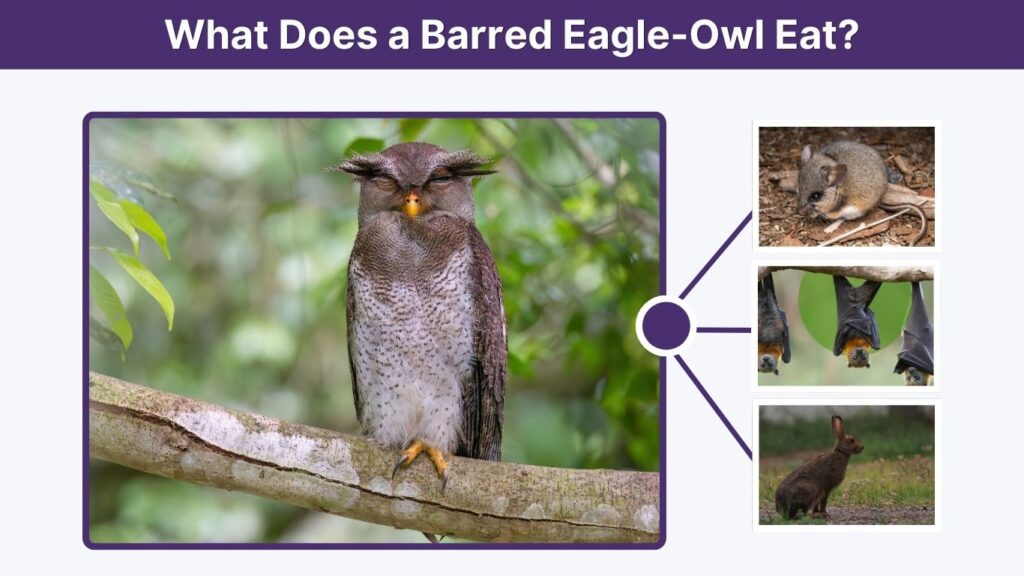
The barred eagle-owl is a carnivorous predator that hunts from forest perches. Its diet includes invertebrates and vertebrate prey, although detailed dietary studies are limited.
Potential and recorded foods include:
- Large insects
- Rodents and other small mammals
- Bats
- Birds
- Reptiles
- Other forest vertebrates
The owl is strong enough to capture surprisingly substantial animals. Singapore’s National Parks Board reports that it has been known to prey on long-tailed macaques and Malayan colugos. These are notable examples rather than proof that large mammals form most of its diet.
How Does It Hunt?
The barred eagle-owl generally rests on a concealed perch and watches or listens for movement below. Once it detects prey, it flies down and seizes the animal with its talons.
Its broad wings allow controlled flight through forest openings, while its forward-facing eyes provide depth perception. Like other owls, specialized flight feathers reduce noise and help it approach prey without giving an obvious warning.
Barred Eagle-Owl Call and Sound
The species produces deep, resonant hoots. It may give a single low hoot or a pair of notes that drop slightly in pitch. Barred eagle-owls can also produce screams, howls and other harsh vocalizations.
The calls are most likely to be heard after dark, particularly when birds are advertising territory or communicating with a partner. Because the owl remains hidden within foliage, its sound may reveal its presence long before it becomes visible.
Behavior and Daily Activity
Barred eagle-owls are primarily nocturnal. During the daytime, they roost quietly in shaded trees, often within the middle or upper forest canopy. Their gray-brown barred plumage helps them blend with branches, bark and filtered light.
They are usually seen alone or as a pair. Their large eyes are adapted for low-light conditions, but the birds also depend heavily on sensitive hearing when locating prey in dense vegetation.
Why Does a Wet Barred Eagle-Owl Look Different?
When wet, the owl’s feathers flatten against its body, making it look thinner and less fluffy. Its ear tufts may droop, separate or point in unusual directions, while the plumage appears darker.
This temporary appearance does not indicate a different species. Once the feathers dry and are preened, the owl normally regains its rounded body shape and better-defined markings.
Nesting, Eggs and Chicks
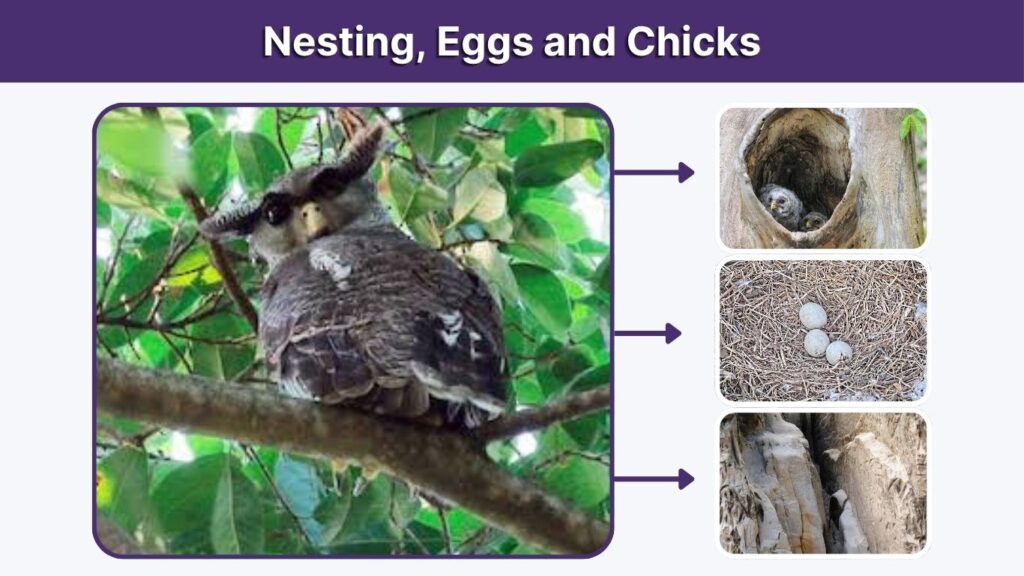
Information about barred eagle-owl reproduction remains limited. Known nests have been associated with sheltered sites in large trees, including cavities and protected spaces formed around epiphytes or major branches.
The female normally lays one egg. Young or dependent birds have been observed during different months across Sumatra, Borneo and Singapore, suggesting that breeding timing varies geographically.
Both adults are believed to participate in raising their chick, although their precise division of incubation and feeding duties is not comprehensively documented. Juveniles remain dependent after leaving the nest and may make repeated calls while waiting for food from their parents.
How Long Does a Barred Eagle-Owl Live?
A reliable, widely accepted lifespan for wild barred eagle-owls has not been established. Some databases provide modeled or generalized longevity figures, but long-term studies of individually marked wild birds remain limited.
Like other large owls, it may potentially live for many years when adequate habitat, prey and nesting sites are available. However, its actual average and maximum wild lifespan should not be stated precisely without stronger species-specific evidence.
Is the Barred Eagle-Owl Endangered?
Current Cornell Birds of the World material lists the barred eagle-owl as Near Threatened globally. This category indicates that it may face a significant risk in the future, even though it has not yet entered one of the globally threatened categories.
Its main concerns include:
- Destruction of tropical forest
- Fragmentation of large wooded habitats
- Removal of mature nesting trees
- Human disturbance
- Illegal capture and wildlife trade
- Declining prey populations
- Road and building collisions
Its status can be much worse locally than globally. Singapore’s current national bird list classifies the barred eagle-owl as Critically Endangered within the country, reflecting its rarity and restricted local population.
Barred Eagle-Owl vs. Barred Owl
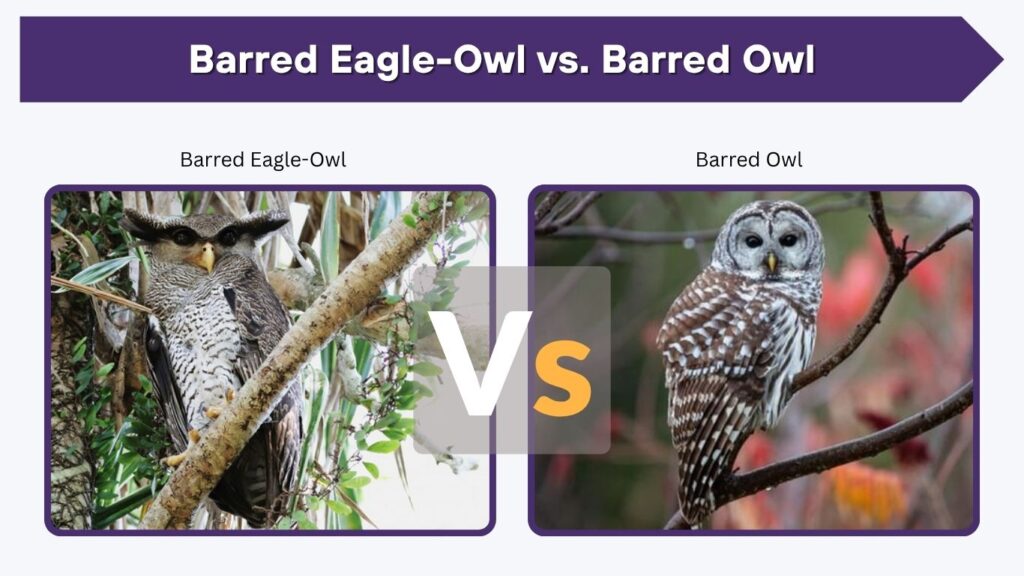
The barred eagle-owl should not be confused with the North American barred owl.
| Feature | Barred eagle-owl | Barred owl |
| Scientific name | Ketupa sumatrana | Strix varia |
| Distribution | Southeast Asia | North America |
| Ear tufts | Long and prominent | Absent |
| Bill | Large and yellow | Smaller and pale |
| Eyes | Very dark | Dark |
| Body pattern | Finely barred | Barred and streaked |
| Typical habitat | Tropical forest | Temperate woodland |
They share similar English names because both have barred plumage, but they are separate species from different regions and genera.
FAQs
Is the barred eagle-owl the same as the Malay eagle-owl?
Yes. Barred eagle-owl, Malay eagle-owl and Malaysian eagle-owl are names used for Ketupa sumatrana. The species was formerly classified as Bubo sumatranus, so that scientific name may still appear in older sources.
Is the barred eagle-owl rare?
It is uncommon or difficult to detect across much of its range. Its nocturnal behavior and forest roosting habits make it easy to overlook. In Singapore, it is considered very rare and nationally Critically Endangered.
What sound does a barred eagle-owl make?
Its usual vocalizations include deep, resonant single or double hoots. It can also produce screams, howls and harsher calls. These sounds may travel far through the forest at night.
Can a barred eagle-owl be kept as a pet?
The barred eagle-owl is a wild bird of prey rather than a domesticated pet. Capturing, selling or privately keeping one may violate national wildlife laws and international trade controls. Injured birds should be handled only by authorized wildlife rescuers.
Is a barred eagle-owl dangerous to people?
It does not normally attack humans or regard them as prey. However, it has strong talons and may defend itself or its nest if cornered. Observers should keep their distance and avoid disturbing adults, chicks or nesting areas.