
The spotted eagle-owl is a medium-sized African owl recognized by its bright yellow eyes, prominent feather tufts, mottled plumage, and mellow hooting call. It is one of southern Africa’s most familiar large owls and can survive in savannas, rocky hills, farmland, parks, and urban neighborhoods. Its varied diet and ability to nest in many different locations make it highly adaptable.
What Is a Spotted Eagle-Owl?
The spotted eagle-owl’s scientific name is Bubo africanus. It is also called the African spotted eagle-owl or African eagle-owl and belongs to the typical owl family, Strigidae.
This species should not be confused with the spot-bellied eagle-owl (Bubo nipalensis), a much larger forest owl found in South and Southeast Asia. Despite their similar names, they are separate species from different regions.
The spotted eagle-owl is currently classified as Least Concern because it has an extensive range and remains widespread.
Spotted Eagle-Owl Identification
Spotted eagle-owls have heavily patterned feathers that provide excellent camouflage against rocks, branches, and tree bark. Their body color varies from grayish brown to darker brown, and a rare reddish-brown form also occurs.
Key Identification Features
- Bright yellow eyes
- Prominent feathered ear tufts
- Pale facial disc with a dark border
- Black, strongly hooked bill
- White or pale throat patch
- Brown upperparts covered with pale spots
- Finely barred chest and belly
- Broad, rounded wings
- Feathered legs and strong blackish talons
- Barred flight feathers and tail
The raised “ears” on its head are only feather tufts. They are not connected to the owl’s hearing and may help break up its outline while it rests during daylight.
Spotted Eagle-Owl Size
The spotted eagle-owl is considered medium-sized compared with other eagle-owls. Females are generally heavier than males, although both sexes have similar plumage.
| Measurement | Approximate range |
| Body length | 40–50 cm |
| Body length in inches | 16–20 inches |
| Wingspan | About 1 meter |
| Weight | Approximately 487–850 grams |
| Female size | Usually heavier than male |
Its broad wings allow slow, quiet flight, while its strong feet help it capture mammals, birds, reptiles, and large insects.
Where Do Spotted Eagle-Owls Live?
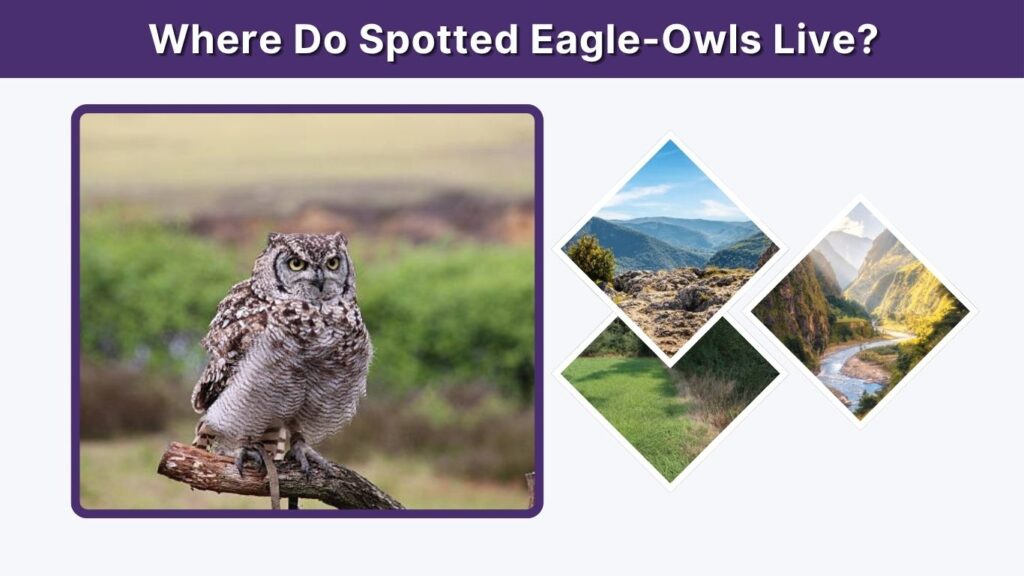
The spotted eagle-owl occurs across much of sub-Saharan Africa, from eastern and central Africa southward to South Africa. Its range also reaches parts of southern Arabia.
Preferred Habitat
It can live in:
- Savannas
- Open woodlands
- Grasslands
- Rocky hillsides
- Scrublands
- Forest edges
- Semi-desert environments
- Agricultural areas
- Parks and large gardens
- Towns and cities
It generally avoids dense tropical rainforest and completely open sandy desert. During the day, it may roost close to a tree trunk, beneath bushes, among rocks, inside a crevice, on a sheltered ledge, or in tall grass.
Spotted eagle-owls have adapted particularly well to human-modified areas. They may use streetlights, telephone poles, walls, chimneys, and rooftops as hunting perches.
What Do Spotted Eagle-Owls Eat?
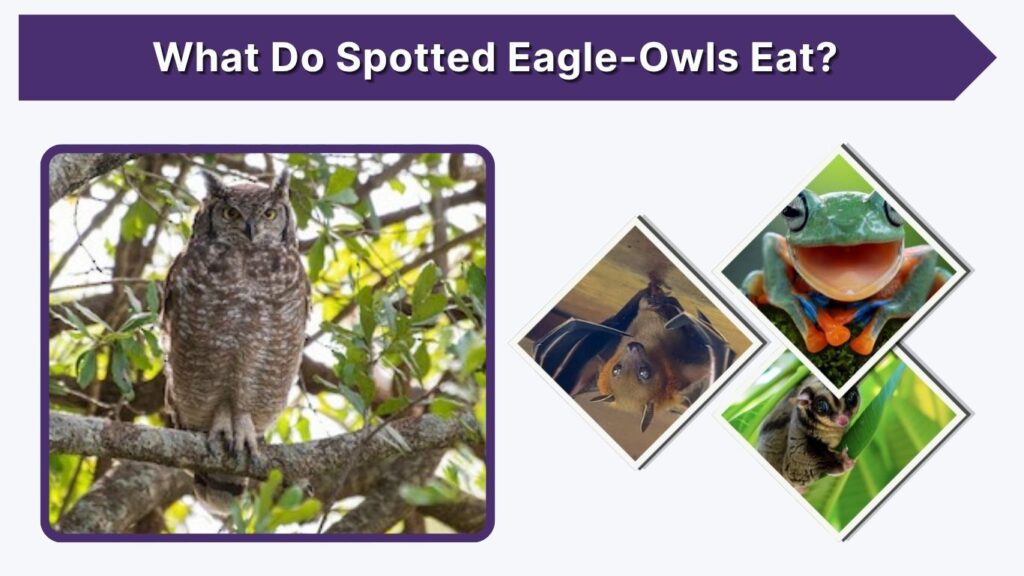
Spotted eagle-owls are opportunistic carnivores whose diets change according to habitat and prey availability. More than 60 prey species have been recorded in southern Africa.
Their diet includes:
- Mice and rats
- Shrews and mole-rats
- Bats
- Small birds
- Frogs
- Lizards
- Snakes
- Beetles and crickets
- Grasshoppers
- Moths
- Centipedes
- Scorpions
- Occasional carrion
Rodents can be important prey in urban and agricultural areas, but insects and other arthropods may dominate the diet in some locations. One study from northeastern South Africa found that moths, beetles, centipedes, snakes, and frogs made up much of the prey delivered to nests.
How Do They Hunt?
Spotted eagle-owls usually hunt from an elevated perch. They watch and listen for movement before gliding silently toward the ground and striking with their talons.
They can also capture insects and small birds in flight or chase prey across the ground. Smaller animals are swallowed whole, while larger prey may be torn into pieces. Indigestible hair, bones, teeth, and feathers are later compressed into a pellet and regurgitated.
Spotted Eagle-Owl Call and Sound
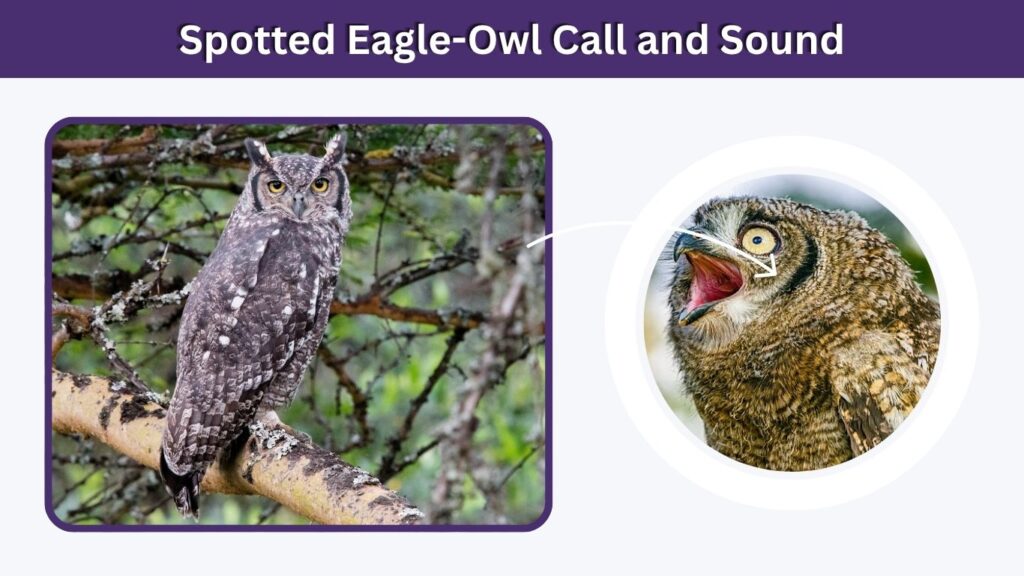
The spotted eagle-owl produces a soft, mellow hooting sound. The male commonly gives a deep double call, while the female answers with a softer, slightly higher-pitched series of notes.
Pairs may duet, making the two voices sound almost like one complicated call. They use hooting to maintain contact, attract partners, and advertise their territory.
Chicks do not produce the same mature hoot. Hungry young birds make loud wheezing or screeching calls and may hiss or click their bills when frightened. Adults defending a nest can also hiss, snap their bills, and spread their wings.
Nesting and Eggs
Spotted eagle-owls do not construct elaborate nests. They usually create a shallow scrape or occupy an existing protected space.
Common Nesting Sites
They may nest:
- Between rocks
- Beneath a bush
- On the ground in tall grass
- On cliff ledges
- In hollow trees
- In abandoned bird nests
- Inside quarries or eroded banks
- On building ledges
- In large window boxes
- Inside specially designed owl boxes
A successful nest site may be reused for many years. In southern Africa, breeding frequently peaks from late winter through spring, although timing differs across the species’ wide range.
Eggs and Chicks
A typical clutch contains two to four rounded white eggs. The female performs most or all of the incubation while the male brings food. The eggs hatch after approximately 30–34 days.
Young chicks hatch blind and covered in white down. They begin exploring outside the immediate nest area at about four to six weeks and can normally fly by around seven weeks. Their parents continue feeding and protecting them until they become independent, which may take several additional weeks or months.
A young owl found on the ground is not necessarily abandoned. Fledglings commonly leave the nest before becoming confident fliers, while their parents remain nearby.
Spotted Eagle-Owl Lifespan
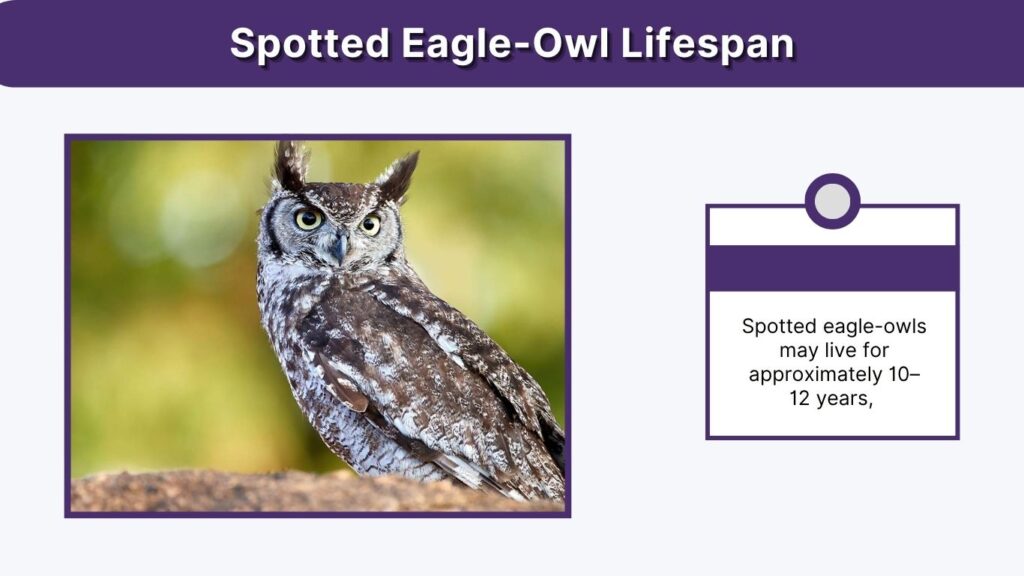
Spotted eagle-owls may live for approximately 10–12 years, although many wild individuals die earlier. Survival is influenced by food availability, disease, predation, habitat quality, and human activity.
Recorded causes of death include vehicle strikes, barbed-wire collisions, fires, persecution, and secondary poisoning after eating rodents that consumed poison.
Spotted Eagle-Owl vs. Cape Eagle-Owl
These species overlap in parts of southern Africa and can appear similar.
| Feature | Spotted eagle-owl | Cape eagle-owl |
| Scientific name | Bubo africanus | Bubo capensis |
| Length | About 40–50 cm | About 48–54 cm |
| Eye color | Usually yellow | Usually orange |
| Breast pattern | Fine horizontal barring | Heavier dark blotching |
| Typical color | Grayish brown | More reddish brown |
| Habitat | Broad range of open habitats | Often rocky, mountainous areas |
Size alone is not always reliable. The spotted eagle-owl’s yellow eyes and finely barred breast are usually more useful identification clues.
Spotted Eagle-Owl vs. Spot-Bellied Eagle-Owl
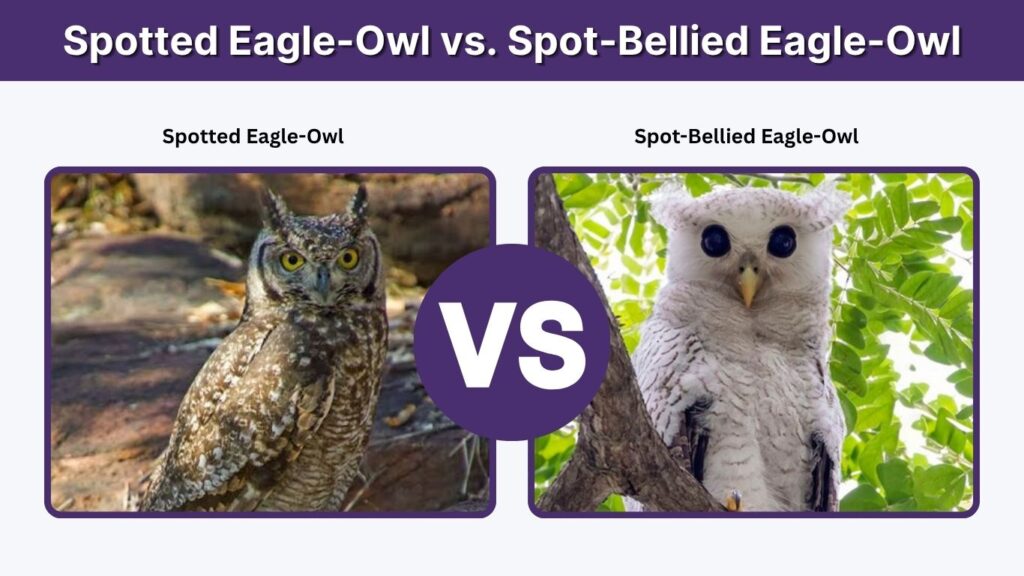
The spot-bellied eagle-owl is an Asian forest species rather than an African form of the spotted eagle-owl.
| Feature | Spotted eagle-owl | Spot-bellied eagle-owl |
| Scientific name | Bubo africanus | Bubo nipalensis |
| Main range | Sub-Saharan Africa | South and Southeast Asia |
| Habitat | Savannas, scrub and open woodland | Dense forests |
| Size | Medium-sized | Much larger |
| Underparts | Fine bars and mottling | Large heart-shaped spots |
| Eyes | Yellow | Dark brown |
Conservation and Human Interaction
Spotted eagle-owls benefit people by eating rodents and insects that can damage crops, contaminate food, or become household pests. However, rodent poison can also kill owls when they consume contaminated rats or mice.
Other threats include road traffic, barbed-wire fences, habitat disturbance, deliberate persecution, and domestic dogs or cats attacking young birds. Although the species remains common and widespread, reducing these preventable dangers can protect local breeding pairs.
FAQs
Is the Spotted Eagle-Owl Endangered?
No. It is currently categorized as Least Concern because it remains widely distributed. However, individual owls still die from poisoning, road collisions, fence strikes, persecution, fires, and disturbance around their nesting sites.
What Do Spotted Eagle-Owls Eat?
They eat rodents, shrews, birds, frogs, lizards, snakes, bats, beetles, moths, crickets, centipedes, and other available prey. Their diet changes considerably by habitat, with rodents dominating in some places and insects or reptiles becoming more important elsewhere.
Are Spotted Eagle-Owls Dangerous?
They normally avoid humans and do not consider people prey. However, adults may swoop at people or pets that approach their eggs or chicks. Keeping a respectful distance from an active nesting site prevents most defensive encounters.
Can Spotted Eagle-Owls Use Nesting Boxes?
Yes. They sometimes occupy large, properly designed owl boxes when the location is quiet, elevated, sheltered, and close to suitable hunting habitat. A box should be installed with guidance from a local bird or wildlife organization.
Can You Keep a Spotted Eagle-Owl as a Pet?
It is not an appropriate ordinary household pet. It is a powerful wild predator requiring specialized housing, food, permits, and professional care. Wildlife ownership laws differ between countries, and wild-caught owls should never be purchased.