
The Ural owl is a large, pale woodland owl known for its rounded head, long tail, powerful call, and calm-looking facial expression. Scientifically named Strix uralensis, it lives across northern Europe and Asia, including forests in Scandinavia, Russia, Japan, and parts of Central Europe. This nocturnal hunter mainly eats rodents but may also catch birds, frogs, and other small animals. Its impressive size, defensive nesting behavior, and ability to survive cold climates make the Ural owl one of the most fascinating forest owls.
Ural Owl Identification and Appearance
The Ural owl has a distinctive appearance that separates it from many other woodland owls. It is generally pale gray or brown, with dark streaks covering its body. Its broad facial disc, small dark eyes, and lack of visible ear tufts create a gentle appearance. However, it is a powerful predator with strong feet and sharp talons.
Ural Owl Identification
You can identify a Ural owl by the following characteristics:
- Large, rounded head without ear tufts
- Pale gray, whitish, or brownish plumage
- Long, wedge-shaped tail
- Dark vertical streaks across the chest
- Round facial disc with a darker border
- Small black or dark-brown eyes
- Yellowish bill and heavily feathered legs
- Broad wings adapted for silent flight
Ural Owl Size and Wingspan
The Ural owl is one of the larger members of the genus Strix. An adult normally measures approximately 50 to 62 centimeters, or 20 to 24 inches, in length. Its wingspan can reach around 110 to 134 centimeters, or 43 to 53 inches.
Females are usually larger and heavier than males. Depending on sex and geographic location, an adult may weigh approximately 500 to 1,300 grams. Its long tail makes the bird appear even larger when it is perched or flying through the forest.
Color and Feather Patterns
Most Ural owls are pale gray, grayish-brown, or whitish. Dark vertical streaks run down the chest and belly, while the wings and back have darker markings. These patterns provide excellent camouflage against tree trunks and branches.
Some individuals are noticeably darker than average. These are sometimes described as melanistic Ural owls, although completely black individuals are extremely unusual. Feather color can vary between populations and geographic regions.
Ural Owl Habitat and Geographic Range
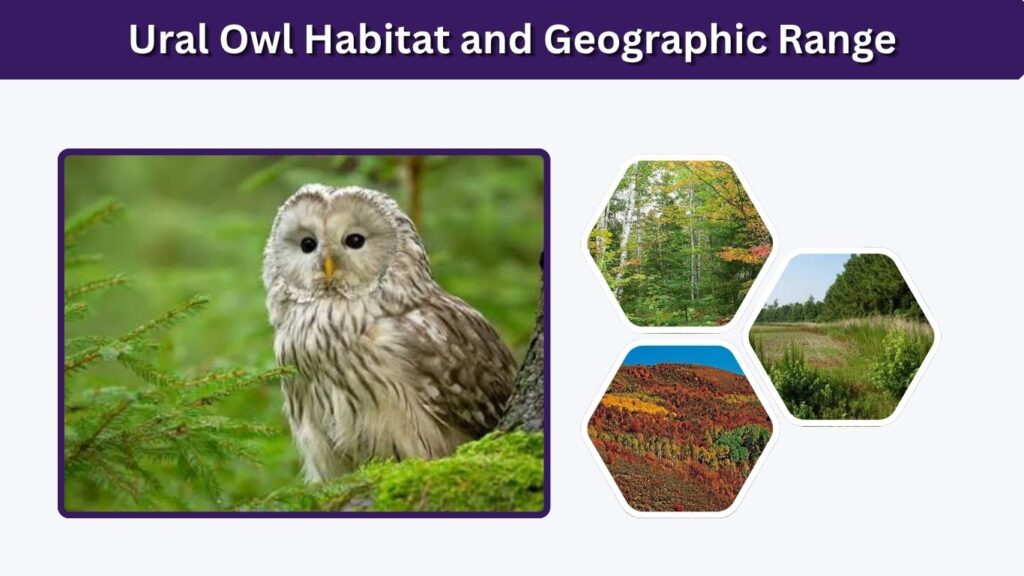
Ural owls are strongly associated with mature forests that contain large trees, open hunting areas, and suitable nesting cavities. Their distribution stretches across a wide portion of Europe and Asia. Although they tolerate cold weather extremely well, they need productive woodland habitats where rodents and other prey remain available throughout the year.
Where Do Ural Owls Live?
The historic range of the Ural owl extends from Scandinavia and Central Europe eastward across Russia and Siberia. It also occurs in parts of Mongolia, China, Korea, and Japan.
Important populations are found in:
- Finland, Sweden, and Norway
- Estonia, Latvia, and Lithuania
- Poland, Slovakia, and Romania
- Russia and Siberia
- Mongolia and northeastern China
- The Korean Peninsula
- Hokkaido and other areas of Japan
Reintroduction programs have helped restore the species in certain parts of Europe where it had previously disappeared.
Preferred Forest Habitat
Ural owls commonly inhabit mature coniferous, deciduous, and mixed forests. They favor areas containing old trees with broken trunks or natural cavities. Forest edges, clearings, wetlands, and small meadows are also valuable because these open areas provide hunting opportunities.
The species may live in lowland forests, mountain woodlands, or northern taiga. In some locations, Ural owls use managed forests when suitable nesting boxes and hunting areas are available.
Ural Owls in Hokkaido, Japan
Hokkaido is well known for its population of Ural owls. These birds frequently nest inside large, hollow trees and may use the same nesting location for several years. Pairs are sometimes photographed resting together near their nesting cavities.
Japanese Ural owls are adapted to snowy winters. Their pale feathers help them blend into snow-covered forests, while their sensitive hearing allows them to detect rodents moving beneath vegetation or light snow.
Ural Owl Behavior, Calls and Social Life
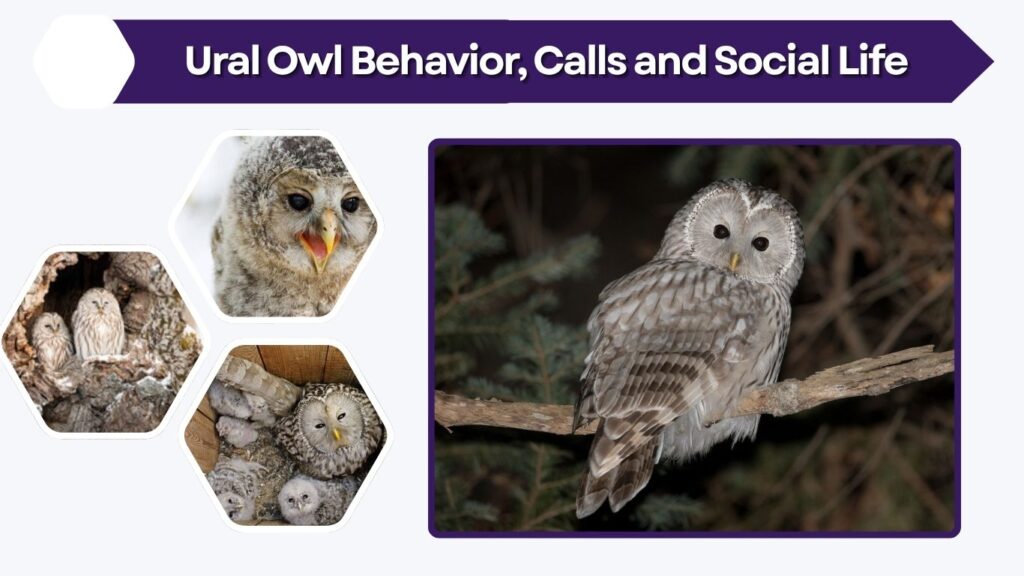
The Ural owl is primarily active at night, although it may occasionally hunt during daylight, especially when feeding chicks. It spends much of the day resting quietly against a tree trunk or inside thick woodland. Despite its calm appearance, it can become extremely aggressive when defending its eggs, chicks, or nesting territory.
Ural Owl Call and Sound
The male’s territorial call is a deep, rhythmic hooting sound that carries over long distances through the forest. The female has a similar call, but it is generally higher in pitch.
Ural owls also produce barking, yelping, screeching, and snapping sounds. Adults may use harsh warning calls when a predator or person approaches the nest. Chicks make high-pitched begging calls when requesting food from their parents.
Are Ural Owls Solitary?
Outside the breeding season, Ural owls usually spend much of their time alone. However, established pairs often remain within the same territory throughout the year. They may roost near one another, communicate through calls, and defend their territory together.
Ural owls are generally monogamous. A male and female may maintain a long-term pair bond and return to the same nesting area during successive breeding seasons.
Nesting and Chicks
Ural owls do not construct complicated nests. They usually lay their eggs inside a large tree cavity, broken tree trunk, abandoned raptor nest, or artificial nesting box. The female commonly lays two to four white eggs.
The female incubates the eggs while the male provides food. After hatching, Ural owl chicks are covered in soft white down. Young owls may leave the cavity before they can fly properly, climbing along nearby branches while their parents continue feeding and protecting them.
What Do Ural Owls Eat?
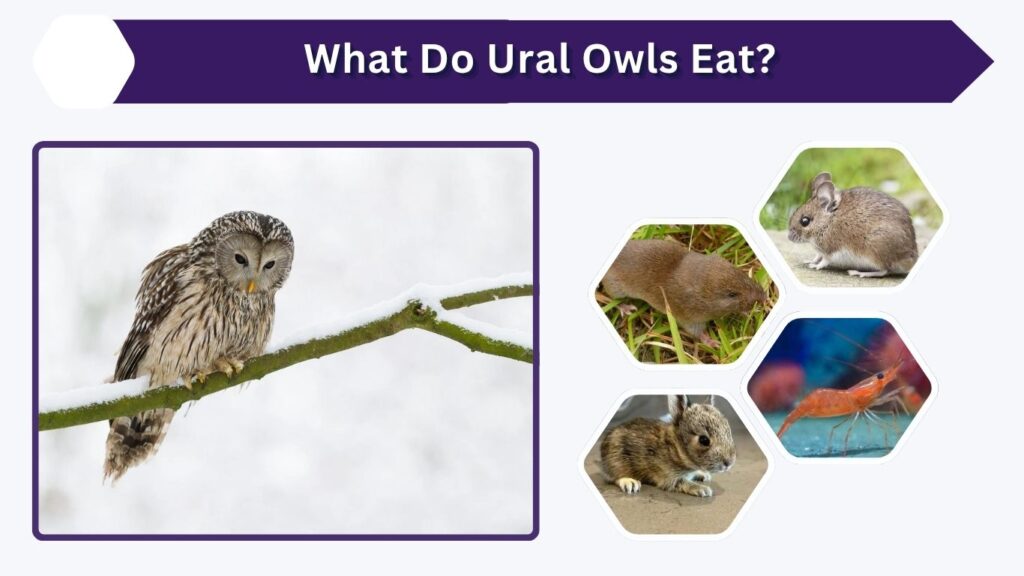
The Ural owl is a carnivorous bird that feeds mainly on small mammals. Its diet changes according to season, location, and prey availability. Rodent numbers can strongly influence breeding success because pairs may produce more chicks during years when voles and mice are abundant. The owl hunts from perches or flies slowly above open ground.
Ural Owl Diet
Common prey eaten by Ural owls includes:
- Voles
- Field mice
- Rats
- Shrews
- Squirrels
- Small rabbits
- Small and medium-sized birds
- Frogs and other amphibians
- Lizards
- Large insects
- Fish on rare occasions
Small mammals form the largest part of the diet in most regions. However, birds may become more important when rodent populations are low.
How Ural Owls Hunt
A Ural owl often waits silently on a tree branch while listening and watching for movement. Once prey is detected, it glides downward and captures the animal with its powerful talons.
Its broad wings have specially shaped feathers that reduce the sound created during flight. This allows the owl to approach prey without being easily detected. Its facial disc directs sound toward the ears, helping it locate animals in darkness, grass, leaf litter, or shallow snow.
Lifespan, Predators and Conservation
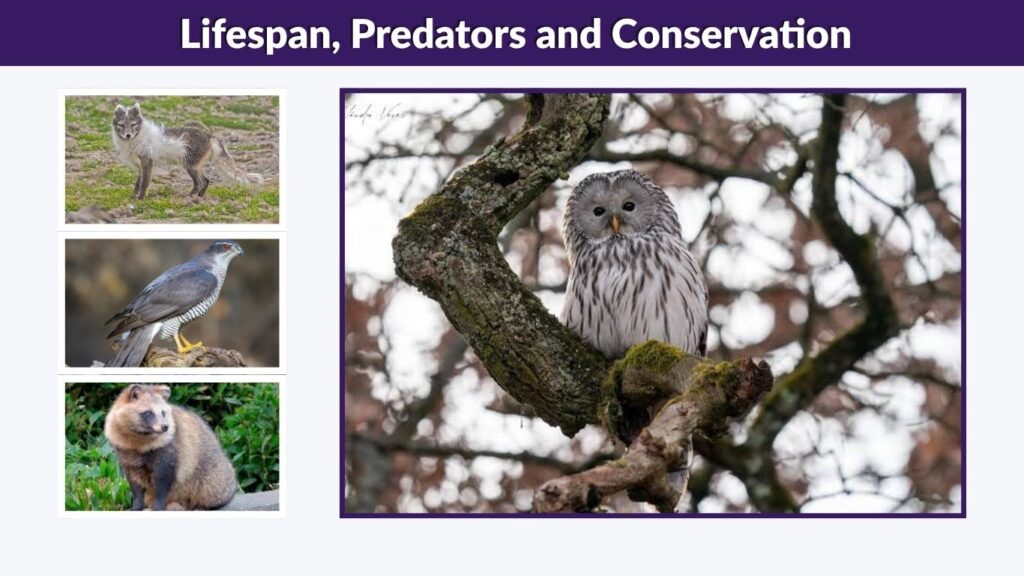
Ural owls are relatively long-lived birds when they survive their vulnerable early years. Adults face fewer natural threats than chicks, but food shortages, collisions, habitat loss, and human disturbance can still affect them. Their dependence on old nesting trees makes responsible woodland management particularly important for maintaining healthy breeding populations.
How Long Do Ural Owls Live?
A wild Ural owl may live for approximately 15 to 20 years, although many young birds do not survive long enough to reach adulthood. Individuals living under managed care may survive longer because they receive regular food, veterinary care, and protection from predators.
Weather, disease, prey availability, accidents, and competition all influence lifespan. Experienced adults with established territories usually have better survival prospects than inexperienced juvenile owls.
Ural Owl Predators
Adult Ural owls are large and powerful, so they have relatively few predators. However, chicks, eggs, and smaller individuals may be vulnerable to:
- Northern goshawks
- Golden eagles
- Eagle-owls
- Pine martens
- Foxes
- Raccoon dogs
- Other climbing mammals
Adults defend their nests aggressively. They may swoop directly toward intruders and strike with their talons, making close approaches to an active nest dangerous.
Is the Ural Owl Endangered?
The Ural owl is not considered globally endangered. Its population is generally stable or increasing in several areas. Nevertheless, local populations can decline when old forests are cleared, nesting trees are removed, or habitats become heavily fragmented.
Conservation measures include protecting mature woodland, preserving hollow trees, installing suitable nest boxes, reducing disturbance around nests, and maintaining open hunting areas near forests.
Ural Owl Adaptations and Interesting Facts
The Ural owl has several specialized features that help it survive in dark, cold woodland environments. These adaptations support silent hunting, accurate hearing, effective camouflage, and winter survival. Its behavior is equally remarkable, particularly its intense nest defense and ability to raise chicks during periods of abundant rodent prey.
Important Ural Owl Adaptations
- Silent feathers: Soft-edged flight feathers reduce noise while flying.
- Sensitive hearing: The facial disc directs sounds toward the ears.
- Strong talons: Powerful feet allow the owl to capture mammals and birds.
- Thick plumage: Dense feathers provide insulation in cold forests.
- Camouflaged coloring: Gray and brown patterns blend with tree bark.
- Flexible neck: The owl can rotate its head widely to observe its surroundings.
- Excellent night vision: Large eyes collect available light in dark conditions.
Interesting Ural Owl Facts
- Its scientific name is Strix uralensis.
- Females are usually larger than males.
- It has a much longer tail than many similar woodland owls.
- Ural owls have dark eyes rather than yellow or orange eyes.
- A breeding pair may remain together for several years.
- Females can aggressively attack people approaching their nests.
- The species may use artificial nest boxes when natural cavities are unavailable.
- Ural owls sometimes hunt during the day when feeding chicks.
- Their breeding success often increases when vole populations are high.
- Some populations have been restored through reintroduction programs.
FAQs
The following answers address common questions about Ural owl identification, behavior, size, habitat, and comparisons with similar species. Understanding these characteristics can help birdwatchers distinguish the Ural owl from other large woodland owls while safely observing its natural behavior without disturbing active nesting sites.
Is a Ural Owl Bigger Than a Barred Owl?
Ural and barred owls are similar in general appearance, but the Ural owl usually looks longer because of its extended tail. Ural owls can also have a slightly greater wingspan. The barred owl has stronger horizontal barring on its chest, while the Ural owl has mostly vertical streaks.
Are Ural Owls Dangerous to Humans?
Ural owls do not normally hunt or attack people. However, nesting females can become highly aggressive when defending their eggs or chicks. They may silently swoop toward a person and strike the head with their talons. People should maintain a safe distance from known nesting locations.
Can You Keep a Ural Owl as a Pet?
A Ural owl is not a suitable household pet. It requires specialized food, a large enclosure, professional care, and legal authorization in many countries. Wild owls should never be captured. Licensed wildlife centers, zoos, and rehabilitation facilities are better equipped to care for these powerful birds.
What Is the Difference Between Male and Female Ural Owls?
Male and female Ural owls have similar feather colors and patterns. The main difference is size, as females are generally larger and heavier. Their voices can also differ. Male territorial calls tend to be deeper, while females commonly produce slightly higher-pitched calls and warning sounds.
Do Ural Owls Stay With the Same Mate?
Ural owls commonly form monogamous breeding pairs. A male and female may remain within the same territory and breed together for multiple years. Although they often rest and hunt separately, paired birds communicate through calls, defend their territory, and cooperate when raising their chicks.