
The tawny frogmouth is a nocturnal Australian bird famous for its owl-like appearance and remarkable tree-bark camouflage. Despite often being called the “tawny frogmouth owl,” it is not a true owl. It belongs to the frogmouth family and is more closely related to nightjars. During the day, it remains almost motionless on a branch, stretching its body upward to resemble broken wood. After sunset, it becomes an active hunter of insects and other small prey. This guide covers its appearance, feathers, diet, habitat, calls, nesting habits, chicks, lifespan, adaptations, and differences from owls.
Tawny Frogmouth Identification
The tawny frogmouth’s scientific name is Podargus strigoides. It is a broad-headed, heavy-looking bird with a wide mouth and a large, flattened bill. Its mottled plumage allows it to blend into trunks, branches, and dead wood.
Key Identification Features
- Broad, flattened head
- Wide, frog-like mouth
- Large yellow or orange-yellow eyes
- Short, broad bill with a hooked tip
- Gray, brown, black, and white mottled feathers
- Bristles around the bill
- Rounded wings and a long tail
- Short legs with relatively weak feet
- Upright, branch-like resting posture
Most individuals are silver-gray with dark streaks and patches. A reddish-brown plumage form also occurs, particularly among some females.
Is a Tawny Frogmouth an Owl?
No. A tawny frogmouth is not an owl, even though the two birds share several features. Both are active at night, have large forward-facing eyes, and possess feathers that help them fly quietly.
However, tawny frogmouths belong to the family Podargidae. They are more closely related to nightjars than to true owls.
The mistaken name “tawny frogmouth owl” comes from its owl-like face, nocturnal habits, and upright posture.
Tawny Frogmouth vs. Owl
Tawny frogmouths and owls differ in their anatomy, hunting methods, feet, bills, and diets.
| Feature | Tawny Frogmouth | True Owl |
| Bird group | Frogmouth family | Owl order |
| Bill | Wide and flattened | Short, sharply hooked |
| Mouth | Extremely broad | Relatively narrow |
| Feet | Small and less powerful | Strong talons |
| Main prey | Insects and small animals | Rodents, birds, and other animals |
| Hunting method | Catches prey with the bill | Captures prey mainly with talons |
| Daytime camouflage | Mimics a broken branch | Hides against bark or foliage |
| Nest | Simple platform of sticks | Cavity or abandoned nest |
Owls usually seize prey with powerful feet. Tawny frogmouths more often capture insects and small animals with their broad mouths.
Tawny Frogmouth Size and Appearance
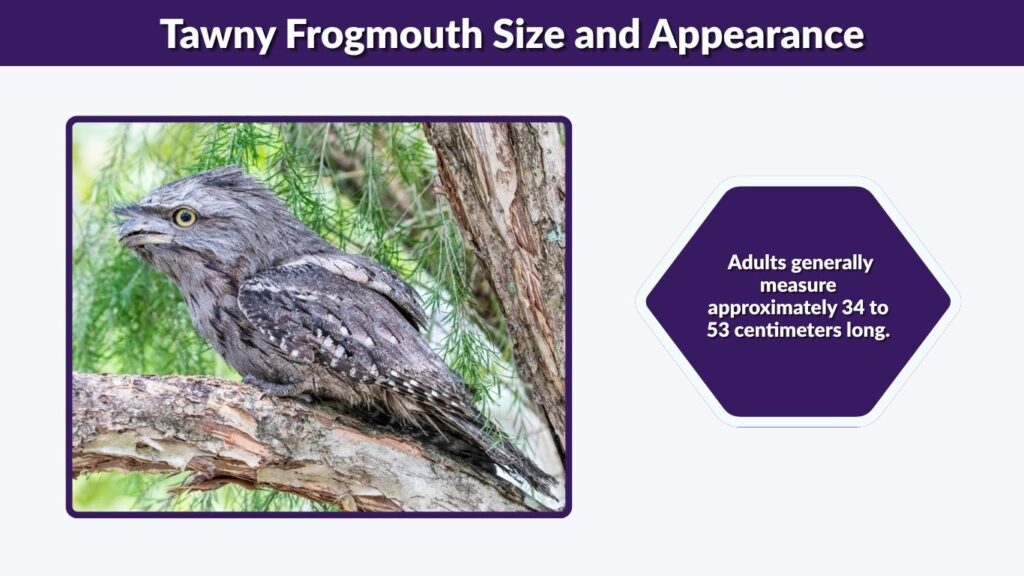
The tawny frogmouth is a medium-to-large nocturnal bird. Adults generally measure approximately 34 to 53 centimeters long. Their weight varies considerably according to sex, region, and subspecies.
Birds from southeastern Australia tend to be larger than those from northern areas.
They have large heads, thick bodies, rounded wings, and long tails. Females may be slightly smaller than males, although the sexes are difficult to distinguish by size alone.
Tawny Frogmouth Feathers
The bird’s feathers are patterned with gray, brown, black, white, and reddish tones. These irregular markings resemble tree bark, cracks, shadows, and lichen.
Its plumage is soft, helping reduce flight noise while it hunts at night. Bristle-like feathers surround the mouth and may help protect the eyes and face when catching insects.
Tawny frogmouth feathers should not be collected from wild birds where native wildlife laws prohibit possessing them. Feathers are also less reliable for identification when found without the bird because patterns vary between individuals.
Master of Camouflage
Camouflage is one of the tawny frogmouth’s most impressive adaptations. During daylight, it chooses a branch that matches its feather pattern and remains almost completely still.
When threatened, the bird may:
- Stretch its neck upward
- Narrow or close its bright eyes
- Press its feathers against its body
- Point its bill toward the sky
- Freeze in an upright position
This behavior makes the bird resemble a broken or dead branch. Its mottled feathers, stiff posture, narrowed eyelids, and ability to remain motionless all contribute to the disguise.
Tawny Frogmouth Habitat and Distribution
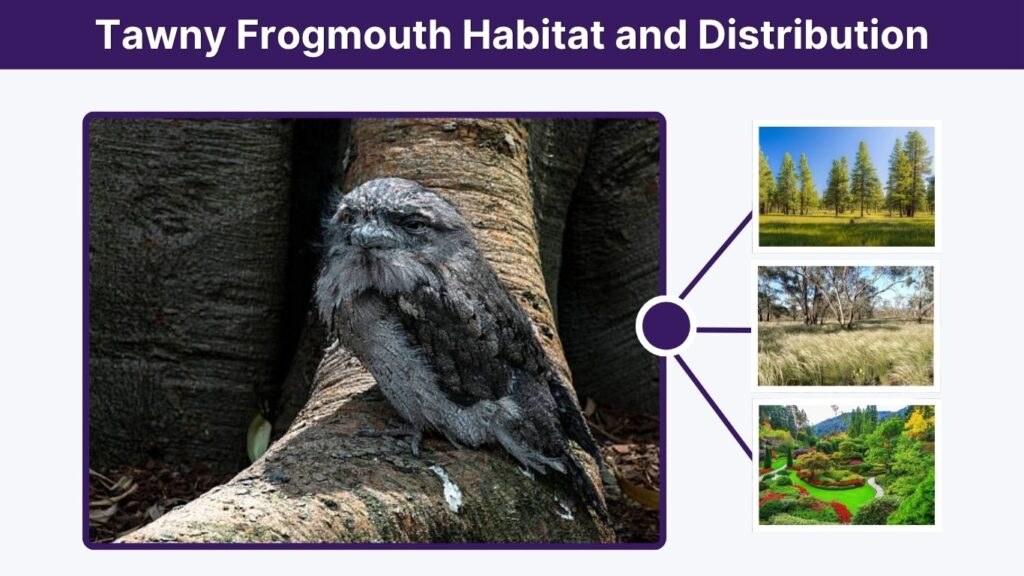
Tawny frogmouths occur throughout most of mainland Australia and Tasmania. They live in a wide variety of environments, from dry inland areas to coastal forests and suburban neighborhoods.
Common Habitats
- Eucalyptus woodland
- Open forest
- Scrubland
- Farmland with scattered trees
- Parks and gardens
- Suburban streets
- Roadside vegetation
- Dry woodland
- Urban bushland
They are less common in treeless deserts and dense rainforests because they need suitable branches for roosting, nesting, and hunting.
Their ability to live in parks and gardens means they can sometimes be found close to houses, even in major Australian cities.
What Do Tawny Frogmouths Eat?
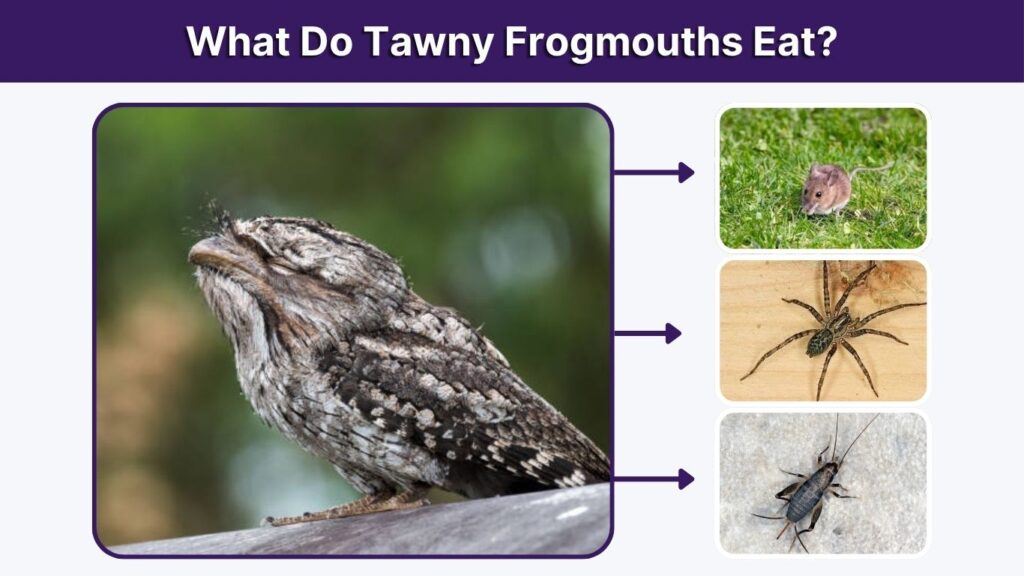
Tawny frogmouths are primarily insect-eaters, although they may also capture small vertebrates.
Common Foods
- Moths
- Beetles
- Cockroaches
- Crickets
- Grasshoppers
- Cicadas
- Spiders
- Centipedes
- Worms
- Snails and slugs
- Small frogs
- Lizards
- Small mice
- Occasionally small snakes
Invertebrates make up most of their diet, while vertebrate prey is taken less frequently. A documented observation has even recorded a tawny frogmouth capturing a live snake.
How Do Tawny Frogmouths Hunt?
A tawny frogmouth commonly waits on a low branch, fence post, or other elevated perch. When it detects prey, it drops or glides down and catches the animal with its broad bill.
It may also:
- Fly out to catch insects in the air
- Collect prey from leaves and branches
- Land on the ground to seize crawling animals
- Wait near lights that attract moths and beetles
Its large mouth makes it highly effective at capturing insects. Unlike an owl, it does not depend mainly on strong talons to kill prey.
Call and Sounds
The most familiar tawny frogmouth call is a low, rhythmic sound often written as “oom-oom-oom.” It may be repeated steadily for an extended period.
Other sounds include:
- Deep booming notes
- Soft grunting calls
- Hissing when threatened
- Clapping or snapping sounds made with the bill
- Loud begging calls from chicks
- Rapid warning noises
Pairs use calls to maintain contact and communicate within their territory. Their low voices are often heard at night before the birds themselves are seen.
Nocturnal Behavior
Tawny frogmouths are mainly nocturnal. They rest during the day and begin moving around at dusk.
At night, they hunt from perches and may travel between feeding areas. During cold weather, they can enter a short-term energy-saving state called torpor, lowering their body temperature and metabolic rate.
Pairs frequently roost together, sometimes sitting side by side on the same branch. Family groups may also remain close after young birds leave the nest.
Tawny Frogmouth Nesting Habits
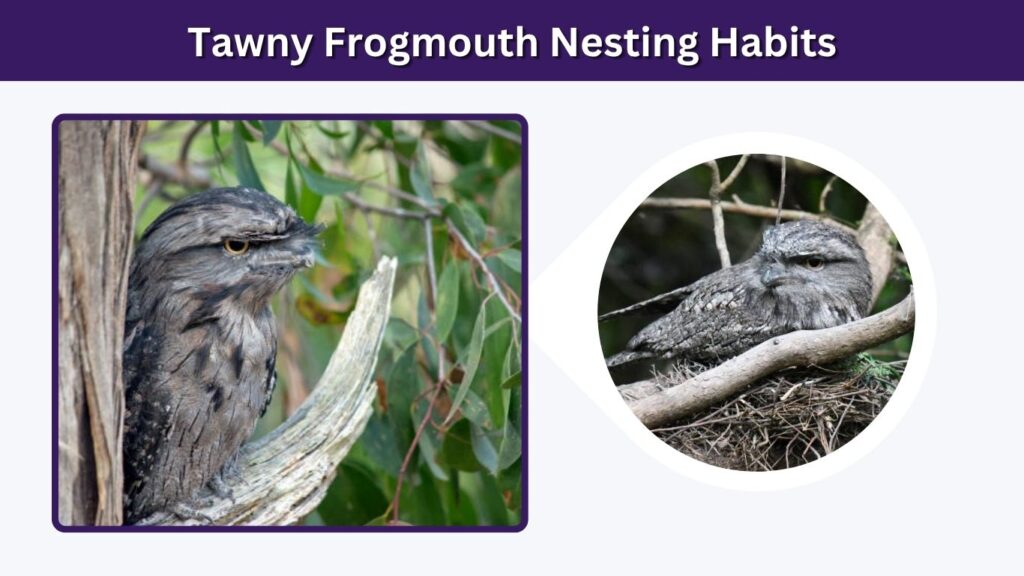
Tawny frogmouths construct a loose, flat platform of sticks on a horizontal tree branch. The nest is often poorly built compared with the nests of many other birds.
The pair may reuse the same tree or nesting area in later breeding seasons.
Both sexes help with nest construction. However, the male commonly incubates during the day, while the female may take over part of the nighttime incubation.
Eggs and Breeding
A female usually lays one to three white eggs, although two is common. The eggs are placed directly on the stick platform.
Incubation lasts for about one month. Both parents protect the nest and later feed the chicks.
The adults may become extremely still when danger approaches, relying on camouflage rather than immediately flying away. They can also spread their wings, hiss, or snap their bills when defending young.
Baby and Juvenile Tawny Frogmouth
Newly hatched chicks are covered in soft white down. Their eyes remain partly closed at first, and they depend entirely on their parents for warmth and food.
As they develop, chicks become fluffy gray-white before gaining the mottled feathers of adults.
Young tawny frogmouths may leave the nest before becoming fully independent. Parents continue feeding and protecting them while they sit on nearby branches.
A juvenile found on the ground is not always abandoned. When it is uninjured and the area is safe, wildlife specialists may recommend placing it on a nearby branch so its parents can continue caring for it.
What Should You Feed a Baby Tawny Frogmouth?
People should not attempt to raise or routinely feed a wild baby tawny frogmouth. Young birds require a carefully balanced natural diet, and incorrect food can cause nutritional disease, choking, digestive problems, or death.
Do not give a chick bread, milk, processed meat, pet food, or water directly into its mouth.
An injured, cold, or genuinely orphaned bird should be placed in a ventilated box and referred to a licensed wildlife rehabilitator or veterinarian as quickly as possible.
Tawny Frogmouth Lifespan
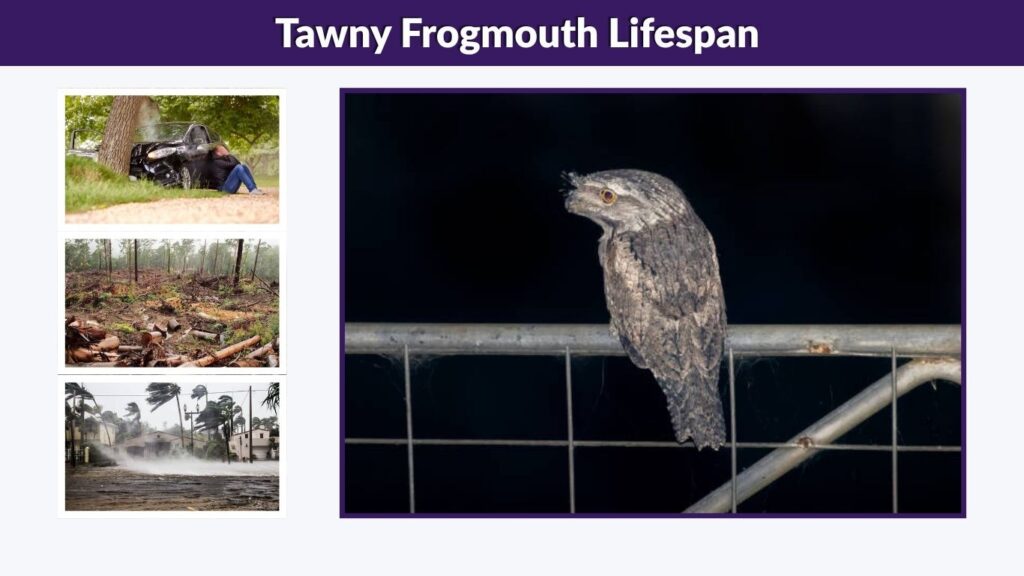
Tawny frogmouths can live for more than ten years in the wild, although many die earlier from accidents, predators, disease, and food shortages.
Major dangers include:
- Vehicle collisions
- Domestic cats and dogs
- Habitat clearing
- Pesticide exposure
- Secondary poisoning from contaminated prey
- Severe storms and heat
- Collisions with windows or fences
Roads are especially dangerous because frogmouths often hunt insects attracted to streetlights.
Are Tawny Frogmouths Endangered?
The tawny frogmouth is not generally considered globally endangered. It remains widespread throughout Australia and can adapt to some suburban environments.
However, individual populations may be harmed by the removal of mature trees, loss of nesting branches, traffic, pesticides, and declining insect populations.
Protecting established trees and reducing unnecessary pesticide use can help local birds.
Can You Keep a Tawny Frogmouth as a Pet?
Tawny frogmouths are native wild birds and are not ordinary pets. Keeping one without the required wildlife authorization is generally illegal in Australia.
They also require specialized food, housing, veterinary care, and behavioral management. An injured bird should be taken to an authorized wildlife carer rather than kept at home.
Tawny Frogmouth Meaning and Symbolism
The bird’s unusual appearance and secretive nighttime behavior have inspired different symbolic interpretations. It is sometimes associated with patience, stillness, observation, camouflage, wisdom, and adaptation.
These interpretations come from modern cultural or personal beliefs rather than scientific facts. Meanings can also vary between communities, traditions, and individuals.
Interesting Tawny Frogmouth Facts
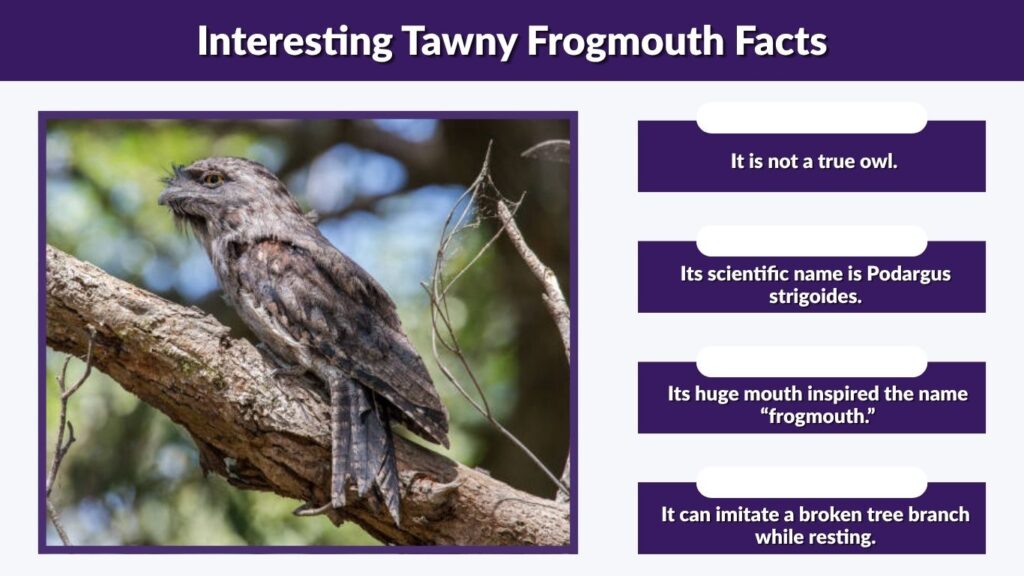
- It is not a true owl.
- Its scientific name is Podargus strigoides.
- Its huge mouth inspired the name “frogmouth.”
- It can imitate a broken tree branch while resting.
- It occurs across most of Australia.
- Insects make up most of its diet.
- It usually catches prey with its bill rather than its feet.
- Both parents help incubate and care for chicks.
- Pairs may remain together for many years.
- It was named Australia’s Bird of the Year in 2025.
FAQs
Why is a tawny frogmouth not an owl?
It belongs to the frogmouth family rather than the owl order. Frogmouths have wider bills, weaker feet, different nesting behavior, and closer evolutionary relationships with nightjars.
What does a tawny frogmouth sound like?
Its best-known call is a deep, repeated “oom-oom-oom.” It may also grunt, hiss, snap its bill, and produce warning or contact calls.
Where do tawny frogmouths sleep?
They usually rest on tree branches during daylight. Their mottled feathers and upright posture make them resemble part of the tree.
Are tawny frogmouths dangerous?
They are not normally dangerous to people. However, a threatened bird may hiss, open its mouth, snap its bill, or defend a nearby nest.
Do tawny frogmouths mate for life?
They often form long-term pair bonds and may remain together within the same territory for many years. Both parents participate in nesting and chick care.