
The tawny owl is one of the most familiar woodland owls in Europe. Known for its rounded head, dark eyes, mottled brown feathers, and haunting nighttime calls, it is especially common across the United Kingdom. This medium-sized owl spends most of the day hidden among tree branches and becomes active after sunset. It hunts rodents, birds, insects, and other small animals using excellent hearing and silent flight. Tawny owls are strongly territorial, usually remain in the same area throughout the year, and often form long-lasting pairs.
Tawny Owl Identification
The tawny owl, scientifically known as Strix aluco, is a stocky owl with broad wings and a short tail. Unlike many owl species, it has no visible ear tufts.
Key Identification Features
- Rounded head without ear tufts
- Large, dark brown or black eyes
- Mottled brown, gray, or reddish plumage
- Pale facial disc with darker edges
- Broad, rounded wings
- Short, hooked bill
- Feathered legs and strong talons
- Short tail with dark bars
Its plumage provides excellent camouflage against bark, dead leaves, and shaded branches. Some individuals appear reddish-brown, while others are mainly gray.
Tawny Owl Size
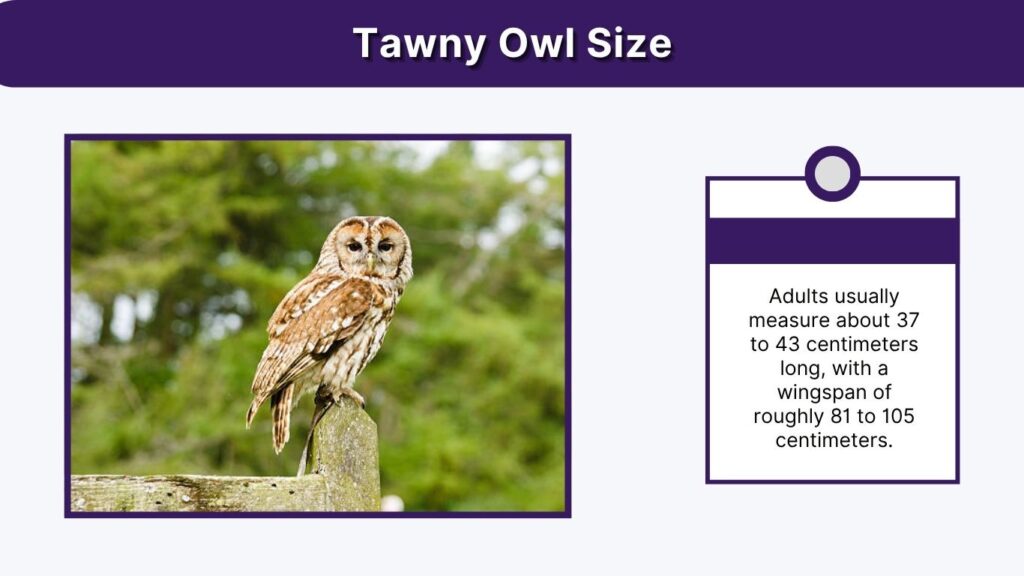
Tawny owls are medium-sized birds. Adults usually measure about 37 to 43 centimeters long, with a wingspan of roughly 81 to 105 centimeters.
Females are generally larger and heavier than males. A female may weigh around 400 to 800 grams, while males are commonly lighter.
Despite their compact appearance, tawny owls have broad wings that support quiet and controlled flight through woodland.
Male vs. Female Tawny Owl
Male and female tawny owls have similar feather colors and markings. Their main differences involve size, voice, and breeding behavior.
| Feature | Male Tawny Owl | Female Tawny Owl |
| Size | Smaller | Larger |
| Weight | Lighter | Heavier |
| Main call | Deep, drawn-out hoot | Sharp “ke-wick” call |
| Incubation | Does not usually incubate | Incubates the eggs |
| Feeding role | Brings food to female | Guards and cares for chicks |
The familiar two-part tawny owl call often comes from two birds. The male gives the long hooting sound, while the female responds with a sharper note.
Tawny Owl Call and Sounds
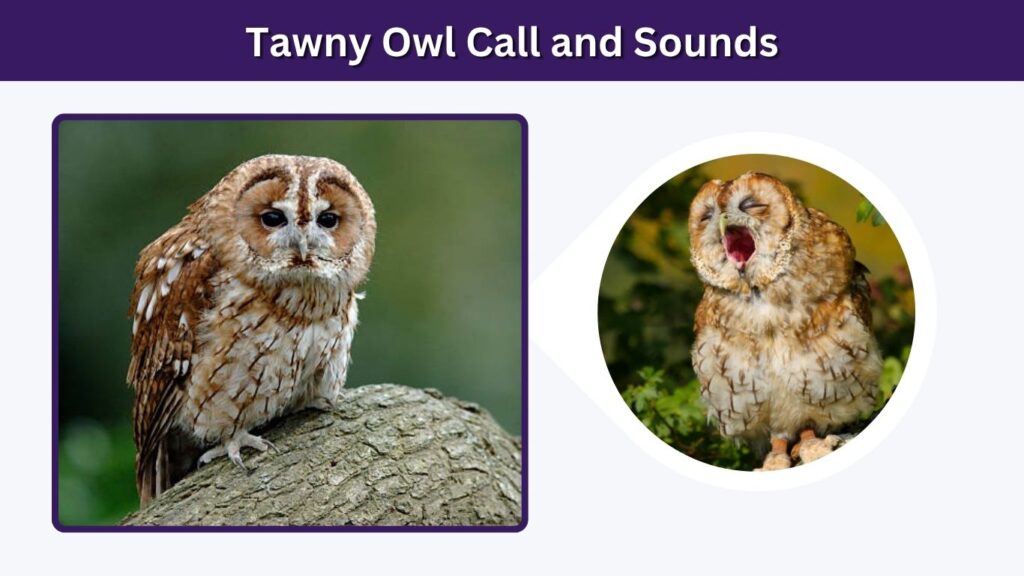
The tawny owl is famous for its classic nighttime hoot. The male produces a long, wavering call that is often written as “hoo-hoo-hooooo.”
The female usually makes a sharper “ke-wick” sound. When the male and female answer one another, their combined calls create the well-known “twit-twoo” effect.
Common Tawny Owl Sounds
- Deep territorial hoots
- Sharp contact calls
- Harsh alarm notes
- Screeches from young birds
- Soft calls between paired adults
Tawny owls call most frequently during autumn and the breeding season, although they may vocalize throughout the year.
Tawny Owl Habitat and Distribution
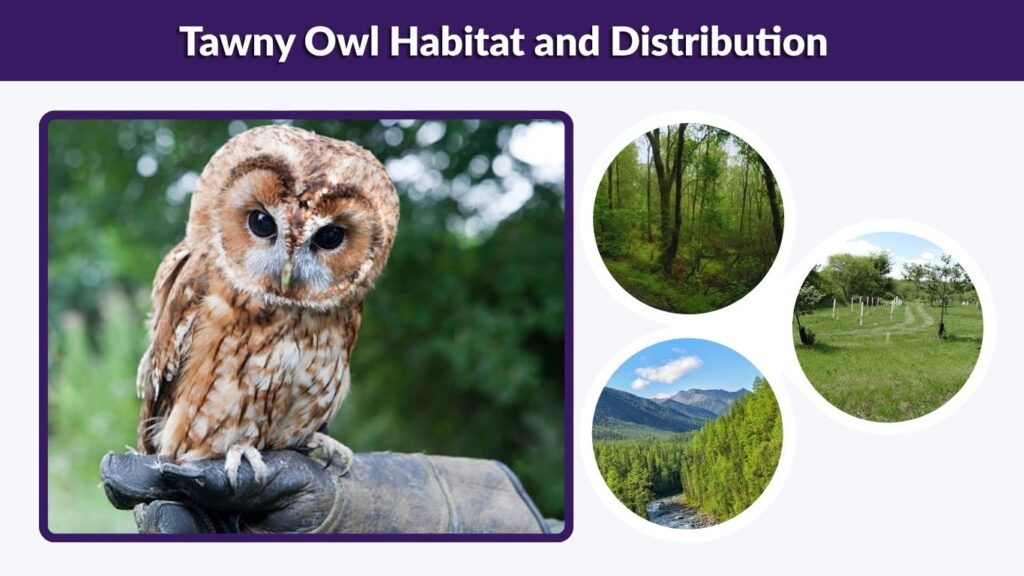
Tawny owls inhabit much of Europe and parts of western Asia and North Africa. They are especially widespread in Britain.
Their preferred habitats include:
- Deciduous woodland
- Mixed forests
- Mature parks
- Large gardens
- Farmland with old trees
- Cemeteries
- Wooded suburban areas
- Orchards and hedgerows
They require trees for daytime roosting and nesting. Old trees with cavities are particularly valuable.
Tawny owls are mainly non-migratory. A pair may remain within the same territory for many years.
Tawny Owls in the UK
The tawny owl is one of the most common owl species in the United Kingdom. It occurs throughout most of England, Wales, and Scotland.
However, it is naturally absent from Ireland. Occasional reports may involve escaped captive birds or mistaken identification.
British tawny owls are closely connected with mature woodland, but they also live in city parks, wooded estates, and large gardens.
What Do Tawny Owls Eat?
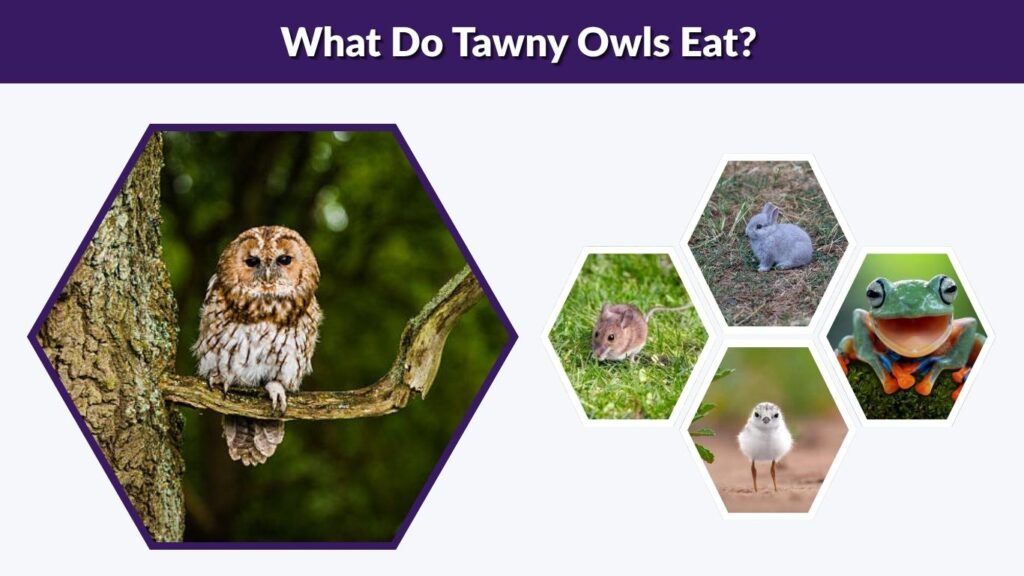
Tawny owls are opportunistic predators with a varied diet. Small mammals form a major part of their food, but they also take birds, amphibians, insects, and other prey.
Common Foods
- Mice
- Voles
- Shrews
- Rats
- Small rabbits
- Young birds
- Pigeons
- Frogs
- Beetles
- Earthworms
- Bats
- Small reptiles
Diet depends on habitat, season, and prey availability. Woodland owls may catch more small mammals and birds, while urban individuals sometimes prey on rats and garden birds.
How Do Tawny Owls Hunt?
Tawny owls usually hunt from a perch. They sit quietly on a branch and listen for movement below before dropping suddenly onto prey.
Their excellent hearing allows them to detect animals moving through leaves, grass, or darkness. Their broad wings have soft feather edges that reduce noise during flight.
Tawny owls may also fly slowly through clearings while searching for prey. Small animals are usually killed with the talons and swallowed whole or torn into smaller pieces.
Tawny Owl Pellets and Droppings
Tawny owls cannot digest fur, bones, feathers, teeth, and other hard materials. These parts are compressed into pellets and later coughed up.
Tawny owl pellets are usually gray, dark brown, or black and may contain visible bones and fur.
Their droppings are different from pellets. Owl droppings often appear as white splashes because they contain uric acid, along with darker waste material.
Pellets found beneath a regular roosting tree can provide clues about the owl’s diet.
Tawny Owl Nesting Habits
Tawny owls are cavity nesters. They commonly use natural holes in mature trees, but they may also nest in abandoned nests, buildings, chimneys, rocky ledges, or large nest boxes.
They do not build an elaborate nest. Eggs may be laid directly on wood debris, old nesting material, or a thin layer of feathers.
Pairs defend their nesting territory strongly, particularly when eggs or chicks are present.
Eggs and Breeding
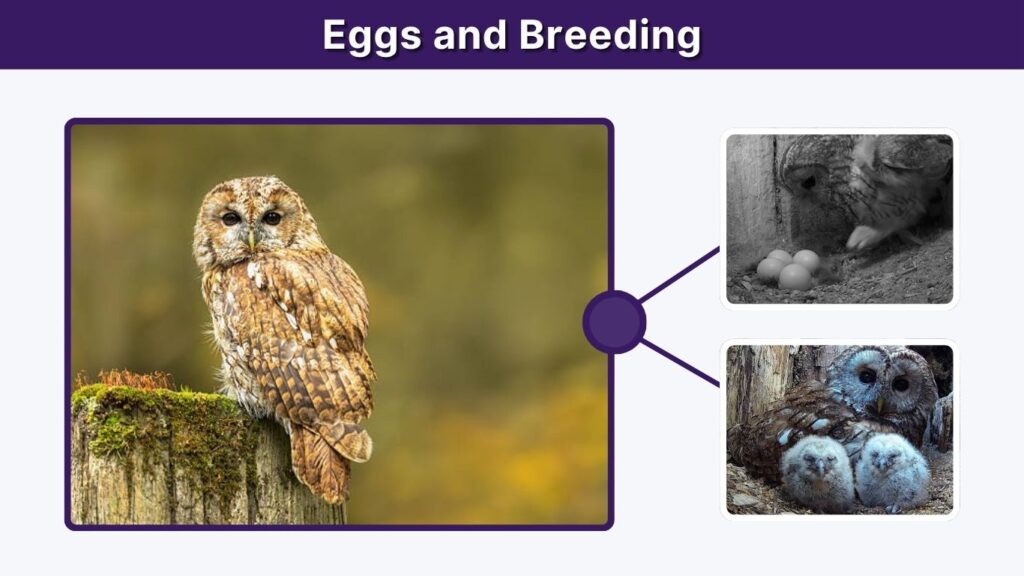
The breeding season usually begins in late winter or early spring. A female commonly lays two to four white, rounded eggs.
She incubates the eggs for approximately one month. The male supplies most of her food during this period.
The eggs often hatch at different times because incubation begins before the full clutch is complete. As a result, the chicks may vary noticeably in size.
Both parents feed and protect the young after hatching.
Tawny Owl Chicks and Juveniles
Newly hatched tawny owl chicks are covered in pale white down. As they grow, they develop soft gray-brown feathers and darker facial markings.
Young tawny owls often leave the nest before they can fly properly. This stage is called branching. The chicks climb or flutter onto nearby branches and continue receiving food from their parents.
A young owl found on the ground may not be abandoned. Its parents are often nearby and continue caring for it.
Juveniles gradually become independent several months after hatching.
Tawny Owl Lifespan
A tawny owl may live for approximately four to six years in the wild, although many survive much longer.
Some individuals have reached more than 15 years. Survival depends on food availability, weather, disease, territory quality, and human-related dangers.
Major threats include vehicle collisions, starvation, poisoning, habitat loss, and injuries from territorial conflicts.
Are Tawny Owls Nocturnal?
Tawny owls are mainly nocturnal. They usually leave their daytime roost shortly after sunset and hunt throughout the night.
During the day, they remain hidden in tree cavities, ivy, dense foliage, or against tree trunks. Their mottled feathers make them difficult to detect.
They may occasionally hunt before sunset, especially during winter or when feeding hungry chicks.
Are Tawny Owls Dangerous?
Tawny owls generally avoid people and are not normally dangerous. However, they can become aggressive when defending a nest, young chicks, or their territory.
A defensive owl may swoop silently toward a person or animal. Its sharp talons can cause painful scratches or cuts.
People should avoid approaching active nests, touching chicks, or repeatedly entering a known nesting area.
Tawny Owl vs. Barn Owl
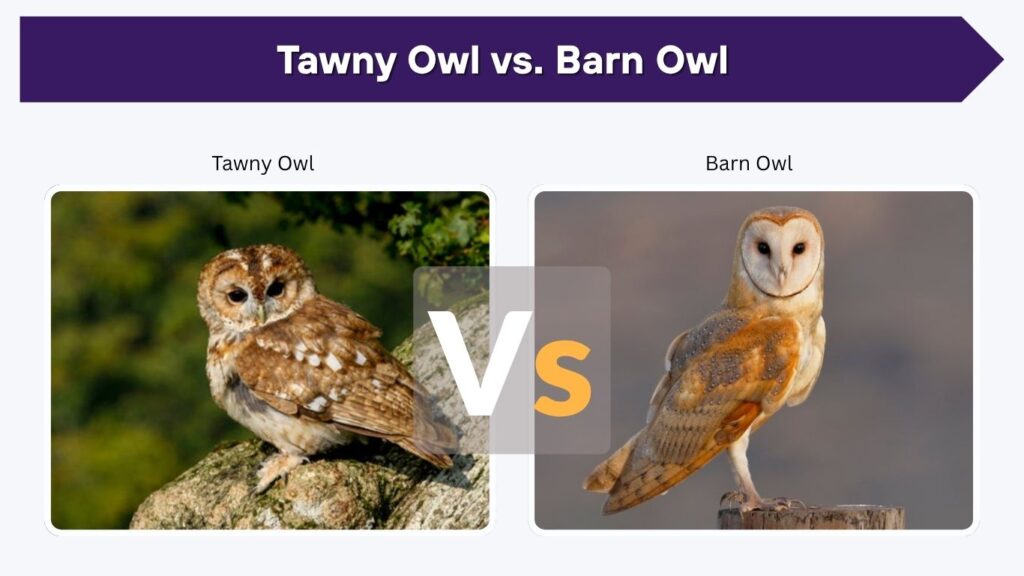
Tawny and barn owls differ in appearance, habitat, voice, and hunting behavior.
| Feature | Tawny Owl | Barn Owl |
| Face | Rounded facial disc | Heart-shaped face |
| Eyes | Dark | Dark |
| Plumage | Brown, gray, or reddish | Pale gold and white |
| Habitat | Woodland and parks | Farmland and open country |
| Call | Hooting and “ke-wick” | Harsh screech |
| Body shape | Stocky | Slender |
| Nesting | Tree cavities | Barns, buildings, and hollows |
The tawny owl is more strongly associated with forests, while the barn owl usually hunts over open grassland and farmland.
Is a Tawny Frogmouth an Owl?
No. The tawny frogmouth is not a true owl. It is an Australian bird belonging to a different family.
Tawny frogmouths have wide, frog-like mouths and often rest lengthwise along tree branches. Although they are nocturnal and have owl-like eyes, they are more closely related to nightjars than to owls.
The tawny owl, by contrast, is a true owl found mainly in Europe and nearby regions.
Is the Tawny Fish Owl the Same Species?
No. The tawny fish owl is a different owl species found in parts of South and Southeast Asia.
It is larger than the tawny owl and is adapted to hunting fish, frogs, crabs, and other aquatic animals near rivers and wetlands.
The similar name refers mainly to its brownish coloring, not a close identity with the European tawny owl.
Do Tawny Owls Mate for Life?
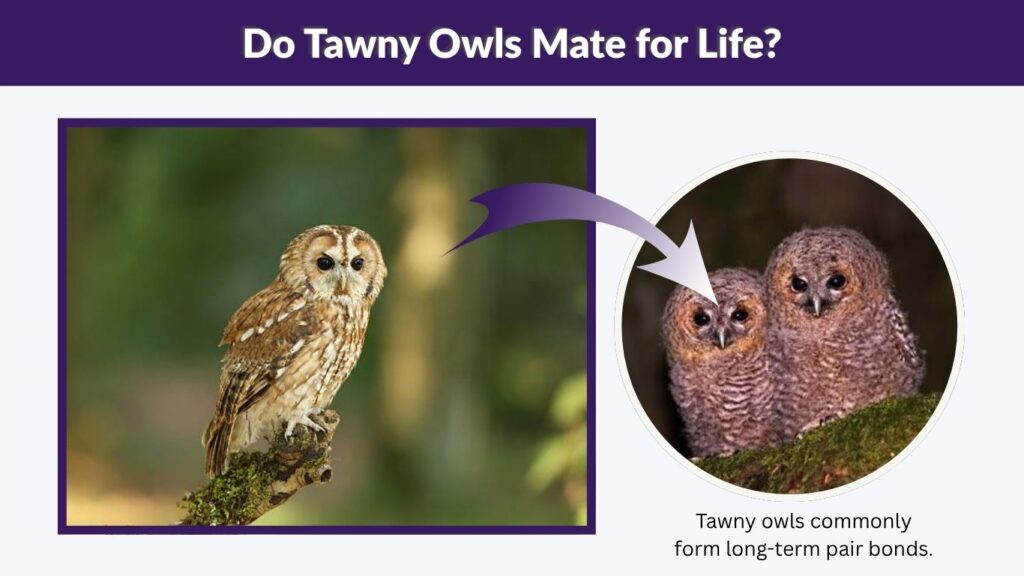
Tawny owls commonly form long-term pair bonds. A male and female may remain together within the same territory for several years.
However, this does not always mean they stay together for their entire lives. A surviving bird may find a new mate if its partner dies or disappears.
Pairs communicate through calls, defend their territory, and work together to raise chicks.
Conservation Status
The tawny owl is widely distributed and is not currently considered globally endangered. However, local populations may decline when mature trees, nesting cavities, and suitable hunting habitats are removed.
Helpful conservation actions include:
- Protecting old woodland
- Retaining mature and hollow trees
- Installing suitable nest boxes
- Reducing rodenticide use
- Preserving hedgerows and field margins
- Avoiding disturbance near active nests
Rodent poison can harm owls when they eat contaminated prey.
Interesting Tawny Owl Facts
- Tawny owls have dark eyes adapted for low-light hunting.
- Their famous “twit-twoo” sound usually involves both sexes.
- Females are larger than males.
- They may remain in one territory throughout their lives.
- Their feathers allow nearly silent flight.
- Young owls often leave the nest before they can fly well.
- They swallow small prey whole and produce pellets.
- Tawny owls occur widely in Britain but are naturally absent from Ireland.
- Brown and gray color forms may occur in the same region.
- They can hunt successfully in almost complete darkness.
FAQs
How big is a tawny owl?
An adult tawny owl is generally 37 to 43 centimeters long and has a wingspan of about 81 to 105 centimeters. Females are usually larger and heavier than males.
What does a tawny owl sound like?
The male produces a long, wavering hoot, while the female commonly makes a sharp “ke-wick” call. When the two calls are heard together, they create the familiar “twit-twoo” sound.
Where do tawny owls sleep?
During daylight, tawny owls roost in tree cavities, dense ivy, thick branches, conifers, or sheltered woodland locations. Their mottled feathers help them blend into the surrounding bark and leaves.
Are tawny owls endangered?
Tawny owls are not considered globally endangered, but local numbers may be affected by habitat loss, removal of old trees, road collisions, reduced prey, and poisoning from rodenticides.
How long do tawny owls live?
Many tawny owls live around four to six years in the wild, although some survive for more than 15 years. Their lifespan depends on food, habitat quality, weather, disease, and human-related threats.