
The Spotted Wood Owl (Strix seloputo) is a large, earless owl found across parts of Southeast Asia. It is recognized by its orange-brown facial disc, enormous dark eyes, chocolate-brown upperparts, white spots, and strongly barred underparts. This nocturnal predator usually rests in tall trees during the day and hunts rodents, birds, and large insects after sunset. It can inhabit forests, plantations, mangroves, gardens, and well-wooded urban parks.
Spotted Wood Owl Quick Facts
The Spotted Wood Owl belongs to the typical-owl family, Strigidae. Cornell’s Birds of the World recognizes three subspecies, each occupying a different part of the species’ Southeast Asian range.
| Feature | Description |
| Scientific name | Strix seloputo |
| Family | Strigidae |
| Length | Approximately 44–48 cm |
| Weight | About 1,011 g for one recorded male |
| Main colors | Brown, orange-buff, black, and white |
| Diet | Mammals, birds, and large insects |
| Activity | Nocturnal |
| Habitat | Forests, plantations, parks, and mangroves |
| Global status | Least Concern |
| Singapore status | Critically Endangered nationally |
BirdLife currently lists the species as Least Concern globally. In Singapore, however, it is considered nationally Critically Endangered because its local population and suitable nesting habitat are limited.
What Does a Spotted Wood Owl Look Like?
The Spotted Wood Owl has a rounded head without visible ear tufts. Its warm orange-buff facial disc surrounds two exceptionally large, dark brown eyes, giving it an unmistakable appearance.
Identification
- Large, rounded head without ear tufts
- Orange-brown or buff facial disc
- Very large, dark brown eyes
- Grayish or greenish-black bill
- Chocolate-brown head and upperparts
- Numerous white spots with dark borders
- Buffy underparts with bold black-and-white bars
- Feathered legs and toes
- Broad wings and powerful talons
The owl’s white spotting and heavily barred breast distinguish it from the related Brown Wood Owl, which generally has a darker face and a different pattern across the breast and body.
Spotted Wood Owl Size
Adults generally measure around 44–48 cm, or approximately 17–19 inches, from head to tail. Females are believed to be larger than males, as is common among many owls. One recorded male weighed about 1,011 grams, although comprehensive weight data are limited.
In Singapore, the bird stands at approximately 46 cm and is described by NParks as the country’s largest owl. Its broad body and rounded head make it appear especially imposing when perched low in a park or garden.
Where Do Spotted Wood Owls Live?
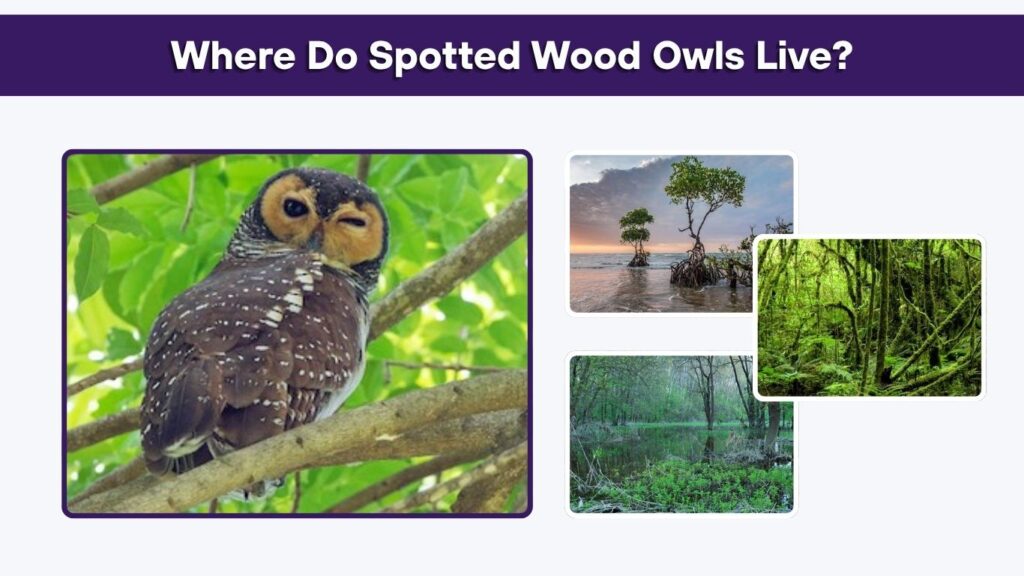
Spotted Wood Owls occur across a scattered Southeast Asian range. They are found from southern Myanmar through Thailand, Cambodia, southern Vietnam, and the Malay Peninsula. Their distribution also includes Sumatra, Java, Bawean Island, Palawan, and the Calamian Islands. Interestingly, they occur around Borneo but are not naturally recorded on the island itself.
Preferred Habitat
The species can live in several wooded environments, including:
- Evergreen and secondary forests
- Partially cleared woodland
- Forest edges
- Coastal swamp forest
- Mangroves
- Plantations
- Orchards
- Gardens and urban parks
- Residential areas containing mature trees
Spotted Wood Owls often forage in open or semi-open areas while relying on tall, leafy trees for daytime roosting and nesting. Records range from sea level to approximately 1,000 meters in elevation.
Spotted Wood Owls in Singapore
The Spotted Wood Owl was first formally recorded in Singapore’s Central Catchment forest in December 1985. A breeding record followed in August 1986, and the species was later documented at several additional locations.
It has been observed in places such as Pasir Ris Park, Jurong Lake Gardens, Singapore Botanic Gardens, Pulau Ubin, Labrador Nature Reserve, Sentosa, and other well-wooded locations. These owls can tolerate some urban development when mature trees, prey, and quiet roosting sites remain available.
Although the owl is now more widely distributed across Singapore than it once was, it remains nationally threatened by habitat loss, disturbance, and limited nesting sites. People who encounter a roosting or nesting owl should observe quietly and avoid revealing an active nest’s exact location online.
What Do Spotted Wood Owls Eat?
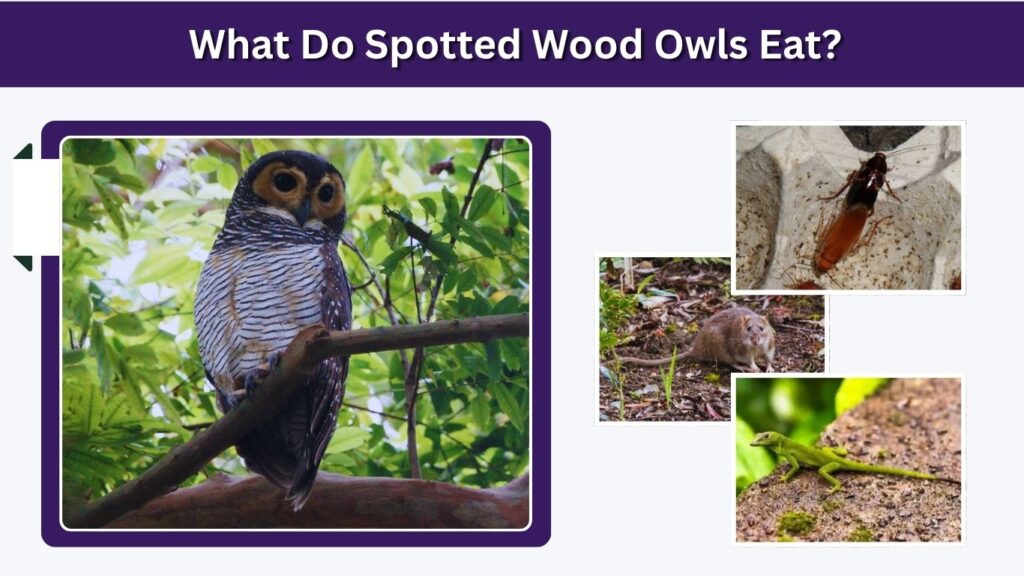
Spotted Wood Owls are carnivorous predators. Their best-documented foods are small vertebrates, especially rodents and birds, although they also consume large insects.
Common Foods
Their diet may include:
- Rats
- Mice
- Small birds
- Chicks and fledglings
- Large beetles
- Other large insects
- Small reptiles
- Other appropriately sized vertebrates
NParks identifies mammals and birds as important prey, while other species accounts specifically mention rats, mice, small birds, and large insects.
Hunting Behavior
The owl becomes active around dusk. It may watch from a tree branch before flying silently toward prey detected on the ground, in vegetation, or among nearby trees.
Its broad wings, soft flight feathers, strong talons, sensitive hearing, and low-light vision make it an effective nighttime hunter. After swallowing small animals, it later regurgitates pellets containing indigestible bones, fur, feathers, or insect remains.
What Does a Spotted Wood Owl Sound Like?
The Spotted Wood Owl produces loud, resonant hoots. Pairs frequently call together in duets, especially around dusk, dawn, and periods of territorial activity.
Its characteristic call has been described as a rolling series of short “huhuhu” notes followed by a long, deep “whoo.” It may also give a loud, wavering call or a mellow metallic hoot. These sounds can carry considerable distances through forests and urban parks.
The owls often call from their daytime roosts in tall trees. Hearing a pair does not necessarily mean they are visible, because their brown-and-white plumage provides excellent camouflage among branches and leaves.
Spotted Wood Owl Behavior
Spotted Wood Owls are mainly nocturnal, becoming active as daylight fades. During the day, they generally roost close to a tree trunk beneath dense foliage.
They may occur alone or in pairs. Unlike highly secretive forest owls, they occasionally choose fairly conspicuous branches in open woodland or parks, allowing people to observe them during daylight.
These owls are wild predators and should not be approached closely. An adult protecting its mate, nest, or young could use its talons defensively. Flash photography, loud sounds, crowding, and repeated disturbance may cause unnecessary stress.
Spotted Wood Owl Nesting and Eggs
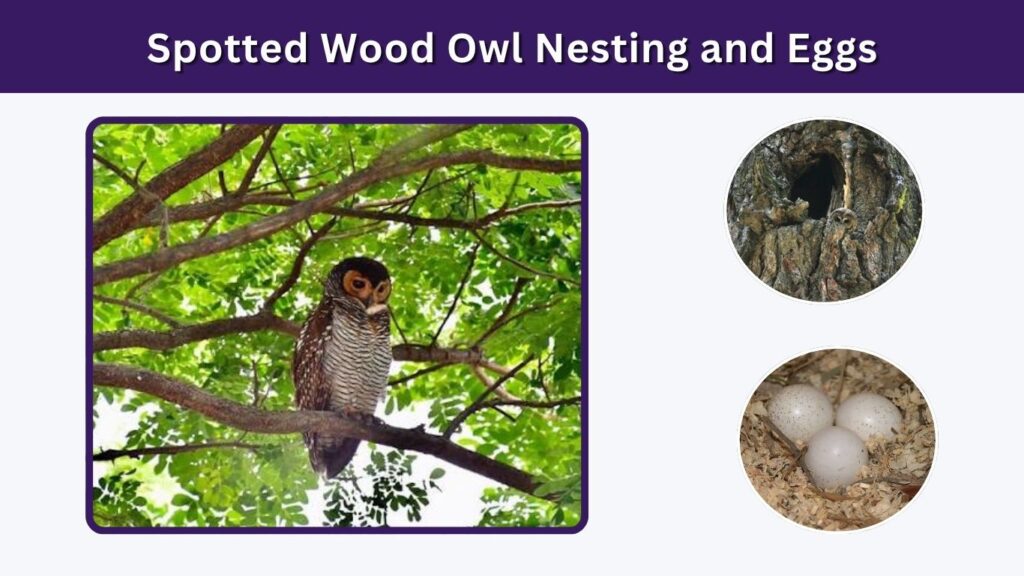
The reported breeding season extends approximately from January to August, although timing may vary by location and weather conditions.
Nesting Sites
Spotted Wood Owls may nest in:
- Natural holes in large trees
- Cavities in trunks or branches
- Open areas high in trees
- Large bird’s-nest ferns
- Other sheltered elevated sites
The female usually lays two white eggs, although clutches of three have been recorded. Eggs may be placed directly on wood, leaves, or debris rather than inside a carefully constructed nest.
Suitable nesting trees are particularly important in developed landscapes. Removing old trees and large cavities can reduce breeding opportunities even when parks and feeding areas remain nearby.
What Does a Juvenile Spotted Wood Owl Look Like?
A juvenile is much paler than an adult. Young birds are generally whitish or light gray, with dark barring across much of the body. They retain the species’ rounded head and large dark eyes but lack the adult’s rich chocolate-brown plumage.
Young Brown Wood Owls can look similar, but juvenile Spotted Wood Owls are usually more extensively barred. As they mature, the pale juvenile feathers are gradually replaced by spotted brown upperparts and bold barred underparts.
Spotted Wood Owl Lifespan
A reliable average or maximum lifespan for the Spotted Wood Owl has not been firmly documented. Precise figures sometimes given online are often based on other owl species rather than long-term studies of Strix seloputo.
Like other large owls, it may potentially survive for many years when it has secure habitat, sufficient prey, and protection from collisions, persecution, and disturbance. However, a species-specific lifespan should be treated as unknown until better ringing or long-term monitoring data become available.
Conservation and Threats
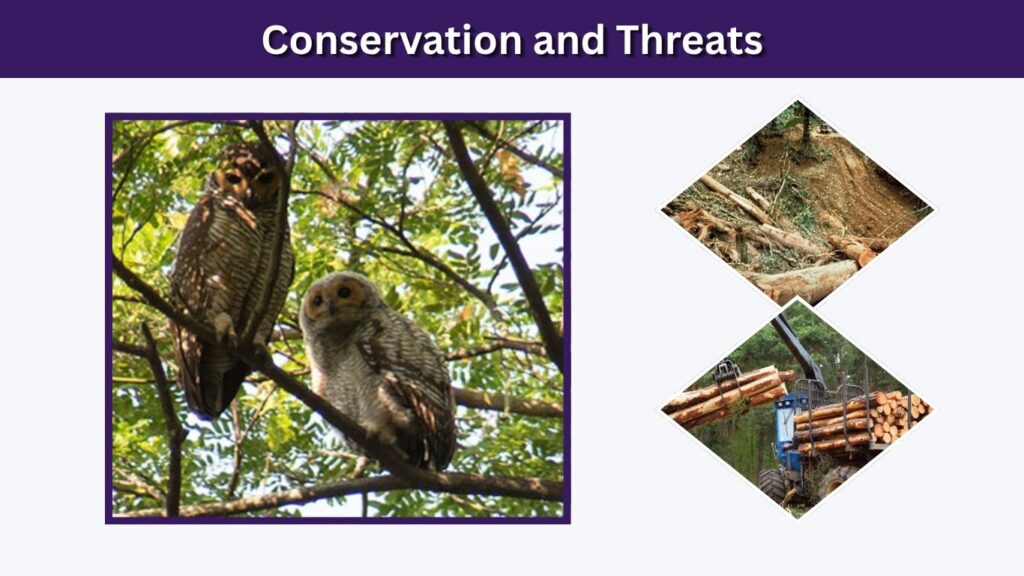
The species is not currently considered globally endangered, but local populations can be vulnerable. BirdLife lists it as Least Concern worldwide, while Singapore classifies it as nationally Critically Endangered.
Major local threats may include habitat clearance, disturbance around nests, removal of mature cavity-bearing trees, road collisions, and reduced prey availability. Protecting connected woodland, preserving large trees, and limiting disturbance near breeding sites can support urban and forest populations.
FAQs
Is the Spotted Wood Owl found in Africa?
No. The Spotted Wood Owl is native to Southeast Asia. It should not be confused with the African Wood Owl or Spotted Eagle-Owl, which are separate African species.
Is the Spotted Wood Owl rare?
It is classified as Least Concern globally, but abundance varies by location. It is nationally Critically Endangered in Singapore despite being seen in several parks and wooded urban areas.
Do male and female Spotted Wood Owls look different?
The sexes have similar colors and patterns. Females are generally larger, but accurately determining sex from appearance alone can be difficult unless both members of a pair are seen together.
Are Spotted Wood Owls dangerous?
They do not normally attack people. However, they have strong talons and may defend a nest or young. Keeping a respectful distance protects both the observer and the owl.
Where can you see Spotted Wood Owls in Singapore?
They have been recorded at Pasir Ris Park, Jurong Lake Gardens, Singapore Botanic Gardens, Pulau Ubin, Labrador Nature Reserve, and several other wooded sites. Sightings are never guaranteed because the birds are nocturnal and well camouflaged.