
Eagle-owls are among the most powerful and impressive owls in the world. Known for their large bodies, strong talons, deep calls, and noticeable ear tufts, these birds are skilled nighttime hunters. Different types of eagle-owls live in forests, deserts, rocky cliffs, mountains, savannas, and wetlands across Europe, Asia, and Africa. Some species, like the Eurasian Eagle-Owl, are huge and widespread, while others, such as Shelley’s Eagle-Owl and the Usambara Eagle-Owl, are rare and secretive. This guide covers 13 types of eagle-owls with key identification features, habitats, behavior, diet, breeding, and conservation details.
1. Eurasian Eagle-Owl
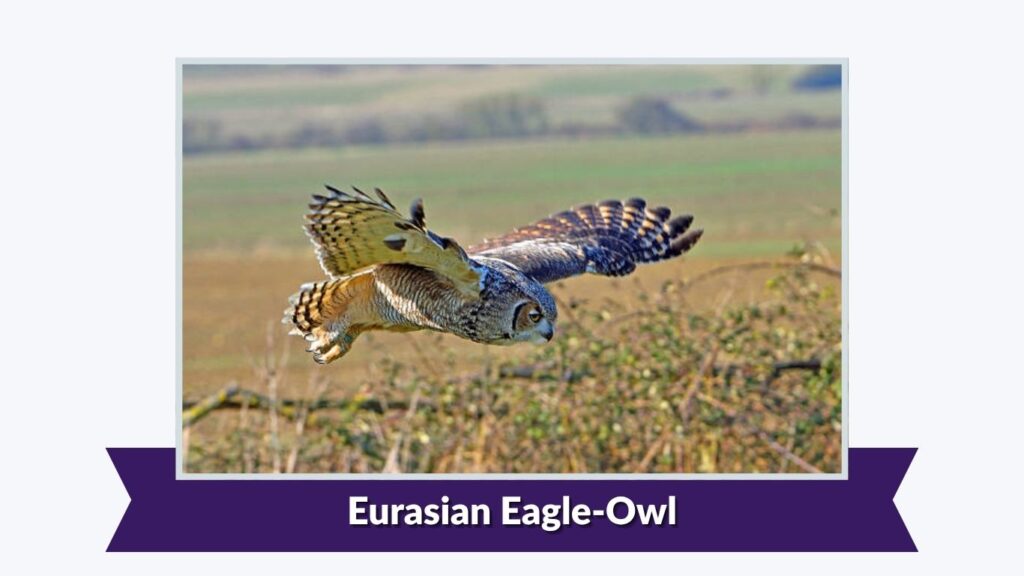
The Eurasian Eagle-Owl is one of the largest and most powerful owls in the world. Known for its bright orange eyes, large ear tufts, and deep hooting call, this owl lives across much of Europe and Asia, with some populations also found in northern Africa. It prefers rocky cliffs, forests, open country, and remote landscapes where it can hunt at night.
Identification
- Very large owl with a bulky body
- Bright orange to reddish-orange eyes
- Long, noticeable ear tufts
- Brown, buff, and black mottled feathers
- Broad wings and strong legs
- Pale throat patch visible when calling
- Deep, powerful “hoo” call
Habitat and Distribution
The Eurasian Eagle-Owl has a wide range across Europe, Asia, and parts of northern Africa. It often lives in rocky landscapes with cliffs, ravines, caves, scattered trees, and patches of woodland. It may also use open habitats such as steppes, grasslands, farmlands, taiga, and semi-arid areas when suitable nesting and hunting places are available.
Behavior and Diet
This eagle-owl is mostly nocturnal, hunting at night with silent flight and powerful talons. Its diet is varied and depends on local prey availability. It commonly eats mammals such as rats, mice, voles, rabbits, and hares, but it can also take birds, reptiles, amphibians, and other small animals. In some areas, studies show mammals form the largest part of its diet.
Lifespan and Breeding
The Eurasian Eagle-Owl is a long-lived owl. In the wild, it may live up to around 20 years, while captive birds can live much longer. It usually nests on cliffs, rocky ledges, ground scrapes, or sheltered areas rather than building a traditional nest. Pairs are often territorial, and the female usually incubates the eggs while the male provides food.
2. Pharaoh Eagle-Owl
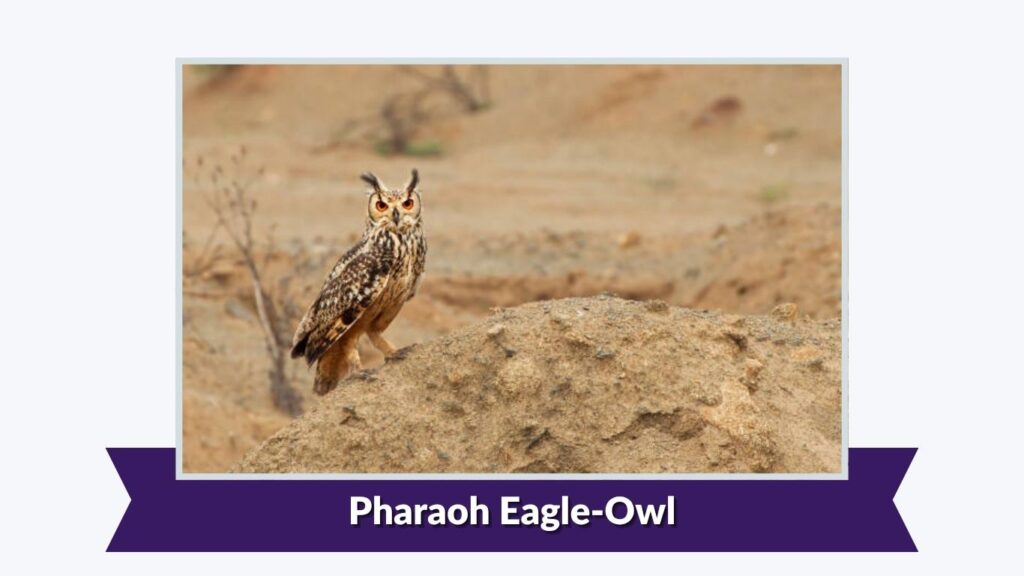
The Pharaoh Eagle-Owl is a large desert owl found across parts of North Africa and the Middle East. It is also called the Desert Eagle-Owl in some sources. This owl is well adapted to rocky deserts, dry cliffs, semi-deserts, and open arid landscapes. With its orange eyes, ear tufts, and sandy mottled plumage, it blends well into desert rocks and cliffs.
Identification
- Large owl with strong body shape
- Orange to yellow-orange eyes
- Noticeable upright ear tufts
- Sandy brown, buff, and dark mottled plumage
- Pale underparts with dark streaking
- Broad wings and powerful talons
- Camouflages well against rocks and desert ground
Habitat and Distribution
The Pharaoh Eagle-Owl mainly lives in rocky deserts, semi-deserts, dry mountain slopes, cliffs, gorges, and rocky outcrops. It may also occur near oases and dry savanna-like areas where prey is available. Its range includes northwestern Africa, patchy areas across northern Africa, and parts of the Middle East toward Oman.
Behavior and Diet
This owl is mostly nocturnal, hunting at night from a raised perch. It waits quietly, watches for movement, then flies down to catch prey with its strong talons. Its diet includes small mammals, birds, snakes, lizards, beetles, and scorpions. Studies from Saudi Arabia found that small mammals made up most of its prey, followed by arthropods, birds, and reptiles.
Breeding and Nesting
The Pharaoh Eagle-Owl usually nests in sheltered rocky places, caves, cliff ledges, or ground-level sites protected by stones and slopes. It does not build a complex nest like many songbirds. Instead, the female lays eggs in a simple scrape or protected hollow. In desert regions, nesting sites are often chosen for shade, safety, and access to nearby hunting grounds.
Lifespan and Conservation
The Pharaoh Eagle-Owl is listed as Least Concern by BirdLife International, meaning it is not currently considered globally threatened. However, local populations may still be affected by habitat disturbance, human activity near nesting cliffs, and loss of prey. Like many large owls, it depends on quiet nesting areas and healthy populations of small animals in desert ecosystems.
3. Indian Eagle-Owl
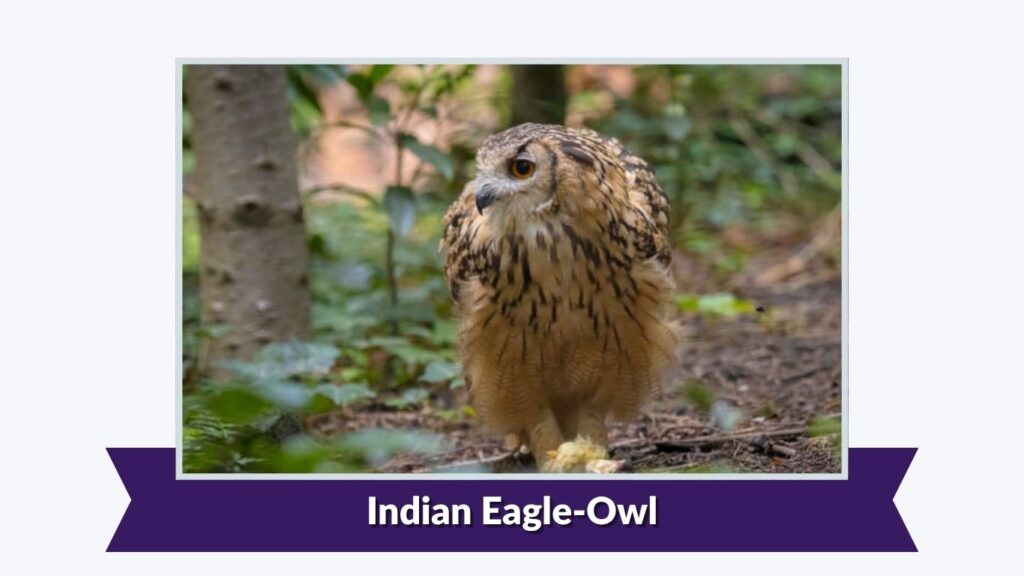
The Indian Eagle-Owl is a large horned owl native to the Indian subcontinent. It is also known as the Bengal Eagle-Owl or Rock Eagle-Owl. This owl is strongly linked with rocky hills, scrub forests, ravines, and dry open landscapes. With its orange eyes, long ear tufts, and heavily streaked body, it is one of the most impressive eagle-owls found in South Asia.
Identification
- Large owl with a strong, upright body
- Bright orange to reddish-orange eyes
- Long dark ear tufts
- Brown, buff, and grey mottled upperparts
- Pale underparts with bold dark streaks
- White throat patch with dark striping
- Heavy feet and powerful talons
- Deep booming call, often heard at dusk or dawn
Habitat and Distribution
The Indian Eagle-Owl is found across parts of India, Pakistan, Nepal, and nearby areas of the Indian subcontinent. It prefers rocky scrubland, bush-covered hills, ravines, dry riverbanks, semi-desert areas, and open country with scattered trees. It avoids very dense evergreen forests and extremely dry, treeless deserts. During the day, it often rests under rocky cover, bushes, or thick trees near quiet hunting grounds.
Behavior and Diet
This owl is mostly nocturnal and becomes active around evening. It hunts from a perch, watching the ground carefully before dropping down on prey. Its diet includes field rats, mice, birds, reptiles, insects, amphibians, and sometimes crabs. Studies from agricultural areas show that rodents form a major part of its diet, making it useful in controlling crop-field pests.
Breeding and Nesting
The Indian Eagle-Owl usually nests in rocky places rather than building a large nest. It may use cliff ledges, rocky crevices, earth banks, old ruins, or sheltered ground scrapes. Pairs are territorial and often stay around suitable rocky areas where nesting cover and prey are available. The female incubates the eggs while the male helps by bringing food. Nesting sites need low disturbance because human activity near the nest can cause stress or breeding failure.
Lifespan and Conservation
The Indian Eagle-Owl is currently treated as a species of least concern globally, but it can still face local threats. Habitat disturbance, quarrying, persecution, superstition, and disturbance near nests may affect some populations. Because it is a top nocturnal predator, it plays an important role in balancing small mammal and insect populations in rocky and agricultural landscapes.
4. Spotted Eagle-Owl
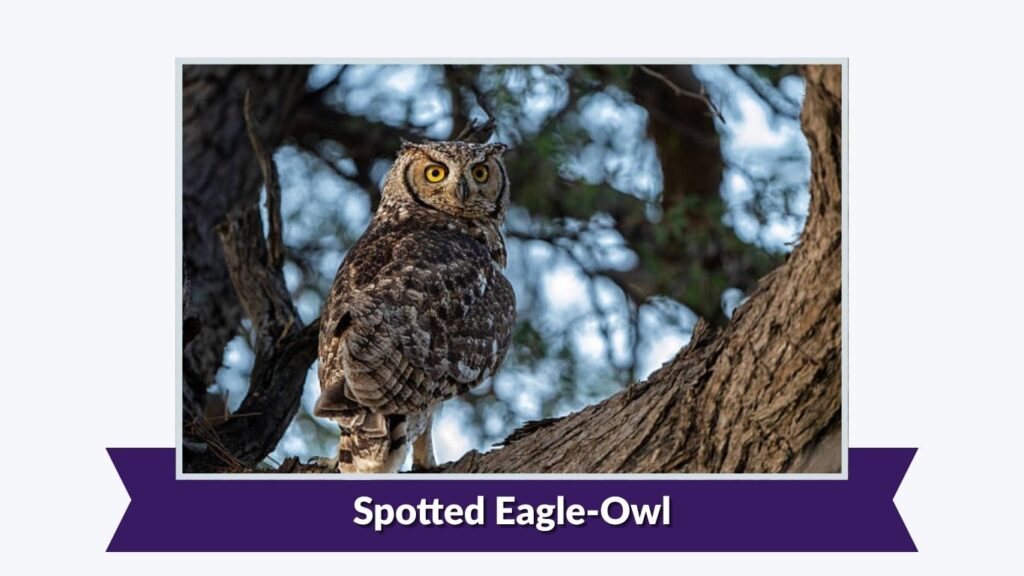
The Spotted Eagle-Owl is a medium-to-large eagle-owl found across much of sub-Saharan Africa and parts of the Arabian Peninsula. It is one of the more adaptable eagle-owls, living in savannas, rocky areas, open woodland, scrubland, semi-deserts, and even suburban gardens. Its bright yellow eyes, ear tufts, and mottled brown plumage make it easy to recognize among African owls.
Identification
- Medium-to-large owl with prominent ear tufts
- Bright yellow eyes
- Pale facial disk, often whitish to pale ochre
- Dusky brown upperparts with pale spots
- Whitish underparts with fine brown barring
- Broad wings and strong feet
- Often rests on rocks, trees, buildings, or the ground
- Deep hooting call, usually heard at dusk or night
Habitat and Distribution
The Spotted Eagle-Owl is widely distributed in Africa south of the equator and also occurs in parts of the Arabian Peninsula. It uses many open and semi-open habitats, including savanna, scrub, rocky outcrops, open woodland, semi-desert, and human-altered areas. In southern Africa, it is especially common and may live close to people, including in parks, gardens, and city edges.
Behavior and Diet
This owl is mainly active at dusk and during the night. It hunts from a perch, watching and listening before dropping down silently on prey. Its diet changes with habitat and prey availability. It commonly eats insects, rodents, shrews, small birds, reptiles, amphibians, and sometimes carrion. South African sources note that crickets, beetles, mice, rats, squirrels, lizards, snakes, and frogs may all be part of its diet.
Breeding and Nesting
The Spotted Eagle-Owl usually nests in a simple scrape rather than building a true nest. It may choose sheltered ground sites, rocks, bushes, grass cover, or ledges. Breeding can vary by region, but some African records describe a season from July to February. The female lays about two to four eggs, and the young leave the nest after several weeks, though they remain dependent on the parents for food and protection for a time.
Lifespan and Conservation
The Spotted Eagle-Owl is generally considered secure in much of its range because it has a broad diet and can live in many different habitats. Its adaptability helps it survive in both natural and human-modified landscapes. However, local threats can include road accidents, poisoning from rodenticides, nest disturbance, and collisions with wires or vehicles. It is currently listed as Least Concern globally.
5. Cape Eagle-Owl
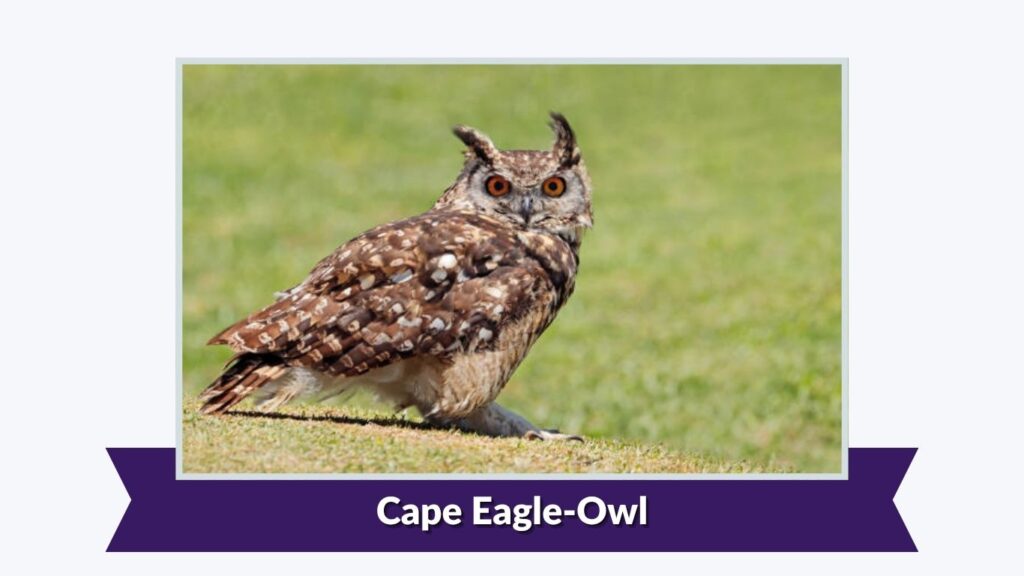
The Cape Eagle-Owl is a large, powerful owl found mainly in rocky and mountainous parts of Africa. It is closely associated with cliffs, hills, rocky outcrops, grasslands, and nearby open areas where it can hunt from high perches. This owl has bold ear tufts, bright yellow to orange eyes, and heavily mottled brown plumage that helps it blend into rocks and dry landscapes.
Identification
- Large eagle-owl with a strong body
- Prominent dark ear tufts
- Yellow to orange-yellow eyes
- Dark brown upperparts with pale spotting
- Pale underparts with heavy dark blotches and barring
- Broad wings and powerful feet
- Often seen on rocks, cliffs, or open perches
- Deep hooting call, usually heard at night
Habitat and Distribution
The Cape Eagle-Owl is mainly found in mountainous regions, rocky hills, cliffs, wooded gullies, and grasslands near rocky cover. It can occur from sea level up to high elevations and may sometimes move close to towns or human settlements, especially where prey such as pigeons and rodents are available. Its range includes parts of southern and eastern Africa, with some populations linked to highland habitats.
Behavior and Diet
This owl is mostly nocturnal and hunts from an exposed perch. It waits quietly, then glides down silently to capture prey with its strong talons. Its diet is mainly made up of small to medium-sized mammals, including rodents, mole-rats, hares, and hyraxes. It can also eat birds, reptiles, frogs, scorpions, crabs, and large insects when available.
Breeding and Nesting
The Cape Eagle-Owl usually nests in a simple scrape rather than building a large nest. It may choose a sheltered rock ledge, cave, rocky crevice, or protected ground site under dense vegetation. Breeding activity can be influenced by rainfall and food availability, especially in highland areas where prey numbers may change with the season.
Lifespan and Conservation
The Cape Eagle-Owl is generally considered a species of least concern because it has a wide range and stable overall population. However, local threats may include road accidents, nest disturbance, power-line collisions, barbed wire injuries, and poisoning from pesticides or rodenticides. Protecting rocky nesting areas and reducing poison use can help support healthy populations.
6. Verreaux’s Eagle-Owl
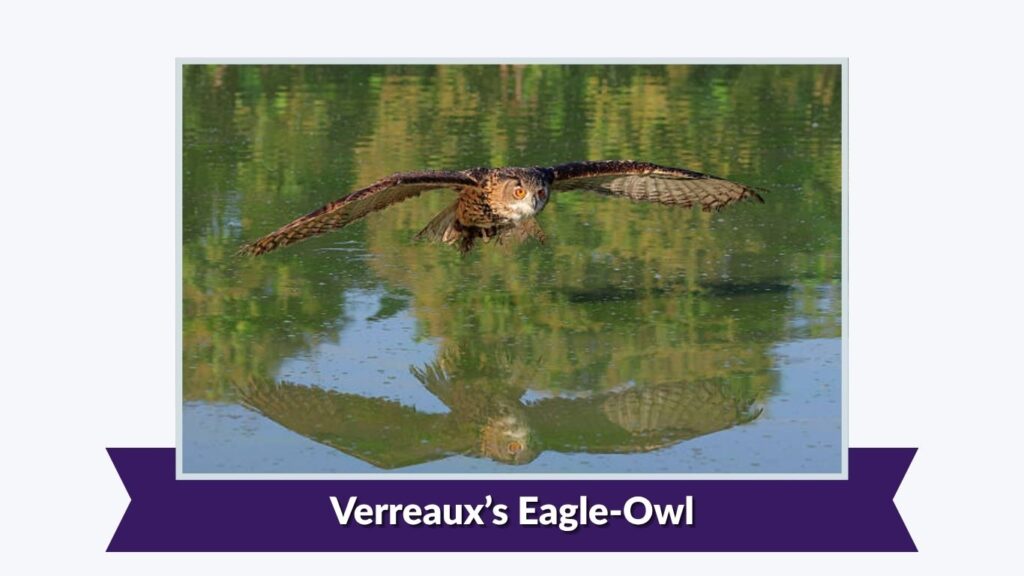
The Verreaux’s Eagle-Owl is the largest owl in Africa and one of the most powerful owls in the world. It is also called the Giant Eagle-Owl because of its huge size, strong build, and impressive wingspan. This owl is famous for its dark eyes, pale gray-brown body, and unusual pink eyelids. It mainly lives in savannas, open woodland, riverine forests, and dry areas with scattered trees.
Identification
- Very large owl with a heavy body
- Dark brown to black eyes
- Distinctive pink eyelids
- Prominent ear tufts
- Gray-brown mottled plumage
- Pale face with dark facial markings
- Broad wings and powerful feet
- Often roosts in large trees during the day
Habitat and Distribution
The Verreaux’s Eagle-Owl is widely found across sub-Saharan Africa. It avoids dense rainforest and is more common in dry savanna, thornbush, open woodland, riverine areas, semi-desert edges, and open countryside with large trees. It often needs tall trees for roosting and nesting, along with open hunting areas nearby.
Behavior and Diet
This owl is mostly nocturnal, although it may become active around dusk. It usually hunts from a perch, watching the ground carefully before gliding down on prey. Its diet is highly varied and may include mammals, birds, reptiles, insects, amphibians, and even fish in some areas. It is considered an apex predator, meaning healthy adults have few natural enemies.
Breeding and Nesting
The Verreaux’s Eagle-Owl often uses old stick nests made by other large birds instead of building its own. It may nest in large trees, especially in savanna or riverine habitats. The pair is usually territorial, and the female does most of the incubation while the male brings food. Young owls remain dependent on their parents for a long period after leaving the nest.
Lifespan and Conservation
Verreaux’s Eagle-Owls can live for many years, with some sources noting that they may reach about 20 years in the wild and longer in captivity. Their wide African range helps support the species, but local threats can include habitat loss, poisoning, road accidents, and disturbance around nesting areas. Protecting large trees and reducing poison use are important for their survival.
7. Shelley’s Eagle-Owl

Shelley’s Eagle-Owl is one of the rarest and least-known eagle-owls in Africa. It is a large forest owl found in parts of West and Central Africa, especially in dense tropical rainforest. Because it is secretive, nocturnal, and rarely photographed, much of its life history remains poorly understood. The species was photographed clearly in the wild in Ghana in 2021, confirming its continued survival there.
Identification
- Very large, heavy-built eagle-owl
- Prominent dark ear tufts
- Dark eyes, unlike many yellow-eyed eagle-owls
- Strong pale or yellowish bill
- Dark sooty-brown upperparts
- Heavily barred wings and tail
- Broad wings and powerful feet
- Forest-dwelling appearance with dark camouflage
Habitat and Distribution
Shelley’s Eagle-Owl is mainly linked with lowland tropical rainforest and old-growth forest. It has been recorded across scattered parts of West and Central Africa, including historical and recent records from Ghana, Liberia, Sierra Leone, Côte d’Ivoire, Cameroon, Gabon, Congo, and the Democratic Republic of the Congo. Its strong forest dependence makes it vulnerable where rainforest is cleared or fragmented.
Behavior and Diet
This owl is nocturnal and usually roosts quietly in dense forest during the day. It is heard more often than seen, and field observations are very limited. Its large size and strong feet suggest that it takes medium-sized to large prey. BirdLife notes that it has been observed eating a large flying squirrel, while other sources suggest rodents, small mammals, and birds may form part of its diet.
Breeding and Nesting
Very little is known about the breeding habits of Shelley’s Eagle-Owl. Reports from Central Africa suggest young birds have been seen in different months, but there is not enough information to describe a clear breeding season. Like many large forest owls, it may depend on quiet, mature forest with suitable roosting and nesting sites.
Lifespan and Conservation
Shelley’s Eagle-Owl is considered vulnerable because it is rare, poorly known, and dependent on rainforest habitat. BirdLife notes that its population may be below 10,000 mature individuals and that good-quality habitat is important for such a large forest owl. Forest loss, logging, mining, and habitat fragmentation are likely major concerns for the species.
8. Fraser’s Eagle-Owl
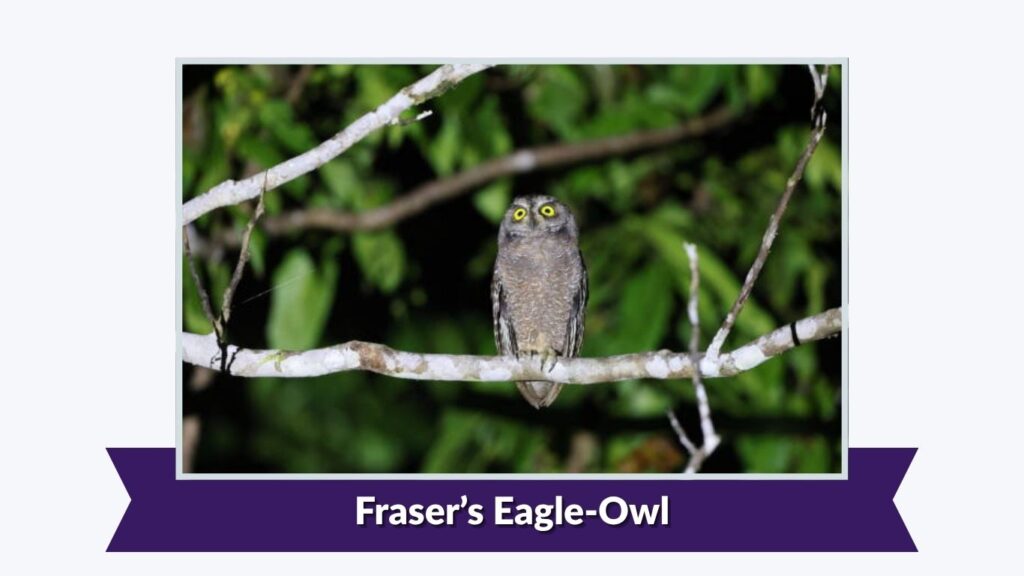
Fraser’s Eagle-Owl is a forest-dwelling eagle-owl from tropical Africa. Compared with many larger eagle-owls, it is relatively small, but it still has a strong owl shape, dark eyes, ear tufts, and heavily barred plumage. This species is closely linked with rainforest, forest edges, and clearings, where it hunts mostly at night and stays hidden during the day.
Identification
- Medium-sized eagle-owl compared with larger eagle-owls
- Dark brown to blackish eyes
- Short, fluffy ear tufts
- Rufous-brown facial disc with a dark border
- Upperparts barred with darker brown markings
- Pale rufous underparts with narrow barring
- Rounded wings and strong feet
- Well-camouflaged in dense forest shade
Habitat and Distribution
Fraser’s Eagle-Owl is found across parts of the African tropical rainforest zone, including West and Central Africa. It also occurs on Bioko Island. Its main habitats include rainforest, forest clearings, forest edges, and sometimes plantations such as cardamom plantations. In Cameroon, it has been recorded from sea level up to about 1,600 meters, showing that it can use both lowland and upland forest areas when suitable cover and prey are available.
Behavior and Diet
This owl is mainly nocturnal. During the day, it roosts quietly in leafy cover, often high above the ground, where smaller birds may discover and mob it. At dusk, it becomes active and begins calling or hunting. Its diet includes small mammals such as mice, squirrels, and galagos, along with birds, frogs, reptiles, insects, and other arthropods. Some sources also mention occasional fruit feeding, which is unusual among many owls.
Breeding and Nesting
The breeding biology of Fraser’s Eagle-Owl is still not well known. Records suggest breeding may vary by region, with egg-laying reported in different months across parts of Africa. Nesting has been suggested on the ground in some cases because nestlings have been found there, but at least one nestling has also been recorded in a tree cavity. Young birds may remain dependent on adults for a long time after leaving the nest.
Lifespan and Conservation
Detailed lifespan information for Fraser’s Eagle-Owl is limited, especially from wild populations. The species is currently listed as Least Concern, and BirdLife notes that its global population has not been fully quantified but is reported to be common in much of its range. However, because it depends strongly on forest habitats, local forest loss and habitat degradation can still affect populations in some areas.
9. Usambara Eagle-Owl
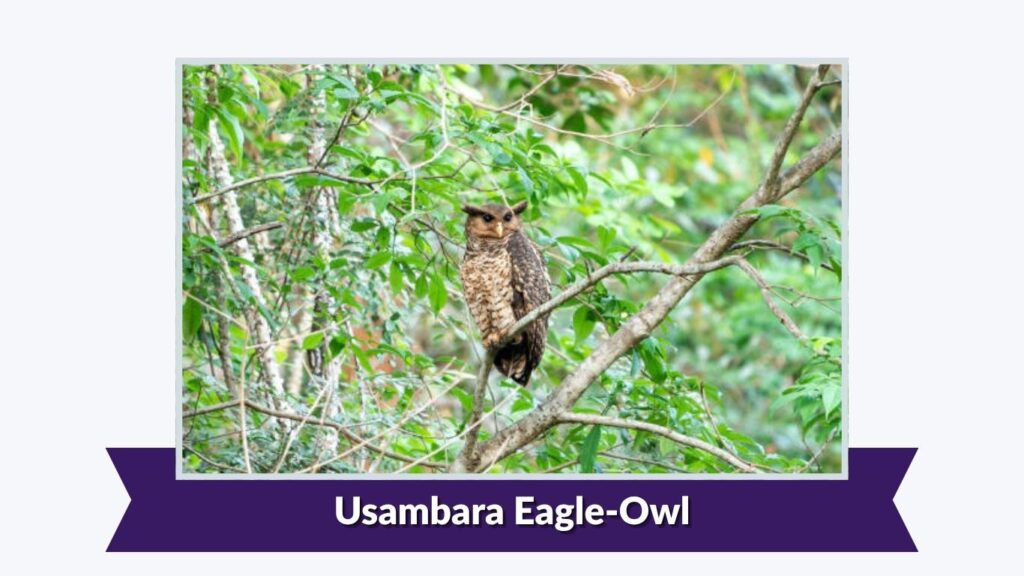
The Usambara Eagle-Owl is a rare forest eagle-owl from Tanzania. It was once treated as a form of Fraser’s Eagle-Owl, but it is now often recognized as a separate species. This owl is strongly linked with moist mountain forests, especially in the Eastern Arc Mountains. It has dark mottled plumage, orange-brown eyes, and a secretive nighttime lifestyle.
Identification
- Medium-to-large eagle-owl with a dark forest appearance
- Brown ear tufts
- Orange-brown eyes
- Pale orange-rufous facial disc with a dark rim
- Reddish-brown upperparts with darker barring
- Tawny-ochre breast with dark spotting
- Whitish-buff belly and flanks with fine dark bars
- Yellowish to greyish-horn bill
- Dull yellowish legs and feet with dark claws
Habitat and Distribution
The Usambara Eagle-Owl is endemic to Tanzania. It is mainly known from the Usambara Mountains in the northeast, with records also from the Uluguru and Udzungwa Mountains. It lives mostly in subtropical or tropical moist forest, often between about 900 and 1,500 meters in elevation. It may also use forested edges of tea plantations in lower areas when suitable cover and prey are available.
Behavior and Diet
This owl is nocturnal and hunts silently at night. Like many eagle-owls, it probably uses a sit-and-wait hunting style, watching from a perch before dropping or gliding down to catch prey. Its diet includes small mammals, birds, frogs, reptiles, and large arthropods. Because it is related to Fraser’s Eagle-Owl, insects may also be an important part of its food in some forest habitats.
Breeding and Nesting
The breeding season is believed to run from October to February. The Usambara Eagle-Owl probably nests in tree holes or other natural cavities rather than building an open nest. The female usually lays two white eggs, although three or four may occur rarely. She incubates and broods the chicks, while the male provides food. Young owls may depend on adults for a long period after leaving the nest.
Lifespan and Conservation
Detailed lifespan information for the Usambara Eagle-Owl is limited because the species is rare and poorly studied. It is currently listed as Vulnerable and is threatened mainly by forest clearance and fragmentation. Its population has been roughly estimated at 200–1,000 individuals, although discoveries in additional mountain ranges suggest the total number may be higher than once thought.
10. Akun Eagle-Owl
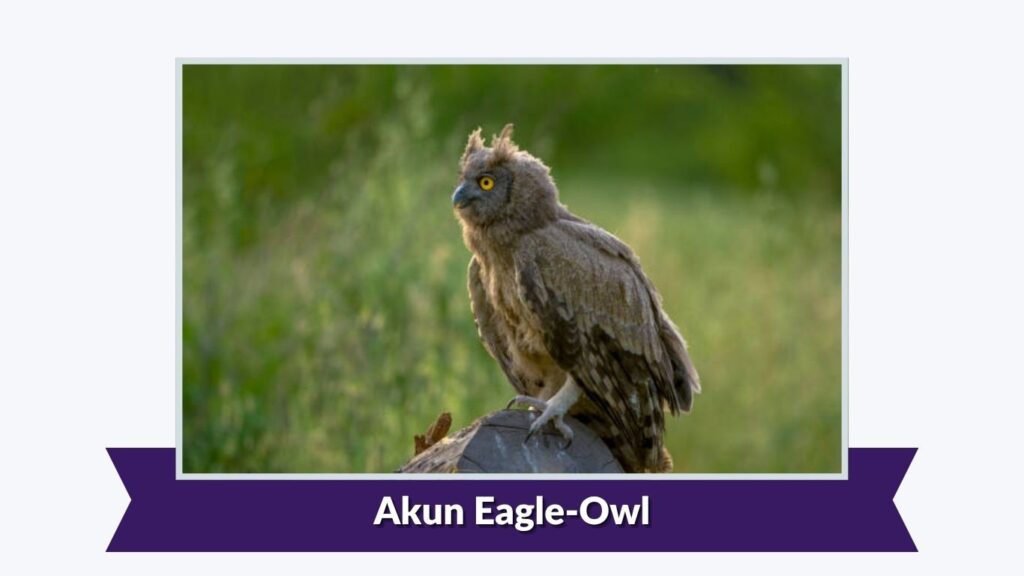
The Akun Eagle-Owl is a forest-dwelling eagle-owl from tropical West and Central Africa. It is one of the smaller eagle-owls and is strongly linked with rainforest, forest edges, clearings, riversides, and forested islands. Unlike many larger eagle-owls that often hunt mammals and birds, this species is especially known for feeding heavily on insects.
Identification
- Small to medium-sized eagle-owl compared with larger eagle-owls
- Dark to reddish-brown head and upperparts
- Pale yellow eyes
- Dark brown ear tufts with pale spotting
- Brown-barred wings and back
- White markings around the shoulders
- Pale lower underparts with dark spots and vermiculations
- Juveniles look paler, with whitish body feathers and reddish-brown barring
Habitat and Distribution
The Akun Eagle-Owl has a patchy range across West and Central Africa. It occurs from Guinea eastward toward Cameroon and south toward Angola, with records also from places such as Ghana, Liberia, Nigeria, Gabon, Congo, and the Democratic Republic of the Congo. It is mainly found in lowland primary and secondary rainforest, especially near forest edges, clearings, rivers, and forested river islands.
Behavior and Diet
This owl is nocturnal and usually leaves its daytime roost at dusk to hunt. It is unusual among eagle-owls because insects make up a major part of its diet. Beetles, cicadas, and locusts are important prey, and the owl may take them from foliage or catch them in flight before carrying them back to a perch. Its small feet and weaker bill suggest it is less suited to catching large prey than many other eagle-owls.
Breeding and Nesting
The breeding habits of the Akun Eagle-Owl are still not fully known. Available records suggest that in West Africa, egg-laying may occur from November to January, while young owlets have been recorded in nests in Liberia between February and April. Like some other eagle-owls, it is believed to nest on the ground rather than building a large stick nest in trees.
Lifespan and Conservation
Detailed lifespan information for the Akun Eagle-Owl is limited because it is a secretive forest species and is not as well studied as many larger owls. It is currently listed as Least Concern, but its population trend is reported as decreasing. Forest loss, habitat fragmentation, and degradation of lowland rainforest may still affect local populations even though the species has a fairly wide range.
11. Spot-bellied Eagle-Owl
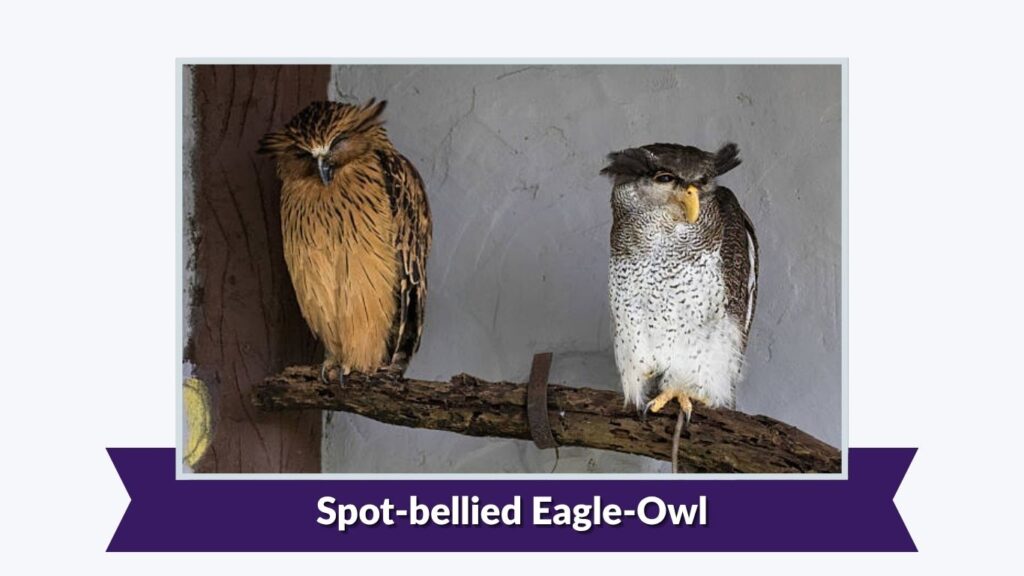
The Spot-bellied Eagle-Owl is a large forest owl found in the Indian subcontinent and Southeast Asia. It is also called the Forest Eagle-Owl because it prefers wooded habitats and dense tree cover. This owl has a powerful build, dark eyes, long ear tufts, and bold spotting across the belly, giving it a fierce and striking appearance. It is generally uncommon and occurs at low densities across its range.
Identification
- Large, strong-bodied eagle-owl
- Long, outward-slanting ear tufts
- Dark brown to blackish eyes
- Pale facial disc with a serious expression
- Grey-brown upperparts with heavy markings
- Whitish underparts with bold dark spots
- Strong yellowish bill and powerful feet
- Also known as the Forest Eagle-Owl
Habitat and Distribution
The Spot-bellied Eagle-Owl lives mainly in forests, including moist lowland and montane forests. Its range extends through parts of the lower Himalayas, India, Sri Lanka, Myanmar, Thailand, Laos, Vietnam, and other areas of Southeast Asia. It usually prefers mature forest, wooded valleys, foothills, and dense tree cover where it can roost quietly during the day and hunt at night.
Behavior and Diet
This owl is mostly nocturnal and is more often heard than seen. During the day, it stays hidden in large trees or thick foliage. At night, it hunts from perches and uses its strong talons to catch prey. Its diet includes birds, small mammals, reptiles, and other forest animals. Because of its size and strength, it can take larger prey than many smaller forest owls.
Breeding and Nesting
The breeding habits of the Spot-bellied Eagle-Owl are not as well documented as those of common owls. Like many large forest owls, it likely depends on quiet nesting areas, mature trees, and undisturbed forest habitat. It may use natural tree hollows, large cavities, or sheltered forest sites. Pairs are believed to be territorial, and breeding success may depend on prey availability and low human disturbance.
Lifespan and Conservation
The Spot-bellied Eagle-Owl is currently listed as Least Concern, but it is generally uncommon and its population is probably declining. Deforestation is considered one of the main threats because the species depends strongly on forest habitat. Even though it has a broad range, local populations may disappear when large forest areas are cleared or heavily disturbed.
12. Barred Eagle-Owl
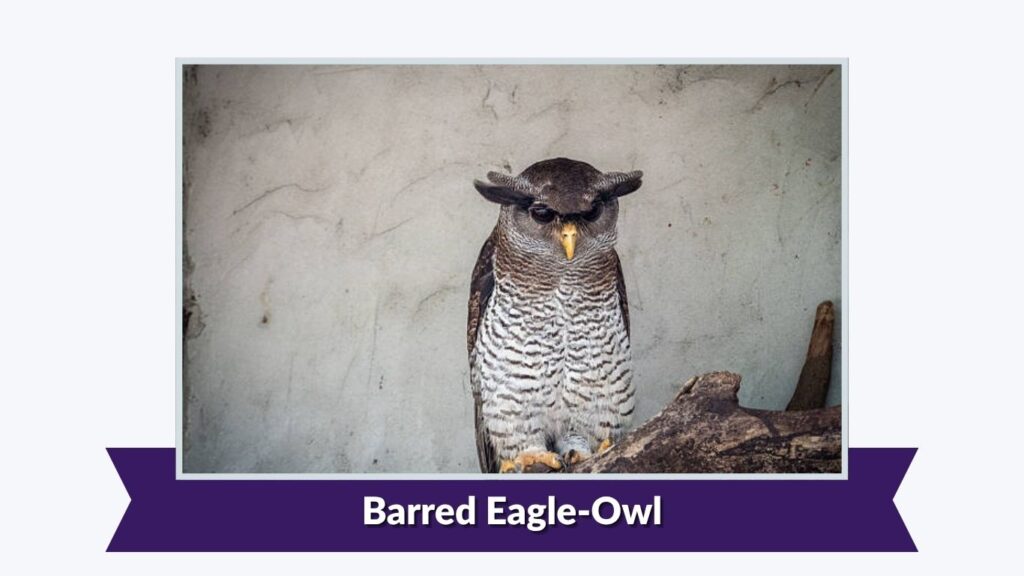
The Barred Eagle-Owl is a large Southeast Asian forest owl known for its dark eyes, bold barred plumage, and long sideways ear tufts. It is also called the Malay Eagle-Owl and is found from the southern Malay Peninsula through parts of Indonesia and nearby islands. This owl usually lives in lowland forests, wooded areas, and mature gardens with tall trees.
Identification
- Large owl, but relatively small for an eagle-owl
- Long, sideways-slanting ear tufts
- Dark brown eyes, sometimes reported as yellow
- Pale greyish-white face
- Pale yellow bill
- Brown upperparts with mottled and barred markings
- Whitish underparts with strong dark barring
- Feathered legs down to the toe joints
Habitat and Distribution
The Barred Eagle-Owl occurs in parts of Myanmar, Thailand, Malaysia, Singapore, Brunei, and Indonesia. It is mainly associated with subtropical and tropical moist lowland forest, especially evergreen forests near pools or streams. It can also use secondary growth, abandoned orchards, wooded gardens, cultivated groves, and sometimes areas not far from human settlements.
Behavior and Diet
This owl is nocturnal and usually hunts under forest cover or from hidden perches. Its diet is broad and opportunistic. Known prey includes insects, small mammals such as rodents, snakes, and small birds. Because it has strong feet and curved talons, it can handle a variety of prey for its size, although it is still less massive than some larger eagle-owls.
Breeding, Lifespan and Conservation
The Barred Eagle-Owl is not as well studied as many common owls, but breeding records show that it can nest successfully in human-modified wooded habitats. A Singapore breeding record described the species using habitat such as secondary growth, orchards, plantations, and wooded gardens. Its global conservation status is currently listed as Near Threatened, mainly because forest loss and habitat degradation may affect its population over time.
13. Dusky Eagle-Owl
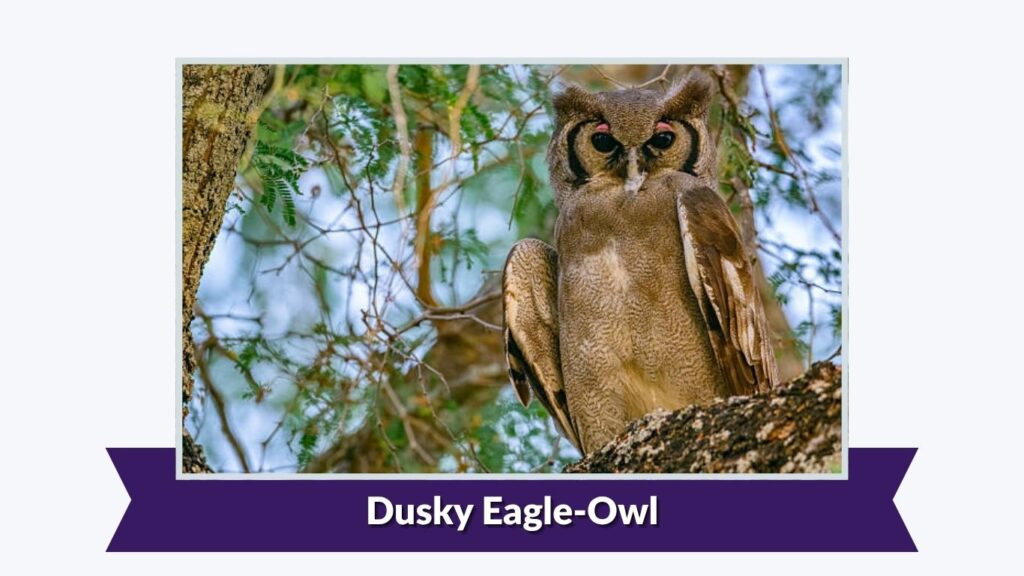
The Dusky Eagle-Owl is a large eagle-owl found across parts of South and Southeast Asia. It is known for its greyish-brown plumage, bright yellow to orange-yellow eyes, and long ear tufts. This owl is mostly active at night but may sometimes be seen during the day, especially in shaded woodland or cloudy conditions. It is currently listed as Least Concern, though habitat loss can still affect local populations.
Identification
- Large greyish-brown eagle-owl
- Long, prominent ear tufts
- Bright yellow to orange-yellow eyes
- Greyish-white underparts with dark streaking
- Dark brown wings with pale or whitish markings
- Strong body, broad wings, and powerful feet
- Southeast Asian birds may appear darker
- Often roosts quietly in trees during the day
Habitat and Distribution
The Dusky Eagle-Owl occurs from Pakistan, India, Nepal, and Bangladesh eastward to Myanmar, Thailand, Malaysia, and parts of China. It is usually associated with wooded areas, riverine forest, groves, plantations, and open forest edges. In Malaysia, it has also been recorded in oil palm plantations, showing that it can sometimes use modified landscapes when trees and prey are available.
Behavior and Diet
This owl is mainly nocturnal and usually becomes active shortly before sunset. It hunts from trees or other raised perches, watching for prey before flying down with strong, silent wingbeats. Like other eagle-owls, it is a top predator and likely feeds on small mammals, birds, reptiles, and other animals available in its habitat. Its large feet and strong flight help it catch and carry prey effectively.
Breeding and Conservation
The Dusky Eagle-Owl often uses old stick nests built by other large birds instead of building its own nest. Breeding is recorded from November to April, with many observations in December and January. In parts of India, pairs have been found reusing woolly-necked stork nests. Although it is listed as Least Concern, BirdLife notes that tree cover has declined within its mapped range, so forest loss and habitat disturbance may still be local concerns.
FAQs
What are eagle-owls?
Eagle-owls are large, powerful owls usually recognized by their strong bodies, broad wings, large talons, and noticeable ear tufts. Many species belong to the genera Bubo or Ketupa. They are mostly nocturnal hunters and often feed on mammals, birds, reptiles, and large insects.
How many types of eagle-owls are there?
There are several recognized eagle-owl species worldwide, depending on the taxonomy used. Some well-known types include the Eurasian Eagle-Owl, Verreaux’s Eagle-Owl, Indian Eagle-Owl, Spotted Eagle-Owl, Pharaoh Eagle-Owl, and Spot-bellied Eagle-Owl. Many are found across Africa, Asia, and Europe.
What is the largest eagle-owl?
The Eurasian Eagle-Owl is one of the largest eagle-owls in the world, while Verreaux’s Eagle-Owl is the largest owl in Africa. Both have strong bodies, wide wingspans, and powerful talons. Their size helps them hunt larger prey than many smaller owl species.
Where do eagle-owls live?
Eagle-owls live in many habitats, including forests, deserts, rocky cliffs, mountains, savannas, scrublands, and wooded river areas. Some species prefer dense rainforest, while others live in dry open country. Their habitat depends on the species, nesting sites, and available prey.
What do eagle-owls eat?
Eagle-owls are carnivorous predators. Their diet may include rats, mice, rabbits, birds, reptiles, frogs, insects, scorpions, and sometimes larger prey. Forest species may hunt birds and small mammals, while desert species may eat reptiles, beetles, and rodents.